


Breathing deep: A metabolic secret of ethane-consuming archaea unraveled

Solving this riddle was only possible thanks to a close collaboration within the partner institutions. Gunter Wegener and his team managed to sample sediments from hydrothermal vents rich in natural gas and cultivate the ethane-degrading microbial consortium from these in the lab, despite this being a very demanding task. Using these cultures, the group of Tristan Wagner managed to isolate and characterise the enzymes involved in ethane oxidation “Isolating enzymes from such a precious and complex microbial culture is a real challenge, but we managed with a lot of effort and meticulousness”, says Tristan Wagner.
A different enzymatic composition leads to a metabolic rewiring
The analyses now published show that both enzymes harbor an additional protein, electronically connected to the rest of the enzyme through a wiring made of iron and sulfur atoms. This subunit allows the use of an alternative electron acceptor: The F420, a molecule based on flavin, which is a class of chemicals also important to humans (as vitamin B2, for example).
“Enzyme compounds of CO2-forming enzymes and F420-reductases were previously unknown”, says Tristan Wagner. The researchers confirmed by additional experiments that both enzymes used F420 as an electron acceptor. “This discovery breaks a dogma in the scientific field of anaerobic metabolism, as it expands what these enzymes can do.”
“We suppose that the coupling of CO2-generation with F420 as electron acceptor might stimulate the entire process. The electrons are then transferred across the cell membrane to another microbe, reducing sulfate, which is a common principle in alkane-oxidizing consortia” says Gunter Wegener.
A milestone in the understanding of ethane degradation
By elucidating this metabolic riddle, Lemaire and his colleagues reveal a key aspect of the ethane-degrading microbes, which play an important role in the carbon cycle. It also shows that the knowledge gained from a few model organisms cannot be simply transposed to related species and that the enzymes involved can be more versatile than assumed. „Our study illustrates how little we know about the metabolism of these microbes, which have lived on our planet for billions of years and can adapt to so many environments, and how important it is to understand them via experimental means”, Tristan Wagner concludes.
The study has a far-reaching impact as the alkane oxidation process performed by this type of microorganism is a crucial element of the biological filter existing in marine seeps, preventing massive effluxes of naturally produced alkanes in the atmosphere and seawater. Therewith the study gives crucial insights into the role of microorganisms in the transformation of organic matter.
This study is part of the research of the Cluster of Excellence “Ocean Floor – Earth's Uncharted Interface”, which is based at MARUM. The carbon cycle and energy production of microorganisms are among the core topics of the cluster.
Contact:
Dr. Gunter Wegener
MARUM – Center for Marine Environmental Sciences, University of Bremen
HGF MPG Joint Research Group for Deep-Sea Ecology and Technology
Max Planck Institute for Marine Microbiology Bremen
Organic Geochemistry
Telephone: 0421 2028-8670
Email: [Bitte aktivieren Sie Javascript]
Original publication:
Olivier N. Lemaire, Gunter Wegener, Tristan Wagner (2024): Ethane-oxidising archaea couple CO2 generation to F420 reduction. Nature Communications (published online October 21, 2024). DOI: https://doi.org/10.1038/s41467-024-53338-7
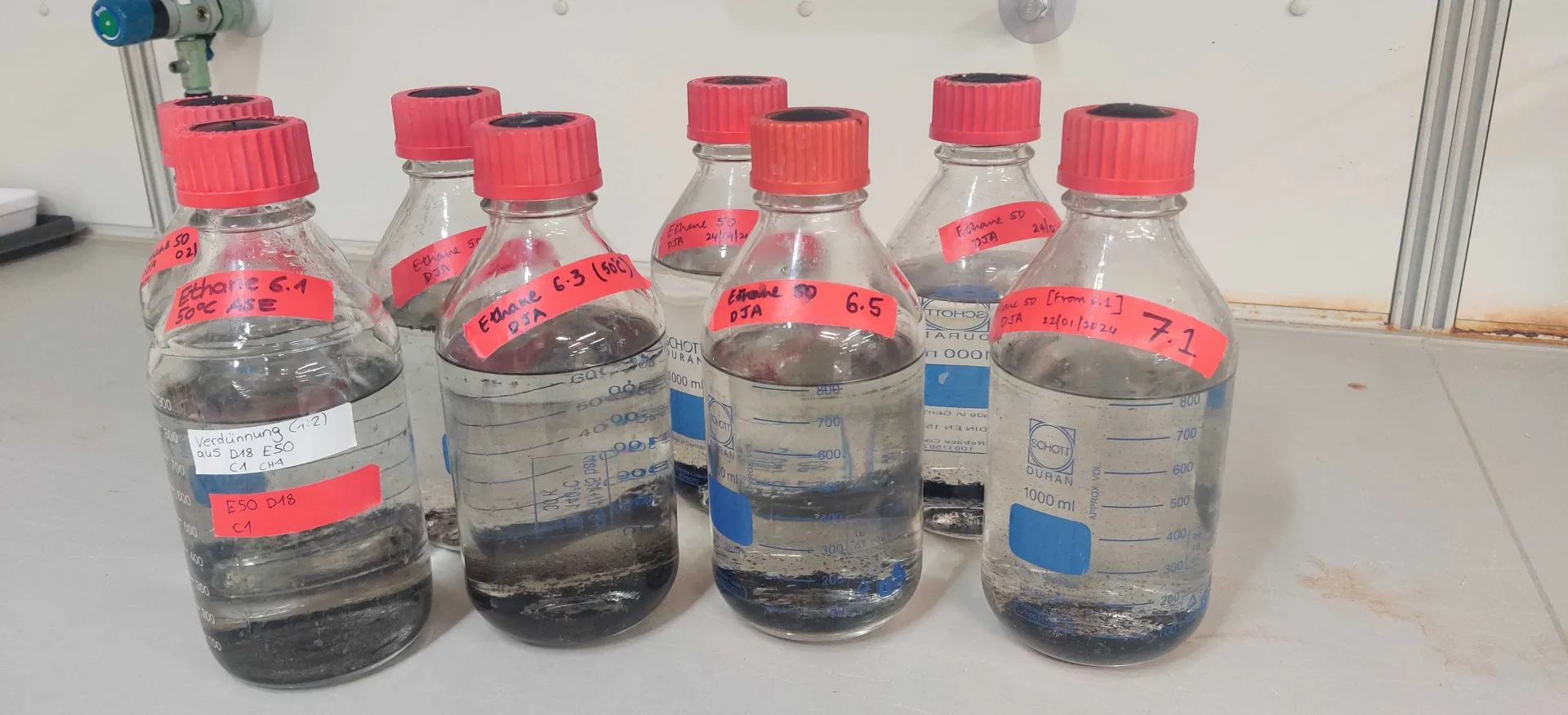
The cultures in the laboratory at the Max Planck Institute for Marine Microbiology in Bremen, Germany. Photo: Disha Jawadekar/Max Planck Institute for Marine Microbiology
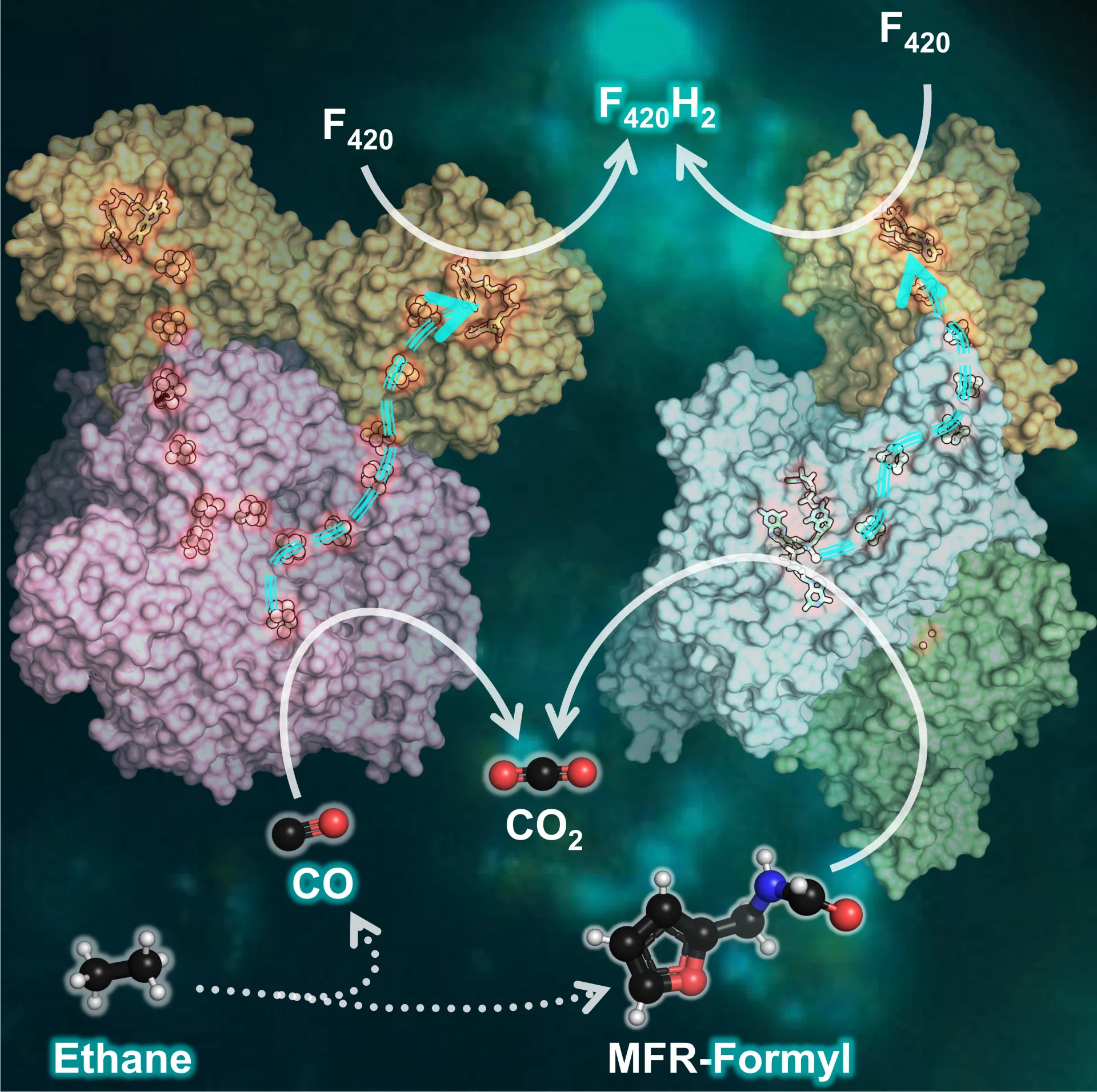
Molecular reactions involved in ethane degradation. The metabolism of the microbe converts ethane into CO and formyl-MFR, used as substrates by the enzymes of this study (presented as surface colored by subunit) to generate CO2. The generated electrons navigate in the enzymes (cyan dashed arrows) to reduce F420 – the molecule responsible for the shiny blue color of the organism under UV light. The background image shows the F420-dependent fluorescence of the ethane-degrading microbes under the microscope. Graphic: Olivier Lemaire/Max Planck Institute for Marine Microbiology