


- Home
- Claudia Wienberg
- Cold-Water Corals
- Projects
- Coral Mounds as Carbon Sinks
Coral Mounds as Carbon Sinks
Cold-Water Coral Mounds as Long-Term Carbon Sinks
Cold-water corals (CWCs) create large, complex structures on the seafloor known as coral mounds, which can store significant amounts of carbon. While their ability to accumulate carbonate (inorganic carbon) is known, few studies have measured their total carbon storage — including organic carbon — over long timescales. This gap limits our understanding of their role in the global carbon cycle.
In this study, we analyzed two sediment cores from coral mounds in the Alborán Sea (western Mediterranean), covering roughly 400,000 years of carbon accumulation. We measured both inorganic and organic carbon content, and compared these results with two additional cores from nearby seafloor areas (spanning ~120,000 years).
Our findings reveal that the coral mounds store up to 15 grams of carbon per square centimeter per thousand years, with 6–9% coming from organic carbon. During active growth periods, these mounds hold up to 14–19 times more carbon than the surrounding seafloor. Notably, organic carbon accumulates at rates up to ten times higher on the mounds compared to adjacent sediments.
These results highlight that cold-water coral mounds can act as powerful, long-term carbon sinks — capturing both organic and inorganic carbon — especially during periods of active formation.

related publications:
Greiffenhagen L, Titschack J, Wienberg C, Wang H, Hebbeln D (2025). Cold-water coral mounds are effective carbon sinks in the western Mediterranean Sea. Biogeosciences 22:2201–2223. DOI:10.5194/bg-22-2201-2025. Highlight Paper.
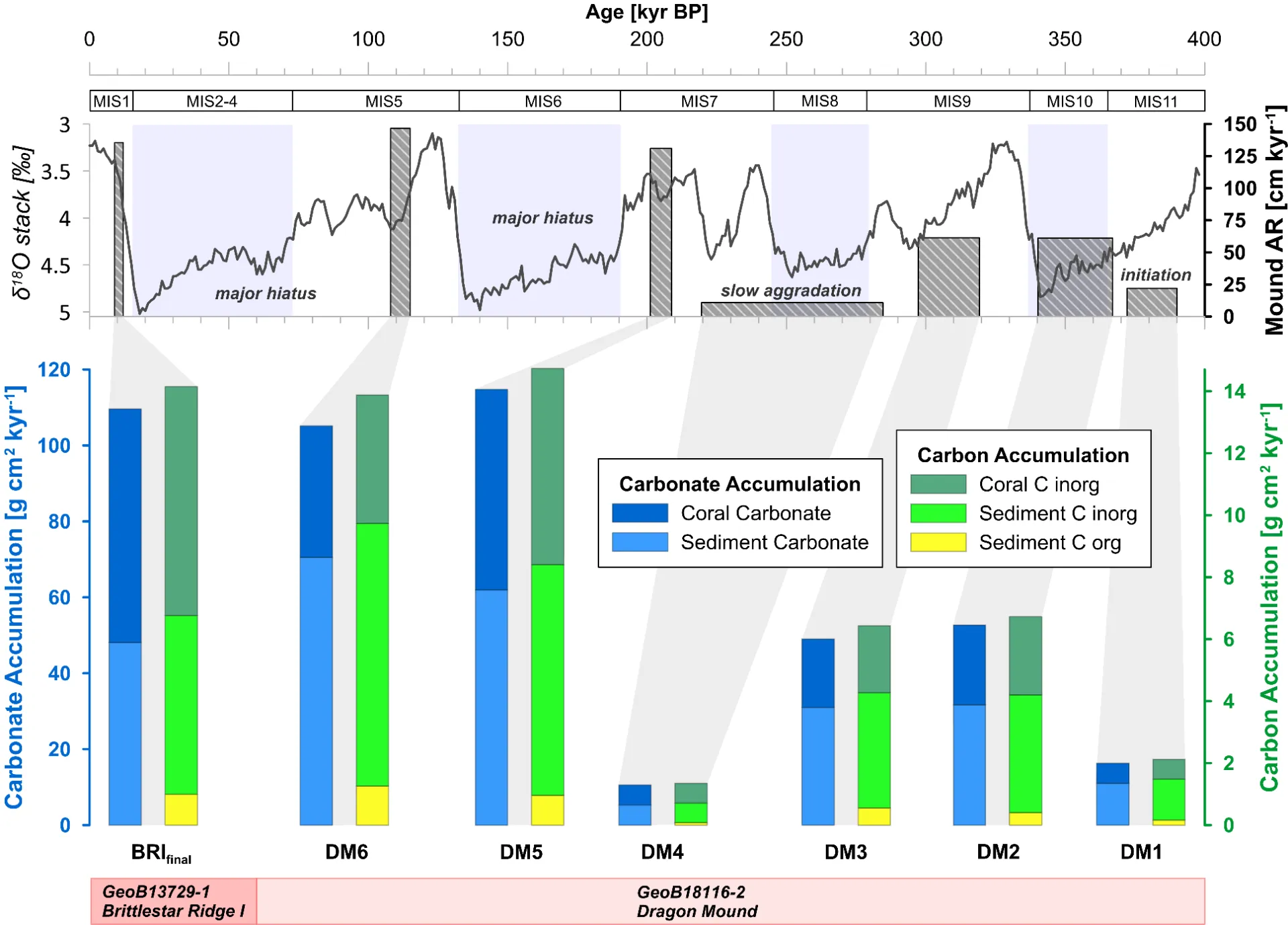
Carbonate and carbon accumulation of two Mediterranean coral mounds during different mound formation phases (BRIfinal, DM6 – DM1). Graph shows the contribution of each carbon(ate) fraction to the total, given in g cm-2 kyr-1 carbon and carbonate.
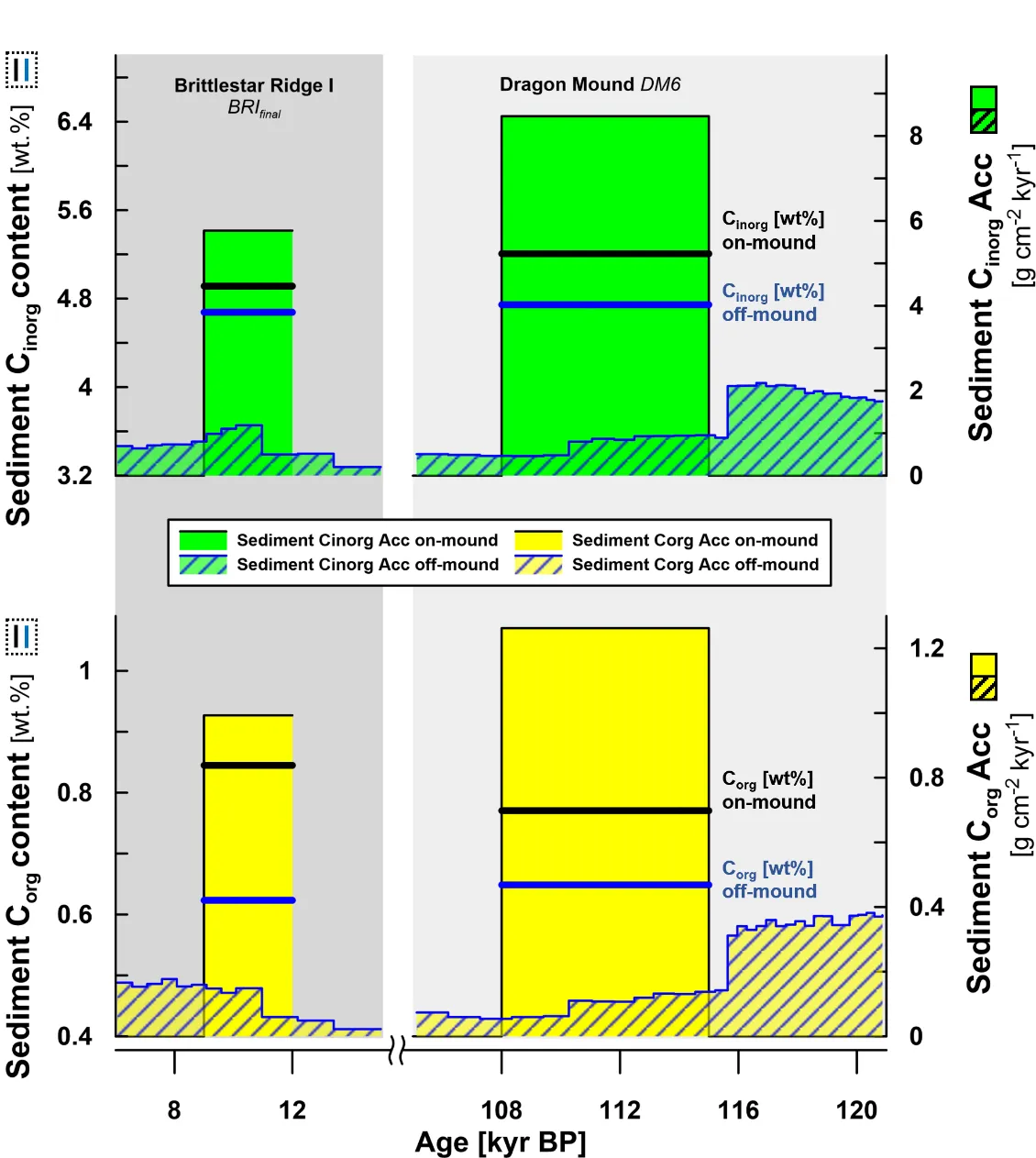
Comparison of sediment Corg and Cinorg contents and accumulation rates between on- and off-mound cores, focusing on two mound formation phases during the MIS1 and MIS5.