


- Home
- Claudia Wienberg
- Cold-Water Corals
- Projects
- MoccaMeBo
MoccaMeBo
MoccaMeBo
An unprecedented dataset of 200 Th/U-dated coral ages has been generated from sediment cores up to 70 m long, retrieved using the sea floor drill rig MARUM-MeBo70 along the northern Moroccan margin. These cores greatly significantly enhance our understandig of the evolution of coral mounds in the western Mediterranean Sea, revealing new insights into their initiation and growth. Notably, the base of a 60-m-high coral mound was penetrated and dated to the Mid-Pleistocene (~390 ka), marking one of the earliest stages of mound formation in the region.
Mound initiation was non-synchronous, with some larger mounds potentially originating during the Mid-Pleistocene Transition. Over the past 480 kyr, mound development occurred in short, intense growth phases (duration: ~10–30 kyr; aggradation rates: 20–275 cm kyr-1), which were not directly tied to glacial-interglacial cycles, but instead aligned with precession-paced variations in African hydroclimate. Periods of increased Saharan dust supply, with regional desertification, likely enhanced both productivity (supporting coral growth) and sediment supply (facilitating mound aggradation).
Mound development was also closely linked to the presence of well-ventilated, nutrient-rich Levantine Intermediate Water (LIW) and associated internal wave activity, which created turbulent conditions favorable for lateral food and sediment delivery. Conversly, African Humid Periods, characterised by increased freshwater input into the Mediterranean, likely supressed LIW formation, leading to oxygen-depleted, low-energy conditions unfavorable to coral communities.
Understanding the interplay between continental hydroclimate and oceanic processes is crucial for unraveling the complex environmental controls on coral mound development. The Mediterranean, situated at the confluence of contrasting climate zones, is particularly sensitive to these land-ocean-atmosphere interactions, rendering its deep-sea ecosystems highly vulnerable to both past and future climate change.

related publications:
Wienberg C, Krengel T, Frank N, Wang H, Hebbeln D (2022). Cold-water coral mounds in the western Mediterranean Sea: New insights into their initiation and development since the Mid-Pleistocene in response to changes in African hydroclimate. Quaternary Science Reviews 293:107723. DOI:10.1016/j.quascirev.2022.107723
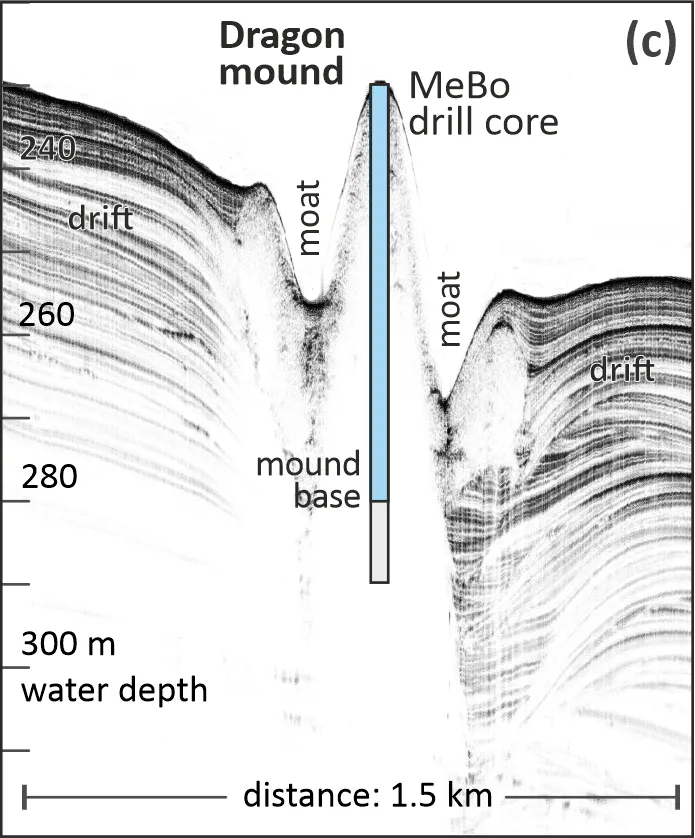
MeBo core collected from a cold-water coral mound. Note that the mound base was penetrated.