

Core section enscribung during Exp. 310 'Tahiti Sea Level', credit: ECORD/IODP
Core section enscribing during Exp. 310 'Tahiti Sea Level', credit: ECORD/IODP

Offshore Sampling and Measurements Plan

Owing to the nature of MSP expeditions, there is commonly limited laboratory space offshore, and as such there is no splitting of the cores at sea. The scientific analyses undertaken onboard are consequently limited to a subset of the expedition dataset. Offshore scientific activities include those essential for core curation, securing head space sediment samples and samples for pore-water chemistry, sampling for shipboard biostratigraphy, measurement of ephemeral properties including physical properties, and downhole logging.

This sampling and meas­ure­ments plan is sub­ject to amend­ment ac­cord­ing to the sci­entific needs/​in­terests of the Sci­ence Party and/​or op­er­a­tional con­straints. Routine meas­ure­ments and core flow will be un­der­taken in line with the IODP³ standard measurements pro­ced­ures.

The following measurements will be carried out offshore:


Curation The cores will be curated and labelled, and stored in a temperature-controlled reefer (~4°C). There will be no split­ting of the cores at sea with the ma­jor­ity of sci­entific ana­lyses being conducted dur­ing the Onshore Science Party (OSP) at the BCR/MARUM is sched­uled for late 2024/early 2025.
All data will be recorded in the offshore mobile Drilling Information System (ExpeditionmDIS) database.
Curation will be done in the designated area on board the drilling plat­form. Cur­a­torial representatives onboard will have del­eg­ated re­spons­ib­il­ity in the ab­sence of the ESO Cur­a­tion and Laboratory Man­ager and Scientific Ocean Drilling Programs Cur­ator for the Bre­men Core Re­pos­it­ory (BCR) and MSPs, Dr. Ursula Röhl.

Core catcher (CC) description and sampling, if available, for initial sedimentological, micropaleontological, petrophysical and/or structural characterization. If no core catcher sample is re­covered, a sample from the lower end of each core will be taken for ship­board ana­lysis. Smear slides or when required thin sec­tion bil­lets may be taken in rep­res­ent­at­ive sec­tions for pre­par­a­tion in ad­vance of the OSP, as advised by offshore scientists.

Geochemistry Headspace sediment samples will be taken from the fresh cut end of a core section on a routine basis (in suit­able li­tho­lo­gies and dependent on core recovery) and stored in the reefer container for onshore analysis.

Taking and storage of groundwater* from various depths in drilled boreholes. Taking and proper storage of groundwater samples for gas analyses, and acquisition and splitting of groundwater samples.

In suit­able li­tho­lo­gies, pore-water samples (e.g. squeez­ers and/​or rhizone mois­ture samplers) will be taken on a routine basis. Pore-wa­ter will be ex­trac­ted im­me­di­ately from cores and ephemeral properties (e.g. sa­lin­ity, pH, al­ka­lin­ity and am­mo­nia) will be ana­lyzed. Sample splits for on­shore ana­lysis (e.g. cations, sulf­ide, 13C) will be pre­pared and pre­served whilst off­shore and stored in the reefer container.

Core physical properties Tem­per­at­ure-equi­lib­rated cores will be meas­ured on the expedition plat­form in a con­tain­er­ized labor­at­ory util­iz­ing a multi-sensor core logger (MSCL). All cores (>10 cm) will be measured on the multi-sensor core logger (MSCL; gamma density, P-wave velocity, electrical resistivity, magnetic susceptibility and natural gamma radiation).

*Under the assumption that the contractor and the Science Team are responsible for the equipment and sampling.
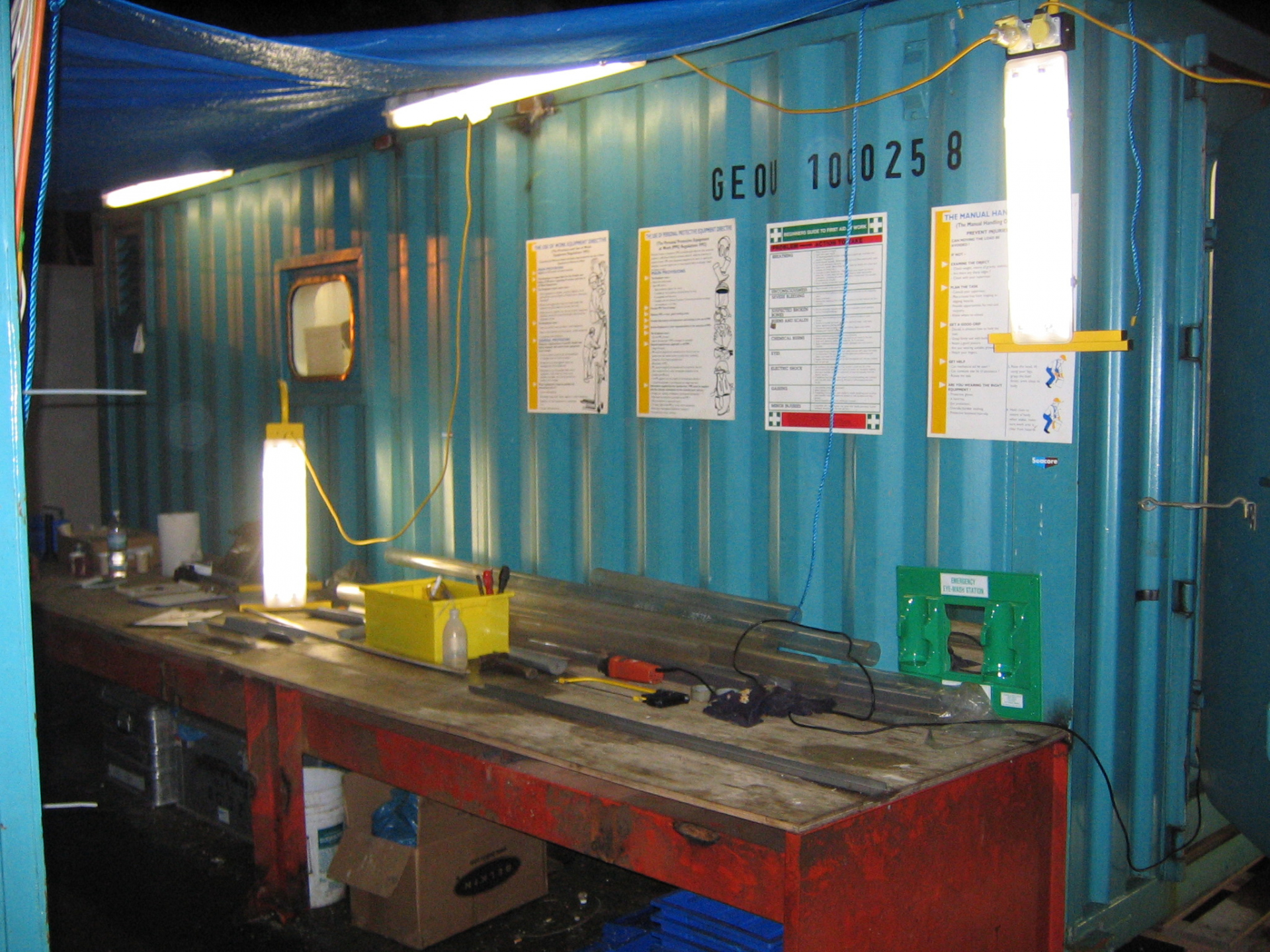
Initial core receiving area during Exp. 310 'Tahiti Sea Level'
ECORD/IODP
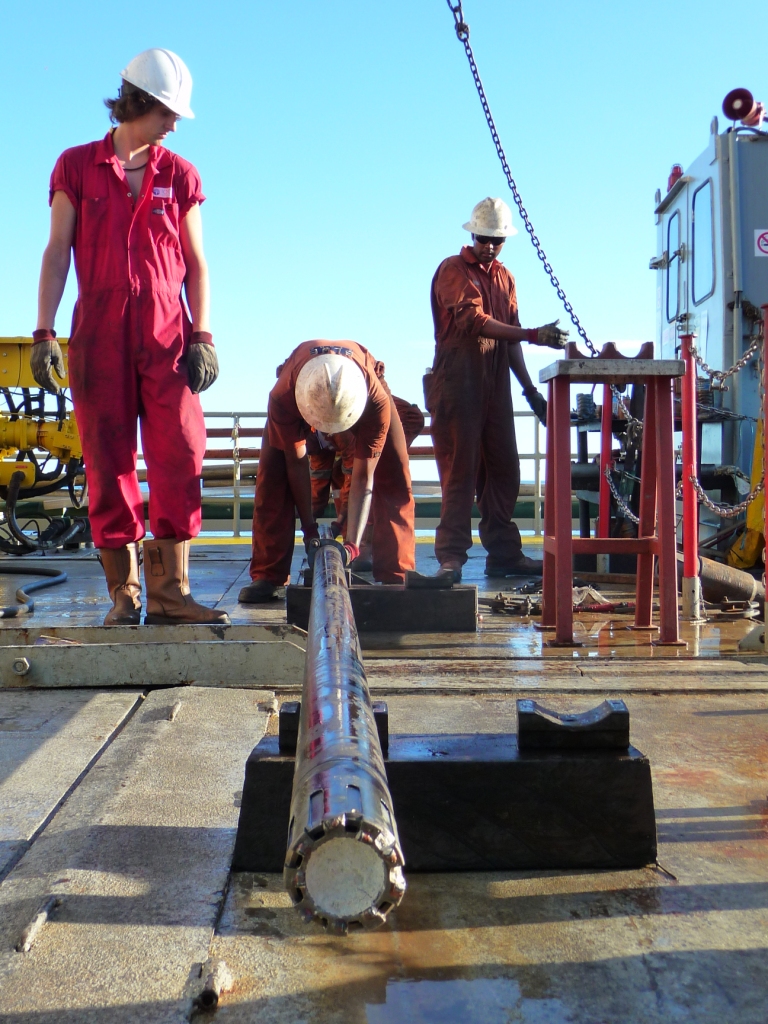
GPC operation onboard RV Kaimei
Core on deck during Exp. 325 'Great Barrier Reef Environmental Changes', credit: ECORD/IODP
Interstitial water sampling with Rhizons
Sampling vials for interstitial water

Onshore Sampling and Measurements Plan

The Onshore Operation (OnO) will be un­der­taken at Bremen Core Repository, MARUM, University of Bremen, laboratories.
The fol­low­ing work flow according to IODP MSP standards will take place after the expedition and during the OnO:

  • Core splitting: the cores will be split into a working and an archive half in line with IODP³ procedures.
  • Core description: IODP³ standard facilities for core description, including access to a CoreWall visualisation system will be provided. Core description will be undertaken on the archive half of the cores. For data entry, ESO will employ a version of the offshore mobile Drilling Information System (mDIS), called “ExpeditionDIS”, which is comparable with others being used in the ocean drilling programs.
  • Digital line-scan imaging: high resolution images of the archive half of the cores will be acquired utilising an XRF-core scanner mounted with a line-scan camera.
  • Thin section and smear slide preparation: as requested.
  • Inorganic geochemistry: whole-rock and pore fluid chemistry; inductively coupled plasma–optical emission spectrometry (ICP-OES); ion chromatography (IC); energy dispersive X-ray fluorescence (ED XRF); and total carbon (TC) / total organic carbon (TOC) content (LECO CS analyzer) / carbonate content.
  • Biostratigraphy: facilities to wash and sieve samples, microscopes including options for image capture.
  • X-ray diffraction analysis (XRD): bulk mineralogy.
  • Physical properties measurements:
    • Thermal conductivity on whole cores will be acquired by ESO staff prior to the OnO at MARUM utilising a needle probe system. Additional standard IODP physical properties measurements may be undertaken on whole cores at this time in the event offshore datasets are incomplete. This may be owing to time (natural gamma radiation) or permitting issues (gamma density).
    • Physical properties of discrete samples: P-wave velocity and moisture and density properties (MAD) including: wet bulk density; grain density; porosity; and void ratio. For MAD measurements, core samples will be oven-dried (60° ± 5°C), the dried sample volume will then be quantified using a Quantachrome penta-pycnometer with sample masses being measured using a high-precision balance.
    • Undrained shear strength (Su): measurements utilizing a torvane, pocket penetrometer, and/or fall cone (on request) can be undertaken on the working half of the core. IF REQUESTED BEFOREHAND
    • Color reflectance: measurements acquired using a MSCL mounted with a Minolta spectrophotometer.
  • Core sampling: A detailed sampling plan will be devised following review of all revised sample requests by the Sample Allocation Committee (SAC), prior to the start of the OnO and after the scientists have submitted their revised sample requests.
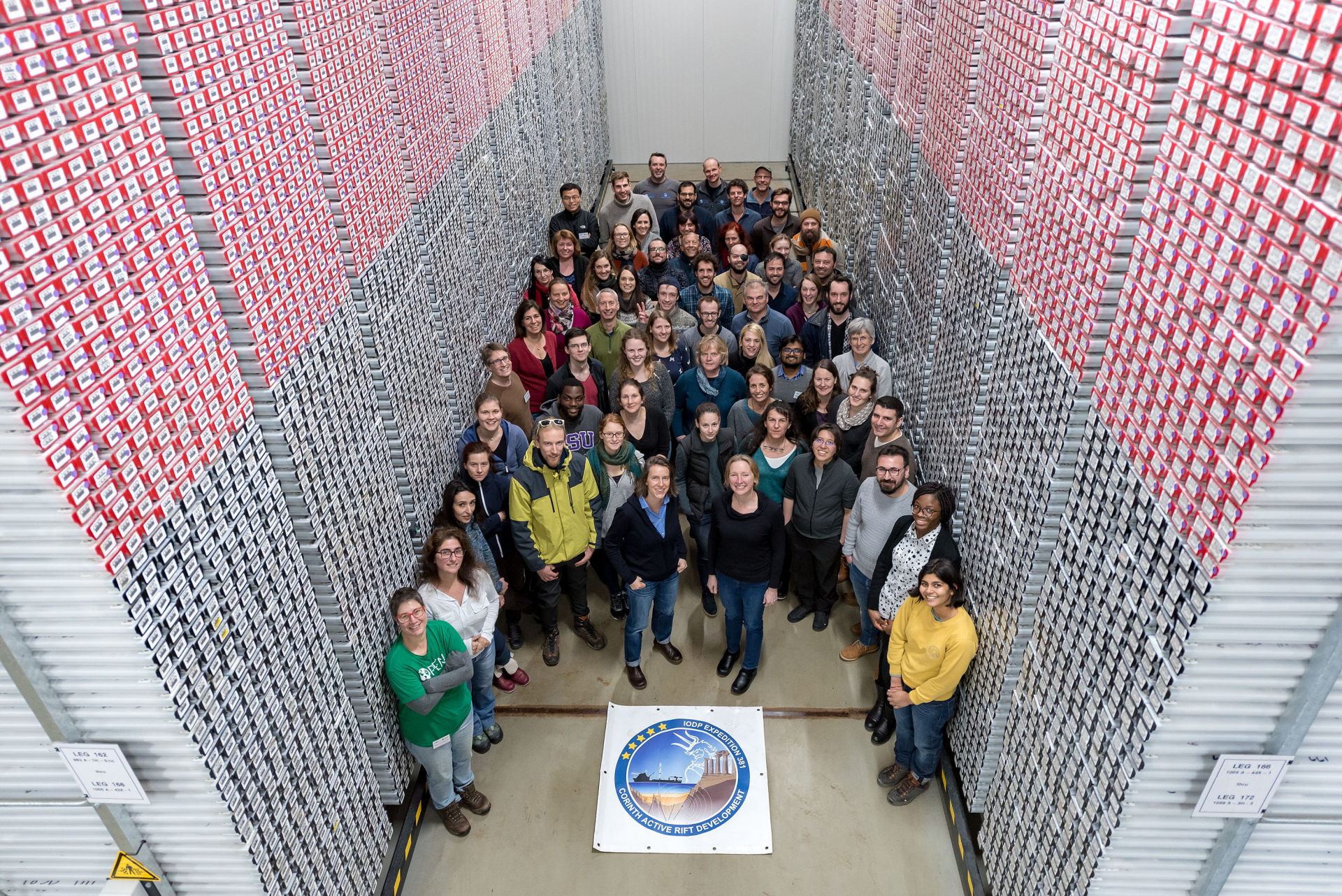
Gruppenbild
Group picture taken during the Onshore Science Party (OSP) of Exp. 381 'Corinth Rift Paleoseismology'