


- Home
- ...
- Organic Geochemistry
- Laboratories
- Geomicrobiology Laboratory
Organic Geochemistry
Hinrichs Lab - Geomicrobiology Laboratory
Introduction
For the investigation of biogeochemical processes, we incubate microbes in cultures or environmental samples in the laboratory. In order to mimic conditions in the deep sea, it is crucial to provide the microorganisms with suitable atmosphere, temperature and pressure conditions.

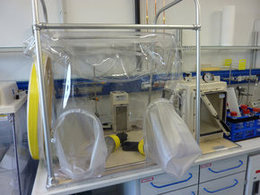
Coy anaerobic chamber
Below are some specifications for this anaerobic chamber:
- Interior size of the chamber: W x D x H = 90 x 80 x 100 cm
- Interior size of the buffer chamber: W x D x H = 34 x 34 x 34 cm, door opening: W x H = 22.9 x 30.5 cm
- One pair of gloves
- Formation gas: 5% H2 in N2
- Pd-catalyst to reduced O2 with H2. The catalyst is regenerated on a weekly basis
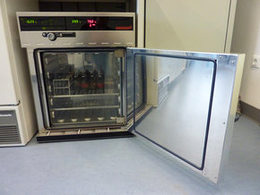
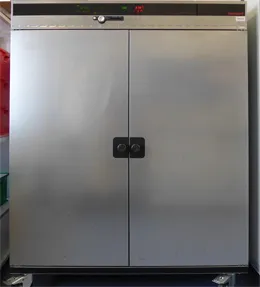
Incubators
The natural habitats for microorganisms have a wide temperature range from lower than 0°C to higher than 100°C. To simulate their natural habitats, temperature control is an essential issue. Laboratory fridges are being used to simulate conditions lower than room temperature, whereas different heating facilities are utilized for generating higher temperatures.
These facilities include:
-A Memmert INE 400 incubator. Temperature range: +30°C to 70°C; natural convection or forced air circulation
-A Memmert IPP 800 incubator. Temperature range: +5 °C to 70 °C; fridge incubator with Peltier technology.
-A GFL 1083 shaking water bath. Temperature regulation: +10°C to 99.9°C; shaking frequency: 10 to 250 min-1
-A Heraeus heating and drying oven. Temperature: up to +300°C; with an air-circulation fan
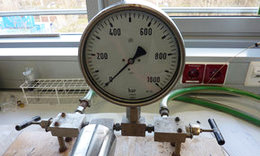
High-pressure incubation equipment
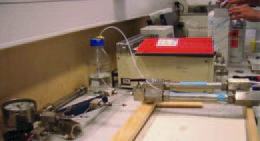
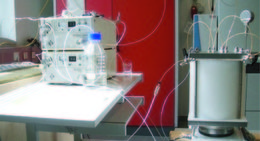
High-pressure stainless steel tubing reactors
The liquid is pumped by the HPLC pump (back, middle) into the stainless steel tubing reactor (right), which is filled with testing materials and gas (photo: Yushih Lin, MARUM).
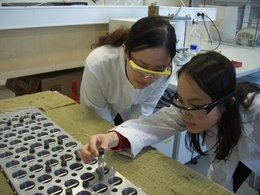
Pressure-temperature-gradient block
The pressure-temperature-gradient block is equipped with polyoxymethylene incubation vessels that endure pressure up to 20 bar
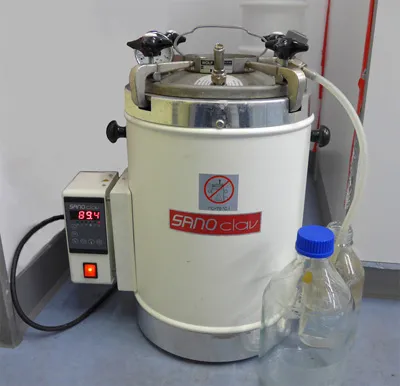
Autoclave
Most important of all: when working with samples from deep ocean or subseafloor sediment, you would not like to end up enriching microbes from your daily life! We use a Wolf Sanoclav LaM-3-20-MCS-J autoclave, which sterilizes laboratory equipments under conditions of either 140°C/2.7 bar or 121°C/1.2 bar. Sometimes a combustion oven is also used for sterilization as well as removal of organic matter.
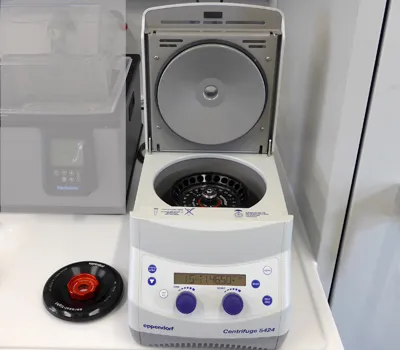
Microcentrifuge
We use a microcentrifuge to separate small volumes of aqueous solutions and suspensions of different densities, e.g. cell cultures.
Eppendorf Centrifuge 5425, non-refridgerated, whisper-quiet, 24 places for 2mL vials.