


- Home
- Our Offers
- Media
- Archive News
- News 2025
- MARUM Otter
In the Kiel Bay
MARUM Otter's first mission successfully completed

The aim of the project is to investigate coastal waters and their ecosystems at times of strong warming and changes in pH value. However, due to their shallow depth, these coastal waters cannot be navigated even by small research vessels such as the FK Littorina. This is where the small USV MARUM-Otter from the ElbeXtreme project of the DAM mission mareXtreme can help. The MARUM-Otter provides a platform for various sensors and cameras for adaptive data collection of important environmental parameters. It can operate completely autonomously at a maximum speed of six knots and achieves an operating time of up to twenty hours when traveling at a constant speed of two knots.
In its first mission for mareXtreme and CDRmare, the MARUM-Otter investigated coastal waters around Kiel Bay. It followed a predefined course and used various sensors to record the pH value, water temperature, and salinity near the water surface. The sensors were procured partly from the ElbeXtreme project (DAM mission mareXtreme) and partly from AIMS3 (CDRmare) and used jointly. With the help of a winch on the MARUM-Otter, it was also possible to investigate the water column by lowering the pH sensor at defined points. The USV was monitored via a radio link from the FK Littorina, which was anchored in deeper water and controlled the investigations.
This measurement campaign is to be repeated at regular intervals and supplemented by video recordings of the seabed in order to research the ecosystems of the region and, if necessary, changes over the course of the year, and to rule out negative environmental influences. In the future, a multi-beam sonar will also be attached to the USV MARUM-Otter to enable highly accurate morphological mapping of the seabed.
Further information:
- Working group “Marine Environmental Technology and Deepsea Engineering”
- DAM mission mareXtreme
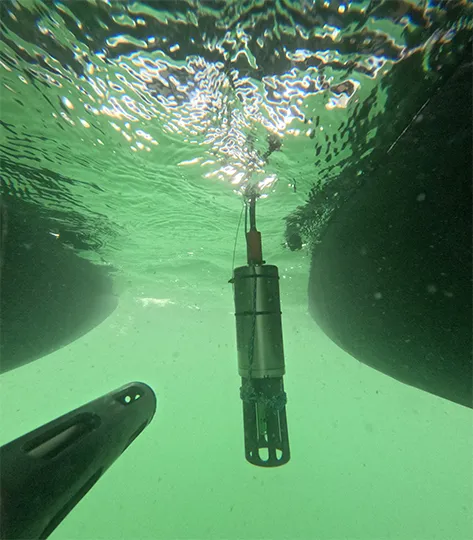
Underwater photograph of the pH sensor on the winch (centre) and CT sensor (lower left). Photo: MARUM – Center for Marine Environmental Sciences, University of Bremen
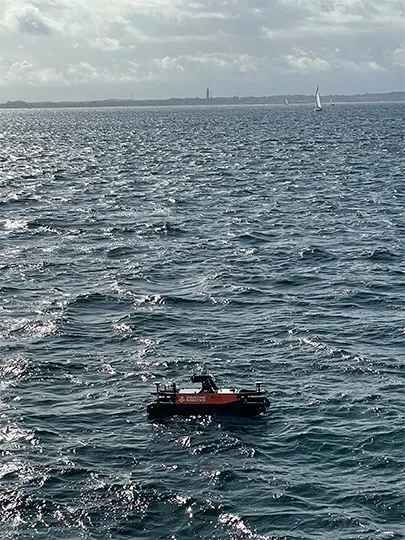
MARUM-Otter follows a predefined course in Kiel Bay. Photo: MARUM – Center for Marine Environmental Sciences, University of Bremen