

Page path:
- Home
- Our Offers
- Media
- Archive Media Releases
- Media Releases 2025
- Microbes and minerals: How microorganisms accelerate calcification
Microbes and minerals: How microorganisms accelerate calcification
Jan 6, 2025

Microorganisms are usually associated with decomposition and degradation processes, but they also facilitate and accelerate the formation of minerals that would otherwise only form very slowly or not at all. It is precisely this phenomenon that interests researchers in geology, geochemistry and materials science, as it can be used for topics in basic and applied research. Limestone minerals, for example, bind carbon dioxide (CO2) from the atmosphere as a solid over long periods of time.
Methane leaks as a natural laboratory
Methane and other hydrocarbons are released from the ocean floor at so-called cold seeps, forming the basis for ecosystems independent of sunlight. The basic process is methane oxidation without oxygen, which is carried out jointly by archaea and bacteria. “This metabolic reaction indirectly leads to calcification in sediments near the ocean floor. Marine methane sources are therefore excellent ecosystems to study microbial processes and their influence on mineral formation,” explains first author Daniel Smrzka from MARUM – Center for Marine Environmental Sciences and the Faculty of Geosciences at the University of Bremen.
The results of the study confirmed previous experimental studies based on microbial cultivation and mineral formation, but for the first time provide quantitative estimates of rock formation over thousands of years. According to the team of authors, these results are an important step towards better understanding the phenomenon of microbial-influenced mineral formation and quantifying its influence for the first time, as microbial activity influences the formation of minerals in almost all ecosystems and environmental conditions.
Original Publication:
Daniel Smrzka, Yiting Tseng, Jennifer Zwicker, Andrea Schröder-Ritzrau, Norbert Frank, Anne-Désirée Schmitt, Thomas Pape, Daniel Birgel, Jörn Peckmann, Saulwood Lin, Gerhard Bohrmann: Marine carbon burial enhanced by microbial carbonate formation at hydrocarbon seeps. Communications Earth & Environment 2024. DOI: 10.1038/s43247-024-01960-0
Contact:
Dr. Daniel Smrzka
General Geology – Marine Geology
MARUM – Center for Marine Environmental Sciences and Faculty of Geosciences, University of Bremen
Email: [Bitte aktivieren Sie Javascript]
Prof. Dr. Gerhard Bohrmann
General Geology – Marine Geology
MARUM – Center for Marine Environmental Sciences and Faculty of Geosciences, University of Bremen
Email: [Bitte aktivieren Sie Javascript]
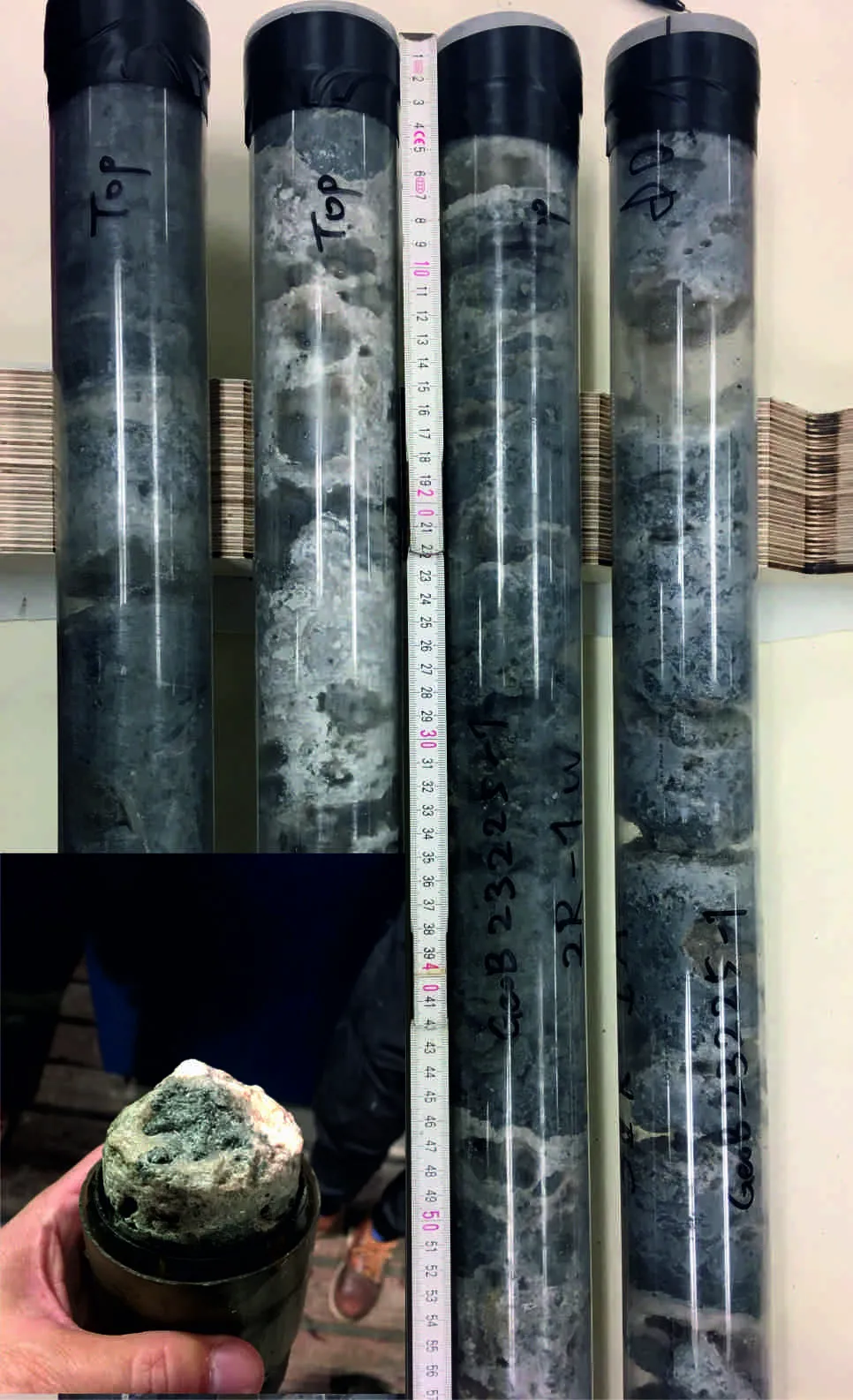
The extracted MARUM-MeBo cores with carbonate after sampling. Photo: MARUM – Center for Marine Environmental Sciences, University of Bremen
MARUM produces fundamental scientific knowledge about the role of the ocean and the seafloor in the total Earth system. The dynamics of the oceans and the seabed significantly impact the entire Earth system through the interaction of geological, physical, biological and chemical processes. These influence both the climate and the global carbon cycle, resulting in the creation of unique biological systems. MARUM is committed to fundamental and unbiased research in the interests of society, the marine environment, and in accordance with the sustainability goals of the United Nations. It publishes its quality-assured scientific data to make it publicly available. MARUM informs the public about new discoveries in the marine environment and provides practical knowledge through its dialogue with society. MARUM cooperation with companies and industrial partners is carried out in accordance with its goal of protecting the marine environment.