


- Home
- ...
- Modelling of Sedimentation Processes
- Research projects
Modelling of Sedimentation Processes
Research projects
MSCA EU Doctoral Network POSEIDON - Improve offshore infrastructure resilience against geohazards towards a changing climate (2024-2027)
- Micro-structural characteristics of failure planes and weak layers – new insights from (4D) mCT measurements combined with geotechnical testing (PhD project Xiaoye Zhao)
- Characterization of lithology endmembers – bridging the gap between micro-scale sediment characteristic and macro-scale landslide behaviour (PhD project Dina Hanifah)
POSEIDON aims a critical research into the impact of natural hazards on critical offshore infrastructure in order to enhance our capacity to develop and to build safe and resilient infrastructure in the future....

DFG funded project SEKT - Sector collapse kinematics and tsunami implications (2021-2026)
- Volcanic island sector collapse: Interrelationship of volcanic processes and associated gravitational mass movements (PhD project Kristina Sass)
SEKT aims to improve the understanding of submarine landslides and flank collapses which may trigger mega-tsunamis and endanger communities as well as seafloor installations. Data were collected during M154-2.


DAM (Deutsche Allianz Meeresforschung) project MultiMarex (BMBF 2024-2026)
- WP2.5 Preconditining factors of slope destabilisation - Micro-structural characteristics of weak layers (Gerhard Bartzke)
MultiMarex focus on earthquakes and volcanic eruptions, as well as the associated tsunamis, as geomarine extreme events, which are among the most serious natural disasters and in Europe...

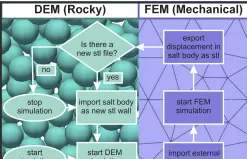
This research project will developed a 3D two-way coupled DEM-FEM framework using Ansys Rocky and Mechanical, integrated via Python, to simulate salt-sediment-ice interactions (2023-2026)
- Investigation of salt deformation processes using a newly developed 3D two-way coupled DEM-FEM simulation technique (PhD project Dayana Behrens)
Glacial loading in salt-bearing sedimentary basins triggers salt flow and sediment faulting, yet these processes are inadequately captured by standalone Discrete Element Method (DEM) or Finite Element Method (FEM) simulations due to their contrasting rheologies.