


Page path:
- Home
- Our Offers
- Media
- News
- Media Releases
- clumped-isotope geochemistry
A new Temperature Record Challenges the Extreme High-Latitude Warmth Paradigm
Research team applies temperature proxy to exceptionally pure fossil phytoplankton for the first time / Results indicate cooler conditions than previously assumed in the North Atlantic since the Miocene epoch
Jan 8, 2026

For their study, Dr. Luz María Mejía, now at MARUM – Center for Marine Environmental Sciences at the University of Bremen, and her colleagues focused on the past 16 million years, most importantly, on the Miocene. According to Dr. Mejía, the CO2 concentrations of this time interval most closely resemble the emission scenario towards which we are currently heading, according to the latest IPCC report, with CO₂ levels between 400 and 600 ppm (parts per million). “Understanding the Miocene climate, between 5 and 23 million years ago, could help us better predict the climate response to anthropogenic CO2 emissions of the near future,” says Luz María Mejía.
As an indicator, the team examined clumped isotopes in fossil coccoliths – bonds between heavy oxygen and carbon isotopes. These are calcite plates produced by marine plankton that function as an exoskeleton. These organisms, called coccolithophores, live in the sunlit surface layer of the ocean and perform photosynthesis. Their calcite plates record an isotopic signature that depends on the water temperature during their lifetime, which can be therefore reconstructed using coccolith clumped isotopes, independently of the seawater chemistry. When the organisms die, the plates sink to the seafloor, where they are archived.
Drilling into the ocean floor provides sediment cores from which samples are extracted. As with tree rings, there are indicators that allow layers to be dated and assigned to geological periods. Depending on temperature, rare (heavy) oxygen and carbon isotopes form bonds within the calcite plates: more clumping at lower temperatures, less at higher temperatures. In this way, researchers can determine the water temperatures at the time the coccolithophores lived by measuring the degree of isotope clumping.
But before Luz María Mejía could study the fossil coccoliths, she first had to develop a method to extract large quantities of them from samples—without mixing them with other organisms or abiotic calcite. To achieve this, the team developed a semi-automatic filtering machine and combined it with centrifugation at the Eidgenössischen Technische Hochschule (ETH) Zurich (Switzerland).
The results surprised the team: “Perhaps the most widely used and accepted temperature indicator, especially for the Miocene, is the alkenone unsaturation index, which is based on organic fossil molecules that are also produced by coccolithophores. Sea surface temperature estimates using alkenones have contributed to the widely-accepted paradigm amongst the proxy and climate-model communities – that during past warm periods such as the Miocene, high latitudes were extremely warm and the meridional temperature gradient was greatly reduced,” explains Mejía.
This means: the more CO₂ in the atmosphere, the warmer the oceans become, and the more similar water temperatures get between the poles and the tropics. “This paradigm always seemed odd to me – because in the Caribbean, where I studied marine biology, I could see with my own eyes how most life struggles terribly during the warm season. How is it possible that life in general could survive and thrive at higher temperatures, including in non-tropical regions, over millions of years?” she wondered.
The answer may lie in the analyses applying new techniques: Coccolith clumped isotopes suggest that the North Atlantic was 9 degree Celsius cooler than previously proposed. The authors emphasize that this challenges the paradigm of extreme warmth in high northern latitudes. Moreover, the data now align with existing climate models for the Miocene.
The new study suggests that temperatures in high northern latitudes during the Miocene may not have been as extremely warm as assumed, and therefore might also not become as extremely warm in the future. The team also highlights that the use of climate reconstruction indicators must be continually reassessed – only then can both trends and absolute temperature values be properly interpreted.
Dr. Mejía is clarifies, however, that this study is just the beginning: “We need to test more,” she says. A next step – also relevant for research within the “Ocean Floor” Excellence Cluster – will be to investigate fossil coccoliths from other regions and latitudes of Earth.
More Information:
Blog article as background to the paper: https://go.nature.com/48kzGsH
Original publication:
Luz María Mejía, Stefano M. Bernasconi, Alvaro Fernandez, Hongrui Zhang, José Guitián, Madalina Jaggi, Victoria Taylor, Alberto Perez-Huerta and Heather Stoll: Modest, not extreme, northern high latitude amplification over the Mid to Late Miocene shown by coccolith clumped isotopes. Nature Communications 2025. DOI: https://doi.org/10.1038/s41467-025-65954-y
Contact:
Dr. Luz María Mejía Ramirez
MARUM – Center for Marine Environmental Sciences, University of Bremen Paleoceanography
Email: [Bitte aktivieren Sie Javascript]
Participating institutes:
- Geological Institute, ETH Zurich (Switzerland)
- Instituto Andaluz de Ciencias de la Tierra (CSIC), Granada (Spain)
- Department of Earth Sciences and Bjerknes Centre for Climate Research, University of Bergen (Norway)
- Department of Earth Sciences, University of Alabama (USA)
- MARUM – Center for Marine Environmental Sciences, University of Bremen
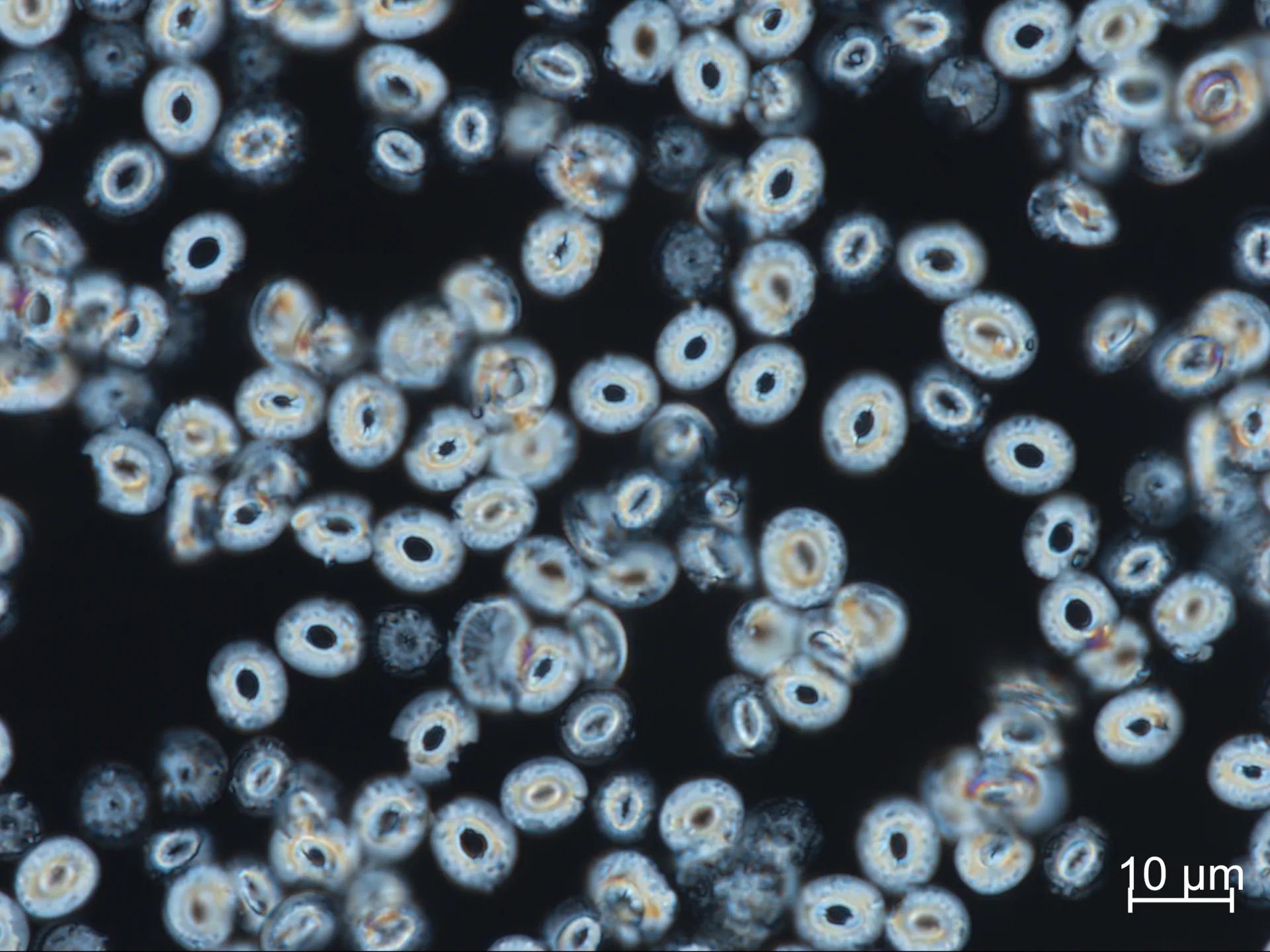
Coccolithophores form calcite plates as a kind of exoskeleton. When the organisms die, the plates sink from the upper ocean to the deep sea, carrying the geochemical signatures of their lifetime, and are deposited layer by layer on the ocean floor. Photo: Luz María Mejía
MARUM produces fundamental scientific knowledge about the role of the ocean and the seafloor in the total Earth system. The dynamics of the oceans and the seabed significantly impact the entire Earth system through the interaction of geological, physical, biological and chemical processes. These influence both the climate and the global carbon cycle, resulting in the creation of unique biological systems. MARUM is committed to fundamental and unbiased research in the interests of society, the marine environment, and in accordance with the sustainability goals of the United Nations. It publishes its quality-assured scientific data to make it publicly available. MARUM informs the public about new discoveries in the marine environment and provides practical knowledge through its dialogue with society. MARUM cooperation with companies and industrial partners is carried out in accordance with its goal of protecting the marine environment.