

- Startseite
- ...
- Der Ozeanboden
- Über uns
- Karriere
- Stellenangebote
- Doctoral Researchers
- Kohorte I
- EXC1-11 Nanoscale Interactions of Vent-Derived Particles
Der Ozeanboden
EXC1-11 Nanoscale Interactions of Vent-Derived Particles: Unlocking Nutrient and Carbon Pathways in the Deep Ocean
Nanoscale Interactions of Vent-Derived Particles: Unlocking Nutrient and Carbon Pathways in the Deep Ocean
Important: Please read in detail the instructions provided in the umbrella advertisement (linked here).
Do not send applications directly to the contacts on this page.
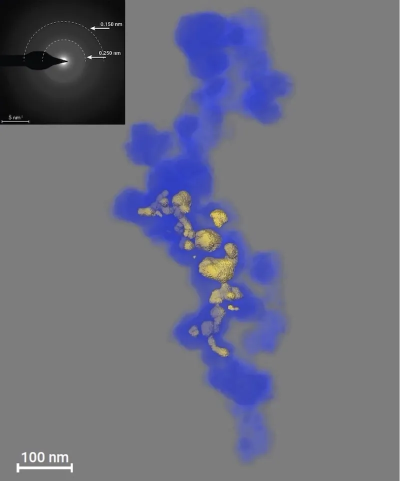
Nanotomography of a hydrothermal vent nanoparticle aggregate from the Rainbow hydrothermal vent field. Inset is an electron diffraction pattern of the vent nanoparticles. (Image credit: Lotta Ternieten, Utrecht University)
Project Description
Hydrothermal vents on the seafloor release iron and phosphorus, key nutrients for marine life, deep into the ocean, but how these nutrients remain stable, travel long distances and become available to microbes is still not fully understood. Recent studies have revealed the crucial role of extremely tiny (nanometre-scale) iron-mineral particles in carrying these elements. These complex core–shell particles often have protective coatings that may prevent iron from oxidising and allow them to travel thousands of kilometres from the vent. Intriguingly, samples collected near vent sources suggest these particles usually lack any organic coating, implying early chemical changes in the plume are driven by inorganic processes. This PhD project will explore how vent-derived nanoparticles interact with organic carbon and phosphorus as they move through the ocean. Using advanced microscopy and spectroscopy at the nanometre scale, we will examine what kinds of organic molecules stick to the particle surfaces and how the particles’ structure, composition and electronic state influence these interactions. At such a tiny scale, minerals can behave in surprising ways, they can become much more reactive, shift their electronic properties or bind nutrients differently, all of which can affect how carbon is stored and transported in the deep ocean. By uncovering these nanoscale behaviours, the project aims to connect the invisible world of mineral particles to big questions about nutrient availability and the global carbon cycle.
Further Reading
- Ternieten, L., Preiner, M., Pekker, P., Kraal, P., & Plümper, O. (2025). Early (trans) formation processes of reduced iron in a black smoker system. In Goldschmidt 2025 Conference. (manuscript to be submitted soon).
- Chogani, A., King, H. E., Tutolo, B., Živković, A., & Plümper, O. (2025). Geochemistry of lithospheric aqueous fluids modified by nanoconfinement. Nature Geoscience, 18(2), 191-196.
- Schmidt, E. M., Klar, P. B., Krysiak, Y., Svora, P., Goodwin, A. L., & Palatinus, L. (2023). Quantitative three-dimensional local order analysis of nanomaterials through electron diffraction. Nature Communications, 14(1), 6512.
- Gartman, A., & Findlay, A. J. (2020). Impacts of hydrothermal plume processes on oceanic metal cycles and transport. Nature Geoscience, 13(6), 396-402.
- Hochella Jr, M. F., Mogk, D. W., Ranville, J., Allen, I. C., Luther, G. W., Marr, L. C., ... & Yang, Y. (2019). Natural, incidental, and engineered nanomaterials and their impacts on the Earth system. Science, 363(6434), eaau8299.
Modalities
The doctoral project will be supervised by Oliver Plümper and Ella Schmidt (University of Bremen), and will be located within the working group “Mineralogy” (Bremen). The remuneration corresponds to pay group TV-L 13 with 75% of the weekly working hours. The positions is for a fixed-term period of 4 years, starting January 1st 2026 the earliest and until at most December 31, 2029 (according to § 2 WissZeitVG) with the aim of obtaining a doctorate.
The project mentoring team also includes: Wolfgang Bach (University of Bremen), Helen King (University of Bremen), and Paul Klar (University of Bremen).
Main Tasks
- Conduct scientific research on the atomic structure, electronic properties, and reactivity of hydrothermal vent nanoparticles involved in Earth's carbon fixation processes.
- Perform advanced microscopy and spectroscopic analyses of natural samples, including three-dimensional electron diffraction and electron energy-loss spectroscopy.
- Develop and implement laboratory-based characterisation workflows and sample-preparation protocols for advanced analysis
- Writing of scientific publications
- Participation in ship expeditions
- Participation in international conferences
Formal Requirements:
Completed scientific university degree (Master/University diploma or comparable) in Materials science, Nanoscience, Solid-state Physics, Geochemistry, Mineralogy, Earth sciences, Chemistry or a related discipline.
Further questions?
Questions about the project can be addressed to Oliver Plümper ([Bitte aktivieren Sie Javascript]) or Ella Schmidt ([Bitte aktivieren Sie Javascript]).
Notes for Applicants
Please do not enclose any original certificates or references with your application documents. Please note that no photos are to be attached to the application documents. Please also do not use folders or transparencies. Application documents will only be returned on request if you enclose a sufficiently stamped envelope. Personal data is subject to restrictive access control to ensure that only authorized persons can access your data. In principle, your application data will only be used by the responsible application-processing personnel departments of the partner institutions of the cluster. Your application data will not be used for any other purpose or passed on to third parties. By sending us your application documents, we assume that you consent to the collection of your personal data. As soon as your application data is no longer used for the defined purpose of processing your application, it will be deleted immediately in compliance with data protection regulations. If you receive a written rejection, your application documents will be kept until the deadline in accordance with § 15 Allgemeines Gleichbehandlungsgesetz (AGG) has expired and then destroyed. The extent to which costs for the application can be reimbursed must be checked on a case-by-case basis.