

Die Inhalte dieser Seite sind leider nicht auf Deutsch verfügbar.
Seitenpfad:

Fluid Sampling System

Project Goal: trace-metal clean and/or isobaric fluid sampling (gas-tight) as well as a filtration system during ROV dives

Overview

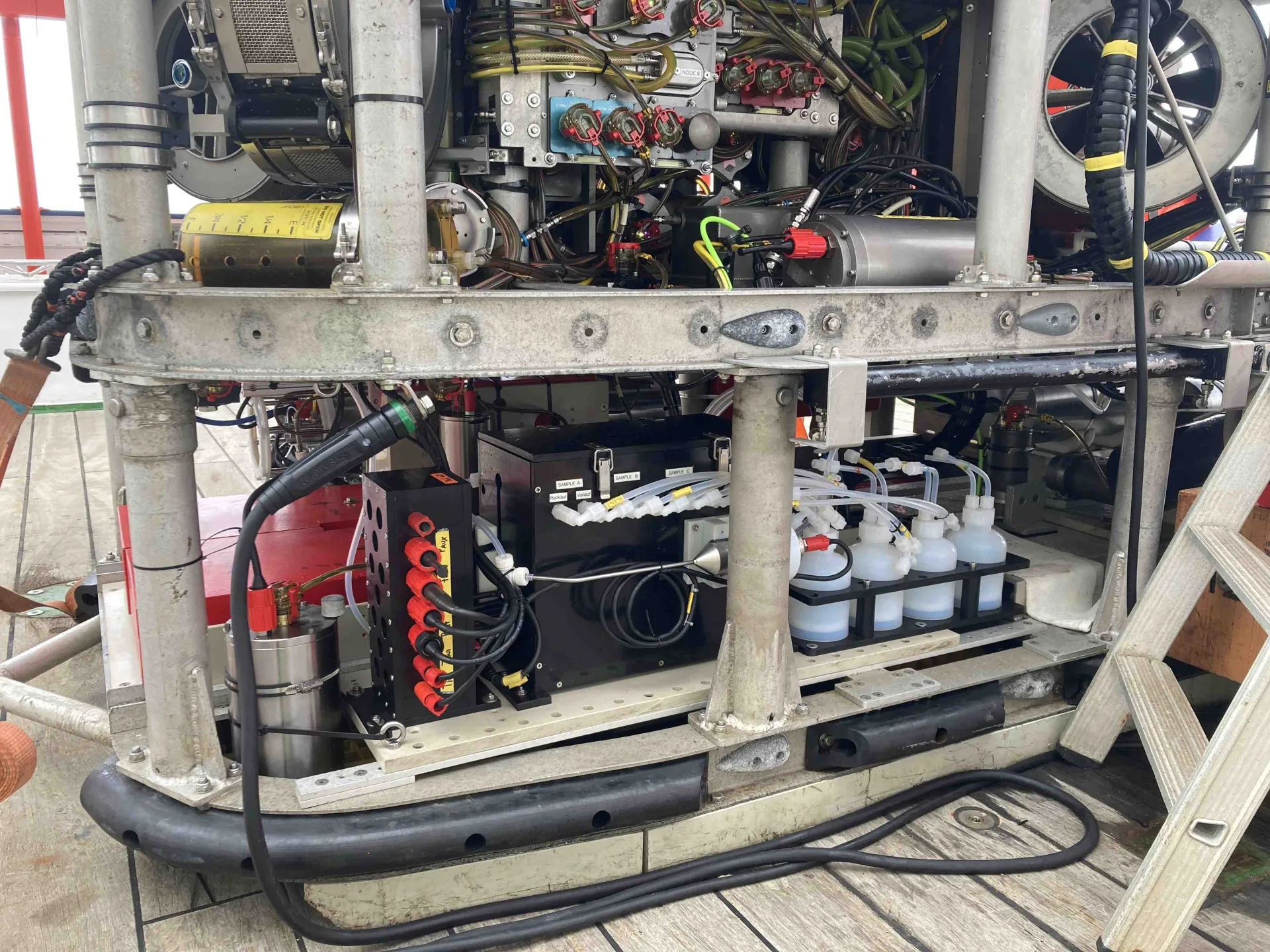
During ROV deployments, fluids enter the system via the titanium tube guided by the ROV’s manipulator arm to the sampling point. The high-temperature probe, mounted parallel to a titanium nozzle, obtains real-time temperature data to guide the ROV pilots during fluid sampling. The fluids are then pumped through 3/8" outer diameter, 8 m length coiled PFA tubing to the remotely controlled sampling unit(s).

Adequate sampling of the various compartments of hydrothermal systems is not possible with a single device; consequently, the MARUM sampling system utilises a combination of different samplers, thereby allowing three modes of sampling: (1) gas-tight sampling into Ti-bottles, (2) sampling into Teflon bottles for trace element work, and (3) filter sampling of particles and microorganisms. The system is combined with additional sensors, such as the ISMS, to enable a single nozzle and thermocouples to be used for all modes of probing and sampling. The sampling system is modular, with each sampling unit able to be deployed individually or in combination with one or both of the other modules. The sampling modules are remotely controlled via a control unit that is fully integrated into the electrical and software control systems of the MARUM ROV QUEST 4000 and ROV SQUID.

Shematic setup of the vent fluid sampling system

The Kiel Pumping System (KIPS), developed by Dr Dieter Garbe-Schönberg of the University of Kiel, forms the foundation of the MARUM fluid sampling system. KIPS is an inert, temperature-resistant, modular, remotely controlled fluid sampling system, designed to store up to four 750 ml samples per ROV dive. This system has been successfully deployed on several MARUM ROV QUEST dives (e.g. SO216, SO253, and previous Mid-Atlantic Ridge cruises during the SPP 1144 project), guaranteeing the retrieval of uncontaminated samples from depths of up to 5000m. However, KIPS is not suitable for gas analysis of vent fluid samples from the deep sea, as samples are stored in non-gas-tight flasks. Furthermore, filtration was only carried out on board, meaning that particles originally retrieved during pumping and particles formed during sample recovery could not be distinguished.

The newly developed fluid filtration unit enables 4 filters to be filled per ROV dive by switching between the individual filters and a bypass line. This allows for precise control during microbial sampling procedures. Following filtration, a separately mounted pump can be used to introduce chemical fixatives, thus facilitating downstream biogeochemical analyses.

The pump (0–1 L/min) is mounted downstream these units and an in-line flow meter provides real-time data on the flow rate and total fluid volume. In addition, the system is complemented with integrated sensors, such as fDOM sensor (or similar) as well as microsensors for in situ measurements of redox potential (eH), pH, hydrogen (H₂), and hydrogen sulfide (H₂S), expanding its analytical capabilities in marine hydrothermal research.

Once the ROV has been recovered on deck, all sample flasks are transferred to the ship’s laboratory for subsampling in accordance with standardised protocols.

Tech­nical Spe­cific­a­tions

Physical Properties

  • Weight in Air (kg): na
  • Weight in SeaWater (kg): na
  • Overall Dimensions (B x H x T mm): na
  • Device is pressure isolated (450 bar pressure housing) and needs no hydraulic interfacing

Power Requirements

  • Operating Voltage: 24V
  • Operating Current: 3.5A
  • Maximum Current (including startup): 5.5A
  • Power Return(V-) is isolated from Chassis (GND)

Data Requirements

  • Port Required: Ethernet
  • Data Bits: 8
  • Update rate: Continuous

Underwater Electric Interface Requirements

  • All connectors can be installed (SeaNet available)

Topside Requirements

  • Device needs lab (bench) space on ship and Laptop
  • Topside Data Interface is PC-based
  • Topside Data Interface needs TCP/IP
  • Topside Interface is used for control and data retrieval

Ex­pe­di­ti­ons

M192-2
(RV Meteor)
08.08.-05.09.2023
Piräus - Limassol

Aegean Sea
Mediterranean Sea
S. Bühring, MARUM

M190
(RV Meteor)
08.06.-10.07.2023
Las Pal­mas - Al­ge­ci­ras

Mid-Atlantic Ridge
North Atlantic Ocean
W. Bach, MARUM

MSM109
(RV Ma­ria S. Me­ri­an)
06.07.-03.08.2022
Trom­sö - Reyk­ja­vik

Kni­po­vich Ridge
North At­lan­tic Oce­an
G. Bohr­mann, MARUM

Impressions

Contact

Jan Kleint

Telefon: 

+49 421 218-65747

Fax:

+49 421 218-65715