


- Home
- Jan Kleint
- Fluid Sampling System
Fluid Sampling System

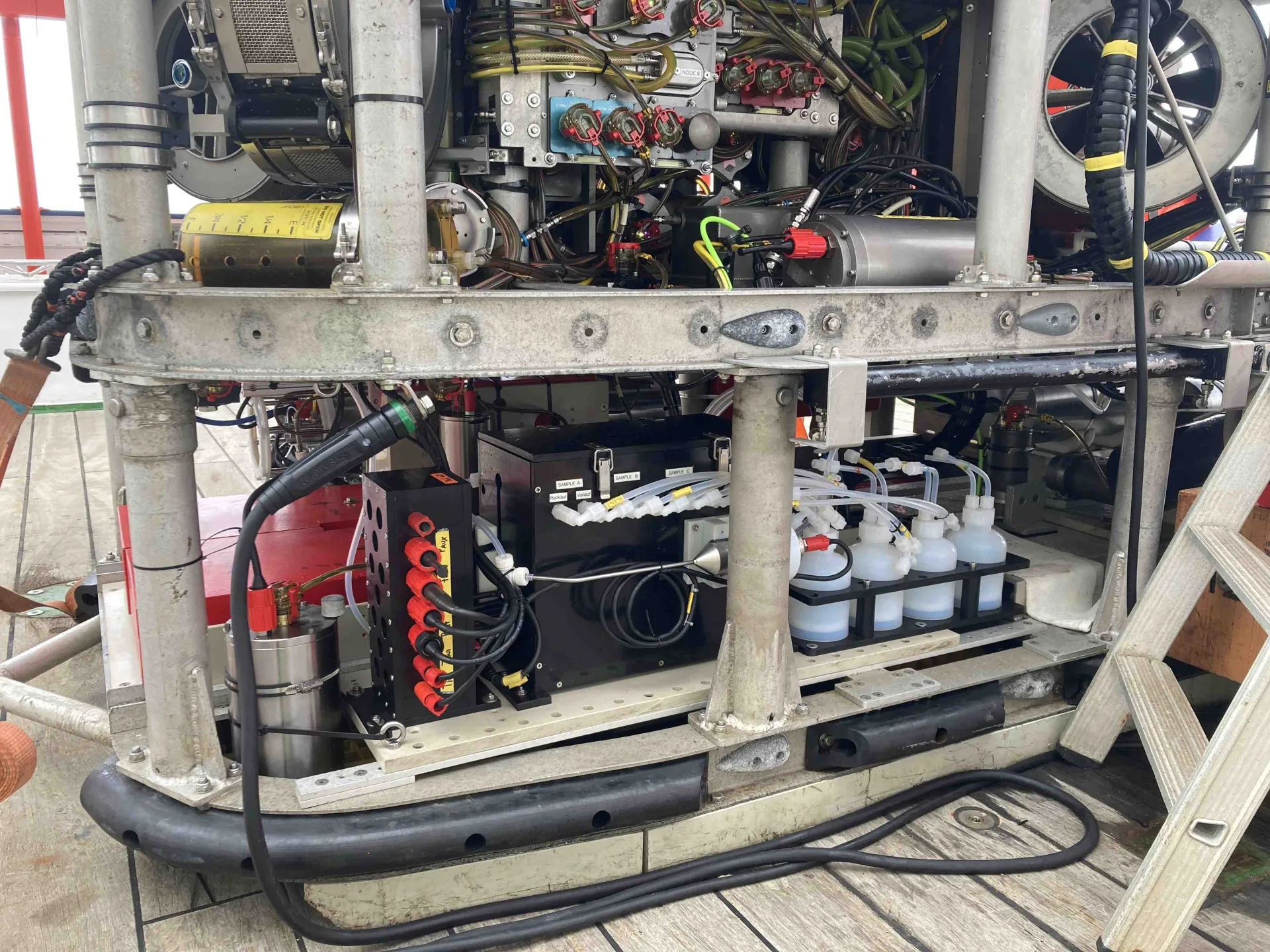
The Kiel Pumping System (KIPS), developed by Dr Dieter Garbe-Schönberg of the University of Kiel, forms the foundation of the MARUM fluid sampling system. KIPS is an inert, temperature-resistant, modular, remotely controlled fluid sampling system, designed to store up to four 750 ml samples per ROV dive. This system has been successfully deployed on several MARUM ROV QUEST dives (e.g. SO216, SO253, and previous Mid-Atlantic Ridge cruises during the SPP 1144 project), guaranteeing the retrieval of uncontaminated samples from depths of up to 5000m. However, KIPS is not suitable for gas analysis of vent fluid samples from the deep sea, as samples are stored in non-gas-tight flasks. Furthermore, filtration was only carried out on board, meaning that particles originally retrieved during pumping and particles formed during sample recovery could not be distinguished.
The newly developed fluid filtration unit enables 4 filters to be filled per ROV dive by switching between the individual filters and a bypass line. This allows for precise control during microbial sampling procedures. Following filtration, a separately mounted pump can be used to introduce chemical fixatives, thus facilitating downstream biogeochemical analyses.
The pump (0–1 L/min) is mounted downstream these units and an in-line flow meter provides real-time data on the flow rate and total fluid volume. In addition, the system is complemented with integrated sensors, such as fDOM sensor (or similar) as well as microsensors for in situ measurements of redox potential (eH), pH, hydrogen (H₂), and hydrogen sulfide (H₂S), expanding its analytical capabilities in marine hydrothermal research.
Once the ROV has been recovered on deck, all sample flasks are transferred to the ship’s laboratory for subsampling in accordance with standardised protocols.
Impressions
Contact
|
Jan Kleint |
|
|
Phone: |
|
|
Fax: |
+49 421 218-65715 |