


Page path:

BlueDOT

BlueDOT – Divers for Ocean Temperature

 
Ocean heatwaves / Copyright of the original image: E. Burwicz-Galerne

Original picture copyright: E. Burwicz-Galerne


Project

A coastal temperature database for monitoring ocean surface water past and present

Ocean warming – Sea surface

In spring and summer of 2023, the Copernicus Climate Service reported alarming sea surface temperature records in the Mediterranean Sea that significantly exceeded previous measurements. This trend has persisted and continues to the present day. We are now experiencing a period of heat excess of the surface ocean that has persisted through the entire year.

https://climate.copernicus.eu/esotc/2023/sea-surface-temperature

Daily sea surface temperatures (°C) averaged over 60°S-60°N 2023 (red) and previous years since 1980 (grey). Data source: ESA SST CCI Analysis v3.0.

View of the ocean floor
Picture copyright: E. Burwicz-Galerne

Studying ocean heatwaves is crucial because these extreme temperature events can have significant impacts on marine ecosystems, including the loss of biodiversity, disruption of fisheries, and damage to coral reefs. For society, understanding ocean heatwaves is essential for protecting coastal communities, ensuring sustainable fisheries, and mitigating the effects of climate change. By studying these events, we can better predict and respond to their impacts, helping to safeguard both the environment and the livelihoods that depend on healthy oceans.

Problem – Subsurface

Temperature anomalies indicative of ocean heat waves have been observed at depth in the Mediterranean Sea by divers for at least 6 years. However, these phenomena were largely not detected by current ocean temperature monitoring methods such as satellites, drifters, and ARGO floats. This raises a critical question for scientists and ocean climate modelers: How can we effectively study these subsurface heat waves if their signal is currently not recorded by existing platforms?

https://climate.copernicus.eu/esotc/2023/sea-surface-temperature
Anomalies and extremes in sea surface temperature in 2023. Colour categories refer to the percentiles of the temperature distribution[2] for the 1991–2020 reference period. The ‘warmest’ and ‘coolest’ categories are based on rankings for the 1980–2023 period. Data source: ESA SST CCI Analysis v3.0. Credit: ESACCI/EOCIS/UKMCAS and C3S/ECMWF.

- Goal

"Every diver carries the story of past heatwaves, stored right on their dive computer!"

Cost effective Solution

The aim of the BlueDOT project is to develop an open access database that centralizes temperature data from individual dive computers. The primary use of this database will be to complement ocean temperature monitoring systems for a better understanding of the ocean warming processes. Our project will convert recreational and professional divers alike into citizen scientists providing them with the tools, including calibration methods, to use their dive computers as sophisticated scientific instruments.

Diver with dive computer
Picture copyright: E. Burwicz-Galerne

- Objective

Fill a data gap!

Our project aims to address a data gap in monitoring coastal ocean temperatures within the upper 40 meters. We plan to achieve this by establishing a global database that centralizes temperature data collected from individual dive computers and from stationary, sustained sensors.
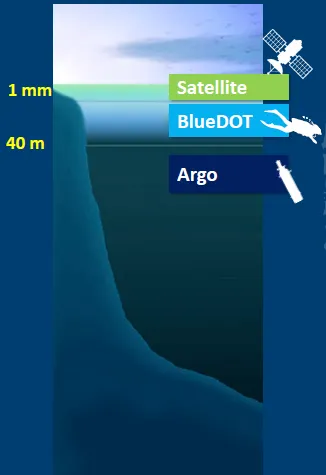
Concept sketch database coverage
Copyright: BlueDOT team

- Project Mission

A/ Enable Dive Computer data sharing and centralization

Our goal is to create the world's first global coastal temperature monitoring database by centralizing data from dive computers. This will provide invaluable insights into the world's oceans for scientist and ocean stakeholders including government and the public.

B/ Provide cost-effective calibration for dive computers

By establishing reference dive sites with fixed temperature sensors at various depths, divers can calibrate their dive computers against high-resolution sensors. This enhances the accuracy of temperature data submitted to the BlueDOT Database.

C/ Create standardizes method for reliable data

We will develop a best practice guide to help divers optimize the scientific potential of their dive computers, ensuring consistency and reliability in data collection.

D/ Promote Ocean Literacy through Citizen Science

Our project empowers recreational and professional divers to become citizen scientists, equipping them with the tools and knowledge to use their dive computers as sophisticated scientific instruments. This initiative also aims to raise awareness and understanding of ocean health and the current condition of our ocean.

- How can you take part?

How can you participate in the BlueDOT citizen science project? It's very simple!

Any diver who owns a dive computer can participate.

Step 1 Upload your dives to https://divelogs.de or https://divelogs.org using either Subsurface or DiveLogs directly. More than 30 dive computer formats are supported.


Step 2. agree to anonymously share the temperature measurements passively recorded by your dive computer


Step 3... No more steps and you can be proud to contribute to ocean temperature monitoring! THANK YOU!

The following video explains the steps and alternative to best share your dives to the BlueDOT database.

Note: if you use Subsurface, make sure you download the latest version before you upload.

Calibration Dive Site (CDS)

What is it?

Dive computers vary in how they measure and react to ambient temperature changes during a dive. To ensure reliable data, Calibration Dive Site (CDS) are popular dive spots equipped with precise, calibrated BlueDOT sensors.

When divers visit these sites, we can compare their dive computer readings with the sensor data. This allows to adjust and correct temperature records from different dive computer models, ensuring higher-quality, consistent data for our analyses.

To know how to share your dives please refer to the section “How can you take part?”.

Sensors are provided by our industry partner SchwaRTech.

The Team

Meet the team

Dr. Christophe Galerne – Geology, Volcanology, Hydrothermal Systems, Diver (>100 dives)

Christophe is a Postdoc Researcher at MARUM – Center for Marine Environmental Sciences (University of Bremen, Germany). He received his PhD from the University of Oslo in 2009. He has held positions at the University of Bonn and at the GEOMAR Helmholtz Center for Ocean Research Kiel, Germany before moving to Bremen in December 2020. His main research focuses on volcanism in sedimentary basins and magma sediment interactions. Besides research, Christophe is a qualified diver (~100 dives) certified as CMAS 1, Apnea 2, and PADI Rescue Diver.

Dr. Rebecca Zitoun – Biogeochemistry, Ocean Literacy, Capacity Development, Best Practices

Rebecca is a Postdoctoral Researcher at GEOMAR Helmholtz Center for Ocean Research Kiel. Rebecca specializes in marine biogeochemistry, including metal speciation, toxicology, ocean acidification, and paleoceanography. Recently, her work has focused on capacity building, science-policy interfacing, ocean literacy, and engaging Early Career Ocean Professionals (ECOPs) in the United Nations Decade of Ocean Science.

Prof. Achim Kopf – Geodynamics, Geohazards, Geotechnics

Achim is a professor of marine geotechnics who is running a geotechnical laboratory, develops and uses in-situ probes, and also designs and uses borehole observatories and other long-term observing systems. Kopf operates the fleet of heat floor and T gradient probes. He is the coordinator of a large-scale projects in DAM (Deutsche Allianz Meeresforschung) where climate-related processes such as extreme events, geohazards and carbon dioxide removal are studied with a focus on societal transformation. These projects involve dialogue formats such as citizen jury, exhibitions, but also citizen-assisted science.

M.Sc. Arne Schwab – Geophysics, Instrument development, High-resolution temperature sensors

Arne is owner of the private company “Schwab Research Technology” which manufactures and develops geophysical measurement devices since 2009. Over the years he successfully developed a great variety of measurement devices for highly diverse applications. He recently developed temperature chains which now measure temperature fluctuations (mK range!) in two 200m deep boreholes in the Antarctic ice-shield.


News

Here is an article from Copernicus Marine Service in collaboration with +ATLANTIC and the AIR Center featuring our research

https://colabatlantic.com/news/Copernicus-Marine-Service-added-value-for--ATLANTIC-and-AIR-Centre-s-stakeholders

11.07.2024

Researching Heat Waves in the Mediterranean with the Diving Community

Citizen science project “BlueDOT” aims to fill data gaps

Headlines in early summer 2024: Surface water temperatures in the Mediterranean Sea are significantly higher than the values from the previous year. Individual data points indicate that it is not only temperatures near the surface that are rising and remaining high, but also those lower in the wa...

+

11/07/2024 - Researching heat waves in the Mediterranean with a diving community,MARUM press release

https://www.marum.de/en/BlueDOT.html

03/08/2024 - When the Mediterranean gets too warm, Weser Courier, by Björn Lohmann

https://www.weser-kurier.de/bremen/kultur/mittelmeer-wie-buergerstudien-die-forschung-unterstuetzen-doc7wi84o9ppc1htp85euf

07/28/2024 - Wild divers for the good of science, TO BHMA, by Theodora N. Tsoli

https://www.weser-kurier.de/bremen/kultur/mittelmeer-wie-buergerwissenschaftler-die-forschung-unterstuetzen-doc7wi84o9ppc1htp85euf

03/08/2024 - When the Mediterranean gets too warm, Weser-Kurier, by Björn Lohmann
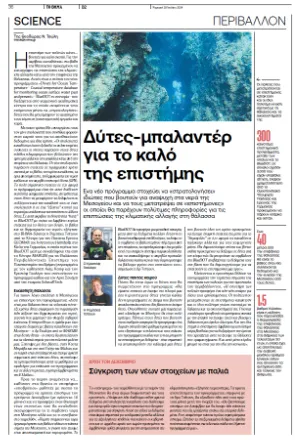
https://www.tovima.gr/
07/28/2024 - Wild divers for the good of science, TO BHMA, by Theodora N. Tsoli
 
 
BlueDOT-Banner at Boot Düsseldorf 2025

18-29/01/2025

We were at Boot Düsseldorf 2025. Many thanks to the VDST for displaying our banner!

Social media post

29/01/2025

I was invited to present BlueDOT at The Deep Discovery Event. An event organized by the non-profit organization INCH (https://www.inter-change.eu/science-communication)

Advertisement for ECOP Webinar Episode 24

15/05/2025

🌊 Discover BlueDOT! How divers worldwide track ocean warming. ECOP Webinar, 15 May, 12:00 CEST. 


We are hiring
Student assistant (f/m/d) wanted

Partners

Locations

BlueDOT locations

Funding statement

This project is funded by the DATIpilot funding line of BMFTR.

Funding duration: 18 months

Start: December 2024

Contact

University of Bremen

MARUM Center for Marine Environmental Sciences

Klagenfurter Strasse 2-4

28359 Bremen

Germany

Email: [Bitte aktivieren Sie Javascript]

Maintained by: Christophe Galerne

Christophe Galerne

University of Bremen, MARUM Center for Marine Environmental Science, Germany

Email:[Bitte aktivieren Sie Javascript]

Phone: +49 421 218 65406

Rebecca Zitoun

IMOS Integrated Marine Observing System

Email:[Bitte aktivieren Sie Javascript]

Achim Kopf

University of Bremen, MARUM Center for Marine Environmental Science, Germany

Email:[Bitte aktivieren Sie Javascript]

SchwaRTech

https://www.schwartech.de/#/

Email:[Bitte aktivieren Sie Javascript]