

- Home
- Our Offers
- Media
- Archive News
- News 2025
- FringeII
Searching for clues in the Mediterranean: FRINGE II expedition with the METEOR

At so-called convergent plate boundaries, where tectonic plates collide and one subducts beneath the other, the actual subduction zone has so far been sufficiently explored due to varies processes. It is precisely this transition zone that is the focus of the expedition.
The research team, led by Prof. Dr. Gerhard Bohrmann, is investigating the landward accretion complex along prominent fault systems where earlier studies have found evidence of deep-rooted mud volcanism and fluid seeps on the seafloor. These sediments probably originate from depths reaching into the subduction channel or the hydrated mantle wedge beneath Crete – areas where the African plate subducts beneath the Eurasian plate.
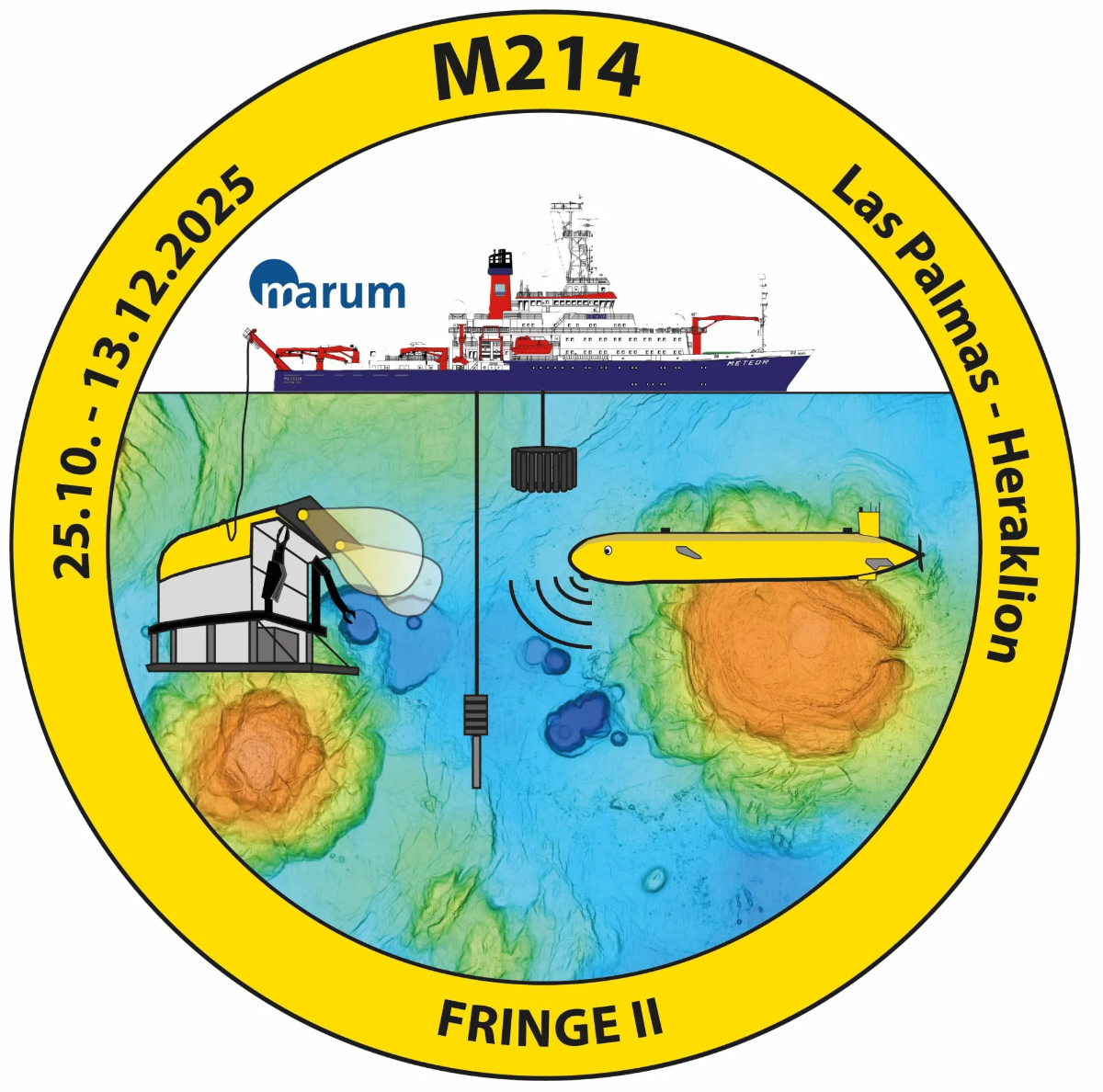
To better understand these processes, the autonomous underwater vehicle MARUM AUV SEAL5000 and the remote-controlled ROV KIEL6000 are being used to investigate specific outlets of deep mud and so-called cold seeps on the seafloor. In addition, extensive sediment sampling, heat flow measurements, and laboratory analyses are planned.
The expedition is part of the Bremen Cluster of Excellence “The Ocean Floor – uncharted interface of the Earth” at MARUM – Center for Marine Environmental Sciences at the University of Bremen and makes an important contribution to understanding the dynamic processes at plate boundaries.
The M214 expedition team reports on the voyage and everyday life on board in an expedition logbook.