

- Home
- Our Offers
- Media
- Archive News
- News 2025
- MSM136start
Research on the continental slope: How particles get into the deep sea

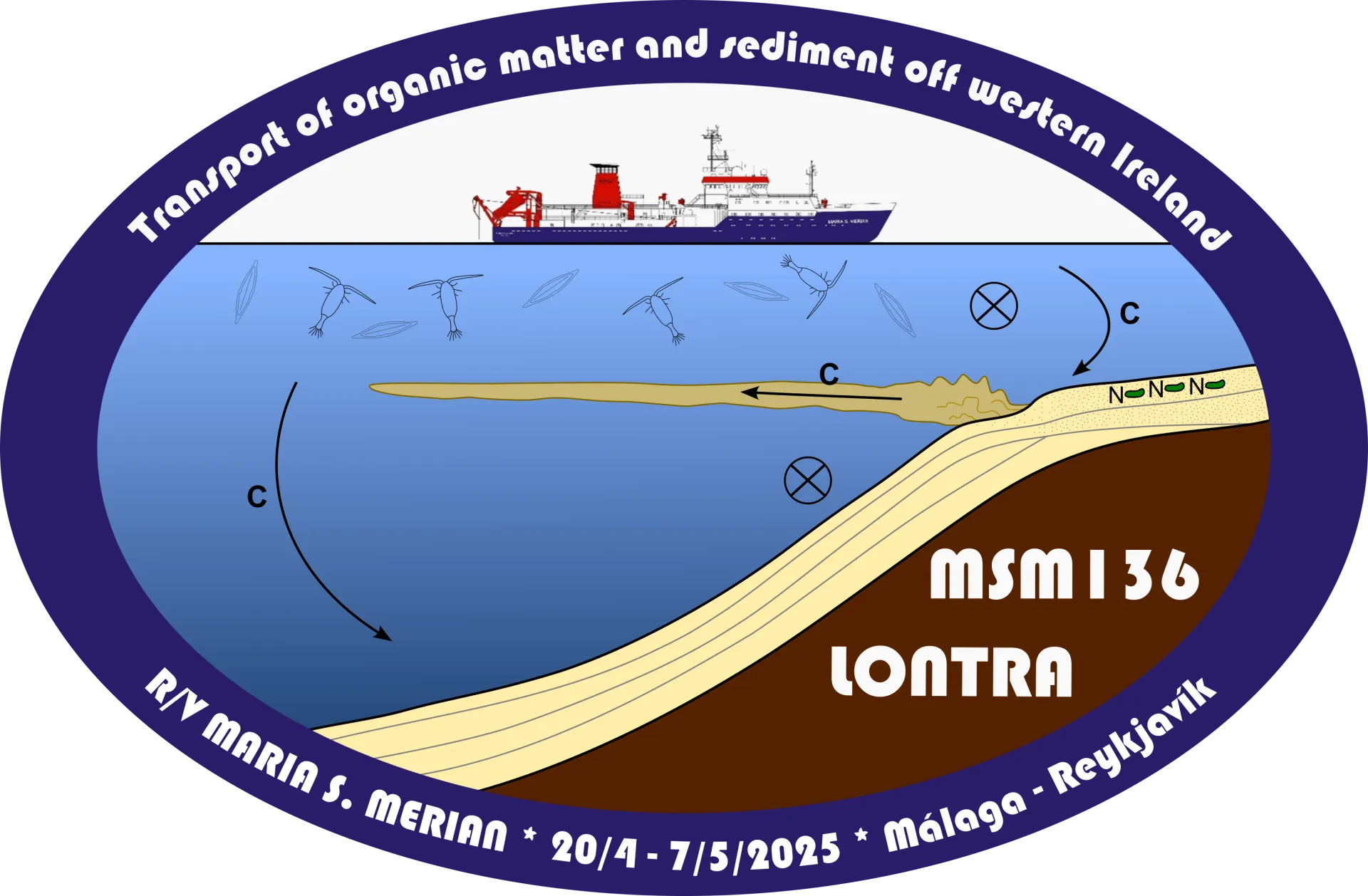
The north-western European continental margin is an area where large quantities of organic material and sediment are transported from the shallow shelf into the deep sea. Oceanographic processes such as currents, internal waves and so-called downwelling – the sinking of water masses – play an important role here. These processes can ensure that carbon is permanently stored in deep ocean areas - a natural climate protection mechanism. However, little is known about the extent of this contribution.
The expedition aims to close this knowledge gap. The aim is to better understand the movement of particles – both natural and man-made – from the shelf to the deep-sea basin. This includes the transport and mixing of sediment, the formation and transformation of organic material and the export of carbon to the deep sea.
In order to improve the understanding of the particle transport, the 22-strong research team relies on a variety of modern measuring techniques. Instruments moored on the ocean floor record current strength and direction, water properties (such as temperature and salinity) and how particles are moving through the water column. Ship-based instruments allow to measure continuously currents in the water column, the shape of the bottom and properties of the sub-seafloor (i.e. the sediment just below the ocean floor). Free-drifting traps are used to capture particles in order to analyze their composition and origin. Organic deposits, known as “marine snow”, and plankton are examined at various depths. Sediment samples are taken from the ocean floor using a so-called multicorer, which makes it possible to analyze how much material is deposited there and how it changes over time.
The expedition is part of the research in the Cluster of Excellence “The Ocean Floor – Earth's Uncharted Interface”, which is based at MARUM – Center for Marine Environmental Sciences at the University of Bremen.
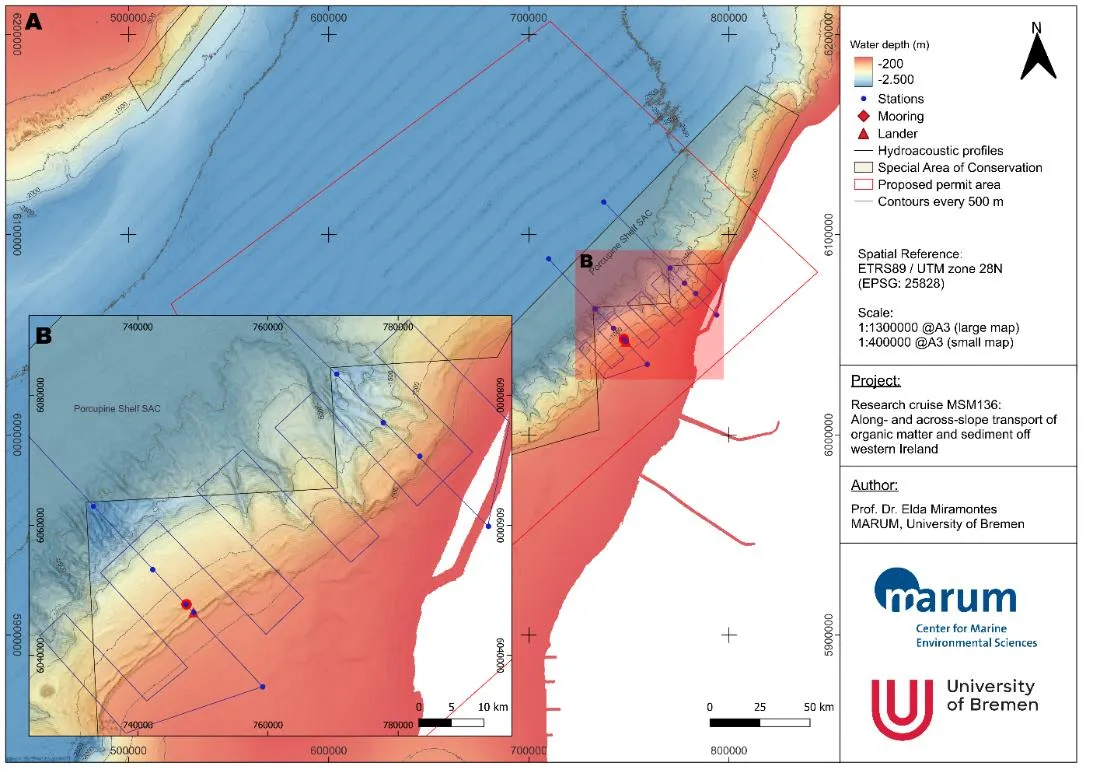
The cruise's working area is located on the continental slope and shelf off the west coast of Ireland. Graphic: MARUM – Center for Marine Environmental Sciences, University of Bremen, E. Miramontes
Further information:
- Background information on the Cluster of Excellence “The Ocean Floor - Earth's Uncharted Interface”
- Research on the marine carbon cycle at MARUM
- Research on the ocean floor at MARUM
- Current position of research vessel MARIA S. MERIAN
- Expedition logbook