




Mar 26, 2025
On the trail of metals in volcanic hydrothermal vents
A team from Germany, New Zealand and Canada set off today on an expedition north of New Zealand on board the German research vessel FS SONNE. Until 1 May, ...
+Through the direct exchange of gases at the sea surface, the marine carbon cycle plays a central role in the climate system. Greenhouse gases (especially carbon dioxide CO2) can be absorbed by the ocean from the atmosphere as well as released into it. The marine carbon cycle is one of the factors that determine the direction of this exchange.
The aim of the researchers at MARUM is to gain a better understanding of the various core processes of the marine carbon cycle. The marine carbon cycle describes the occurrence and reservoirs of carbon compounds in the oceans, as well as the associated biological and abiotic processes.This includes the primary incorporation of dissolved inorganic carbon (DIC) into photosynthesizing biomass (algae), as well as the transport and decomposition of organic material on and in the seafloor.
Typical questions are:
In order to successfully answer these and many other questions, MARUM has excellent and extensive equipment and facilities.
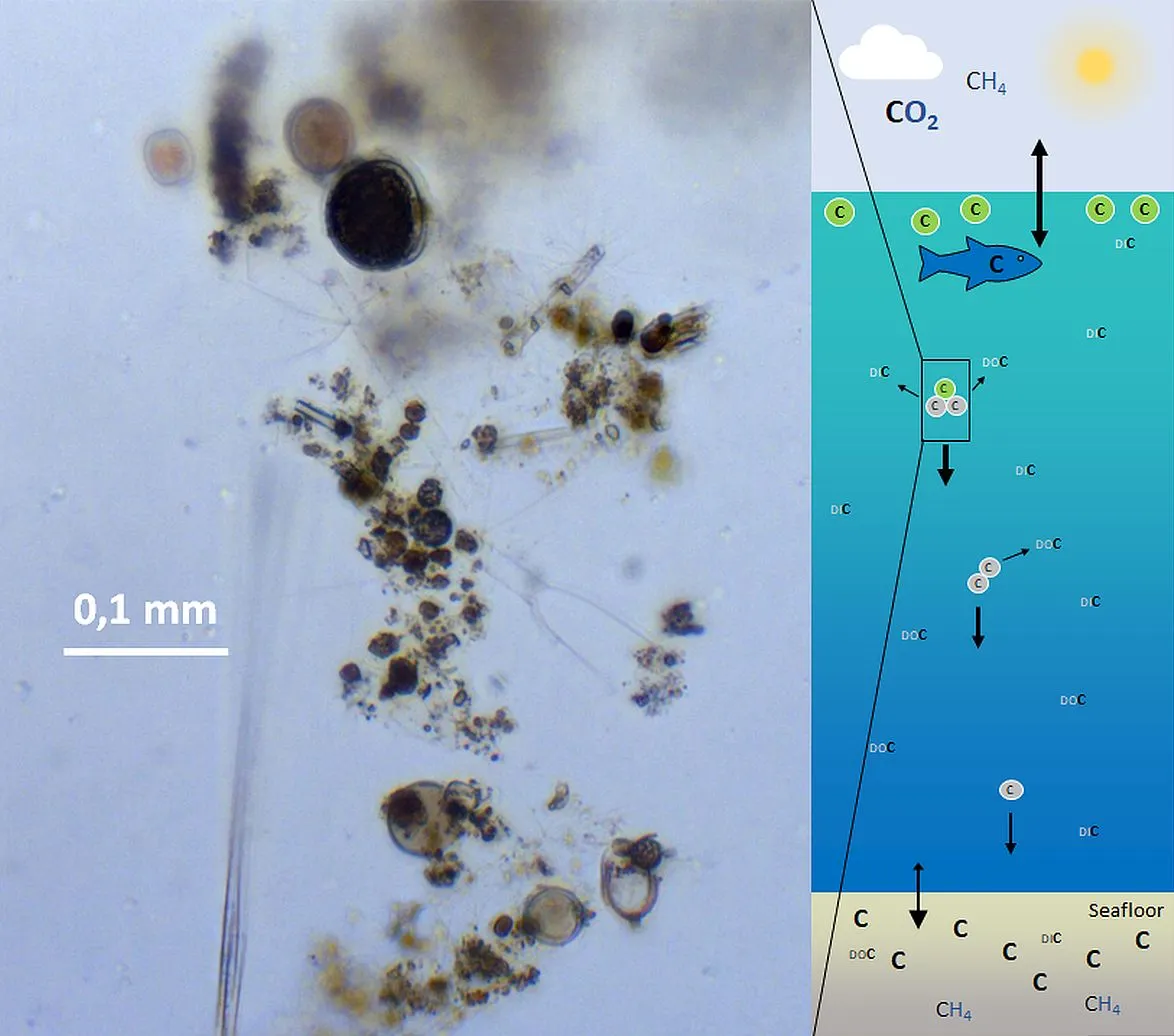
left: sinking organic particles; right: sketch of the marine carbon cycle

A team from Germany, New Zealand and Canada set off today on an expedition north of New Zealand on board the German research vessel FS SONNE. Until 1 May, ...
+
The new Center for Deep-Sea Research has been opened at the University of Bremen. The 4,000 square-meter facility will allow the resident research groups ...
+
There is a greater variety of hydrothermal systems in the deep sea than previously assumed. This is the result of a recent study on the northernmost ...
+
In mid-January, 19 scientists boarded the research vessel MARIA S. MERIAN in Las Palmas, Spain, to study the vertical and lateral transport of organic ...
+