

- Home
- ...
- Marine Geotechnics
- In situ Technologies
- Observatories
Marine Geotechnics
Observatories
MeBo borehole observatory
The MeBo borehole observatory (Type PTTi) consists of a tubular stainless-steel pressure housing (800mm in length, 76mm in diameter), a data logger, a power supply, and the installed sensors. The system is designed to operate for several years, depending on the logging frequency and additional sensor load, under a maximum pressure equivalent to 2000m water depth. The device is fastened to a drill string, ensuring undisturbed measurements while remaining retrievable by ROVs of nearly any size.


Fluid sampling
In order to be able to collect a geochemical time series, osmo-samplers were developed and deployed successfully in the past (Jannasch et al., 2003). They serve to assess any fluid flow or geochemical transients (e.g., Solomon et al., 2010). The osmo-samplers have two 2ML1 ALZET® membranes attached to the housing with two-part epoxy (Hysol ES1902). The ends of the distilled water and saturated salt (non-iodized table salt, NaCl) reservoirs are sealed with a single o-ring and held in place with a setscrew. This configuration will pump 73 ml/y at 20°C. The pump is attached to 300 m of small-bore Teflon tubing that holds 170 ml (1.19 mm I.D. and 2.0 mm O.D.). The tubing was filled with 10% HCl for 5 days before it was rinse with 18.2 M ohm water. Thus, this sampler can be deployed at 20°C for two years and maintain a continuous record for longer if the borehole temperature is cooler than 20°C

At the front end of the osmo-sampler, a unit is mounted that allows the “lower end” tubing string to descend into the open borehole using a spherical drop weight. The sphere is initially screwed to a threaded rod of 5 mm diameter when the MeBo is on deck or being deployed. After a pre-programmed period of 5 days, a timer is triggering a motor that unscrews the drop weight, which then carries the lower tubing (in our case set to 40-50 m length) into the basaltic aquifer at the ridge flank sites.
The whole unit is designed to screw into a custom-built MeBo drill rod, where it screws in with a POM conical thread sealed by an o-ring.

Fluid injection
The MeBo Tracer-T probe was developed in the Marine Geotechnics working group and basically contains two main parts. Below the handle for the ROV to manipulate the instrument later on (i.e. after deployment), there is a unit with a timer and motor that unscrews the lower plug of the second, lower part of the instrument.
For a flow experiment, the reservoir could be equipped with solutions of conservative tracers (sulphur hexafluoride, Xe, Kr, Ne, Ar, He, or fluorescent dyes) or reactive tracers such as cesium chloride, isotopically labelled C, esters, to name just a few. The reservoir also contains an MTL logger so that temperature can be recorded throughout.

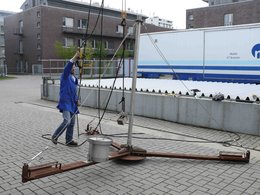
It is a long-term data acquisition system that records in-situ pore pressure and temperature gradients, among other things. It was developed at MARUM for use at depths of up to 4 and 6 kilometres. The steel girder system consists of a 5.5 metre long lance, a base plate and a tower, which serves as a housing for the data acquisition electronics. The access for the pore water, which is channelled to the pressure sensor via a thin pressure pipe, is located at the tip of the lance. The temperature gradient is recorded via a 6 metre long thermistor string attached to the outside of the lance. The absolute water pressure and the temperature of the soil water are also measured.

FINO long-term pore pressure probe
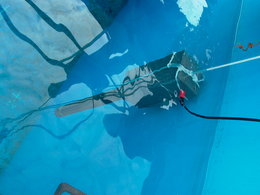
In September 2006, a pore pressure-lance was connected to the underwater docking station, which itself is attached sea-bed near to a steel-girder of the FINO1 platform. This lance can measure pore-pressure and temperature in the first 2 meters below the sea-bed. It was developed to investigate if pore-pressure changes can be detected when the platform moves (e.g. during storm events) and if the movement of the platform has any impact on the stability (liquefaction) of the sediments close to the foundation.
360° scanning sonar system
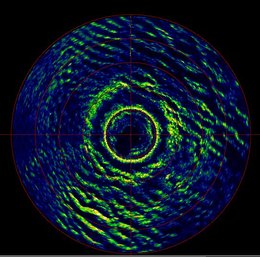
In 2007, a 360° scanning sonar tower equipped with an Imagenex 881L sonarsystem was developed at MARUM, Bremen. It scans a radius of up to 200 m at programmed time intervals to monitor sediment dynamics and remobilisation. The modular tripod allows the user to install the sonar 3 m or 5.5 m above sealevel to monitor over tidal cycles or even months. Areas of interest include estuaries, tidal inlets and dune fields in German Bight and North and Baltic Sea.
Long-term monitoring of mud volcano activity
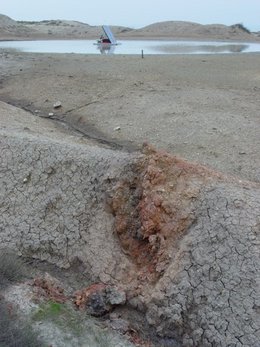
The first two instruments were installed in July 2007 in Azerbaijan, to monitor the activity of Dashgil mud volcano close to the Caspian Sea coastline:
- A 2 m-long pore pressure and temperature lance
- Two gas flow meter
By end of 2015, we replaced the old system with a new observatory, measuring pressure and temperature in the actively venting main crater
For details, see chapter in Projects and Research areas
IODP borehole monitoring
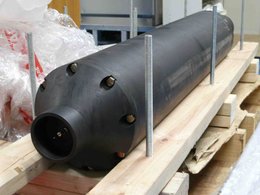
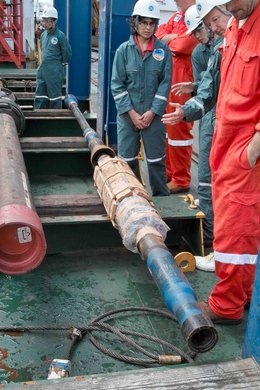
Borehole-Monitoring using so-called CORK systems (Circulation Obviation Retrofit Kits) has been successfully carried out for almost two decades within the scientific marine drilling programmes ODP and IODP. As a simpler approach preceding the CORKs, two "smart plugs" were developed together with colleagues from Pacific Geoscience Centre, Canada (Earl Davis, Bob Macdonald, Alison Labonte, Bob Meldrum) and Pennsylvania State University, USA (Demian Saffer) in 2009. The instruments measure pore pressure and temperature variations in the cased, partially perforated borehole before the final CORK is installed.
The so-called "smart plugs" are part of a mechanical separation in the casing (bridge plug) that decouple the ocean water body from the well hydrologically. They are self-contained instruments which are retrieved prior to CORKing. The aims include monitoring of pore pressure variations in fault zones. Each "smart plug" contains 2 Paroscientific absolute pore pressure transducers with Bennest period counters as well as 4 temperature transducers. The first deployment occurs during IODP Expedition 319 with the NanTroSEIZE (Nankai Trough Seismogenic Zone Experiment) project, whose foremost objective is to unravel seismogenic processes in the subduction zone offshore Japan.
Underwater docking station