


- Home
- Our Offers
- Media
- News
- Newsflashes
- IODP X502 X503
On the trail of mega earthquakes
International drilling expeditions off the coast of Japan with MARUM participation

Pauline Cornard, Dina Hanifah and Matthias Zabel are currently taking part of the IODP3 Expedition 503, on board the Japanese drilling vessel CHIKYU. The expedition targets a trench basin located at approximately 7,600 meters below the ocean surface, where more than 170 meters of sediments have already been recovered. These samples will not only help to estimate the recurrence of major earthquakes but will also shed light on carbon and element cycle in such extreme deep-ocean environments. The expedition is part of the International Ocean Drilling Programme (IODP³) and is led by Ken Ikehara (National Institute of Advanced Industrial Science and Technology (AIST), Japan) and Michael Strasser from the University of Innsbruck (Austria).
The IODP³ Expedition 502 was already successfully completed in November. Matt Ikari from MARUM took part, as he did in the previous Expedition 405 in 2024. The focus was on the Japan Trench, where the Philippine Plate pushes under the Pacific Plate creating a seismically very active region. Drilling and borehole measurements in the outer area of the trench targeted “petit spots”, small volcanoes that, in geological terms, have formed here relatively recently. The data and samples obtained should provide information on whether the petit spot volcanic activity, which is believed to exist under the seafloor at a water depth of about 5,400 meters, extends over a larger area than previously assumed. In addition, the role of petit spots in the formation of earthquakes in subduction zones and in the global material cycle will be clarified.
Expedition 405 has now been awarded a world record for the deepest scientific ocean drilling with a total drilling length of 7,906 meters.
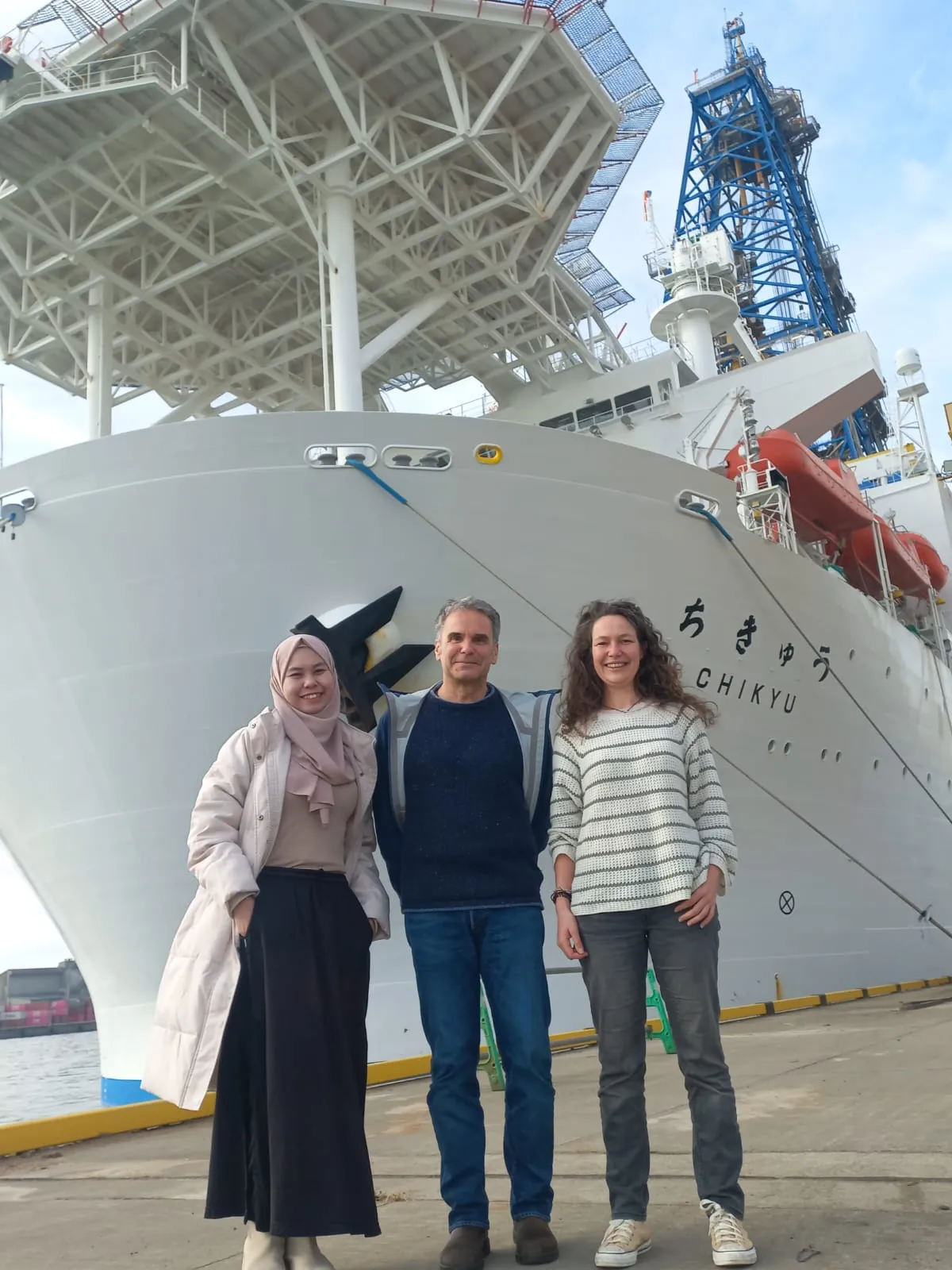
Dina Hanifah, Matthias Zabel and Pauline Cornard (right) from MARUM are team members of IODP³ Expedition 503, which will continue off the coast of Japan until mid-December. Photo: Hiroko Kitajima, Jamstec/IODP3