

- Home
- Our Research
- Underwater Technologies
- SPIRULA
SPIRULA (SPiraling Intelligent Robotic Underwater monitoring pLAtform)
Robust systems for long-term monitoring of the seafloor are of increasing importance for various marine science applications. The capability to survey an area of interest over long periods of time (weeks to months) enables the acquisition of data about mid- and long-term environmental changes and their effect on the local flora and fauna. Further usecases of such robust systems are for instance the monitoring of gas seeps, as well as the monitoring of dynamic seafloor processes over a long time-horizon. The development and application of systems with capabilities to do high precision seafloor mapping, while retaining a reduced footprint in terms of size and energy cost has the added potential to improve and increase the access to and availability of relevant seafloor data.
With SPIRULA we aim to develop such a robust long-term monitoring system with a reduced monetary and logistic foodprint. A key concept is the use of a hybrid monitoring platform comprising a static lander (approximately 2m x 2m x 1.5m) and a small tethered autonomous mobile underwater vehicle (approximately 1m x 0.4m x 0.6m and weighing 37kg in air). This hybrid structure enables the utilisation of the superior temporal monitoring capacity of static landers, along with the enhanced spatial monitoring of mobile platforms. Additionally, tethering the vehicle to the lander will provide added protection against system loss, enables energy and information transfer as well as shared computing capabilities.
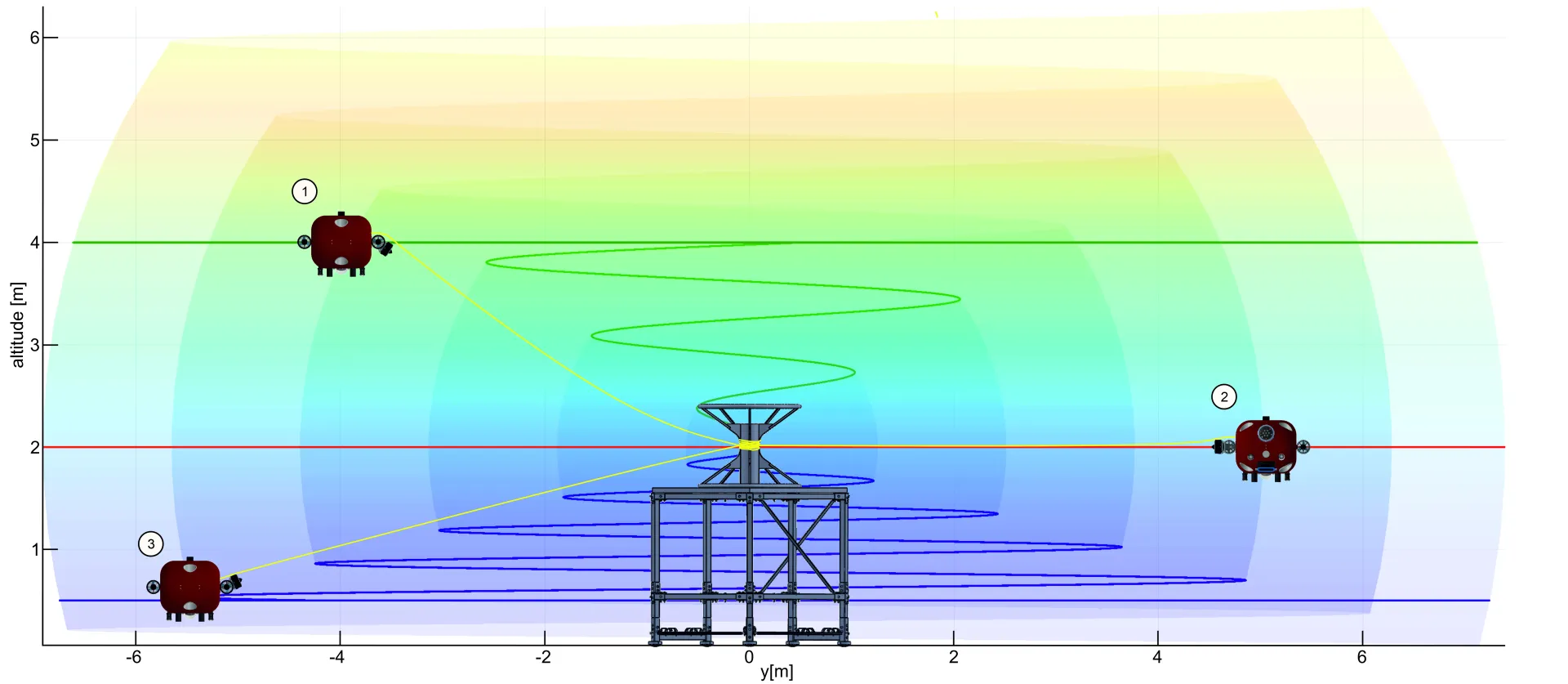
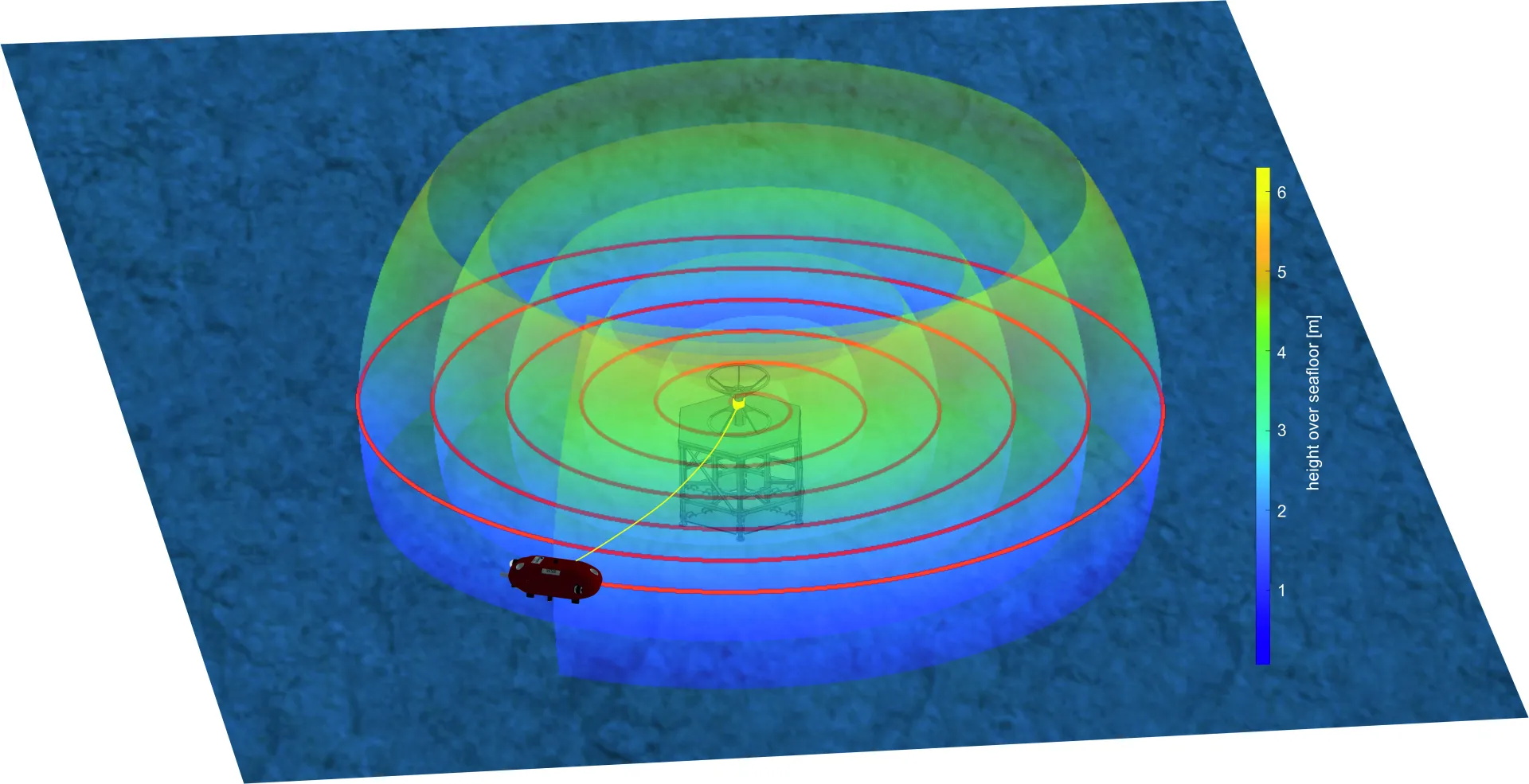
The tether will be wound up on a passive drum, which will constrain the vehicle to follow a circle involute path, as shown in the figure on the right, under the assumption of a taught tether. This has several advantages:
- The followed path can be analytically computed and used as an inexpensive navigation solution
- Tethering the vehicle reduces the risk of system loss
- Spiralling paths have been shown to be more efficient in covering a specific area for observation and sampling purposes
The vehicle is equipped with four battery packs, each providing 270 Wh, and a Nvidia Jetson Orin Nano, which provides guidance, navigation and control functionalities in ROS2. A STM32-based microcontroller board is used for interfacing with actuators and facilitates communication with the main computer via microROS. In its basic sensor configuration as shown in figure 2 d) the vehicle will employ a USBL for positioning and communication purposes and as a payload, two cameras, one forward- and and one downward-looking together with a lighting system. In addition, the vehicle will carry a CTD with a port for one additional environmental sensor, and a multi-beam sonar. However, the system is designed to be modular, allowing for the addition or replacement of payload components.
With regard to the lander, an early concept can be observed in figure 2 c). The lander is design to become a multipurpose platform that serves as a sensor and computation hub, vehicle garage, and mission control center.

Due to the capability of the SPIRULA vehicle to actively move in the vertical direction, various measurement scenarios are enabled. For instance, after deployment of the system to the seafloor a mapping of the seafloor at a safe distance from the seafloor can be carried out. This could be followed up by a baseline survey at the height of the lander, followed by high precission measurements and potential sampling close to or at the seafloor. The various concepts are visualized in figure 3.