


- Home
- Our Offers
- Media
- News
- Newsflashes
- Start OnO501
IODP³-NSF Expedition 501 – Successful offshore operations will launch onshore research at MARUM

The goal of the expedition was to not only sample the ocean floor by retrieving sediment cores, but also to sample the water stored in sediment, both sandy aquifers and clayey aquitards beneath the ocean floor. Their existence has been known for decades but they remained virtually unexplored – until now.
The expedition is a joint collaboration between the International Ocean Drilling Programme (IODP³) and the US National Science Foundation (NSF). For the first time scientists managed to take water and sediment samples from beneath the ocean on the New England Shelf with the intention of understanding this offshore aquifer system.
During the offshore part of the expedition, the science team rotated on and off the Liftboat Robert transported by helicopter or supply vessel. Now they just get on a tram or bus to the laboratories at Bremen University. Together they will split, sample, and analyze the sediment cores and water samples collected. The cores will be archived at Bremen and made accessible for further scientific research for the international scientific community after a one year-moratorium period. All expedition data will be open access in the IODP³ MSP data portal in PANGAEA, and resulting outcomes will be published.
More Information:
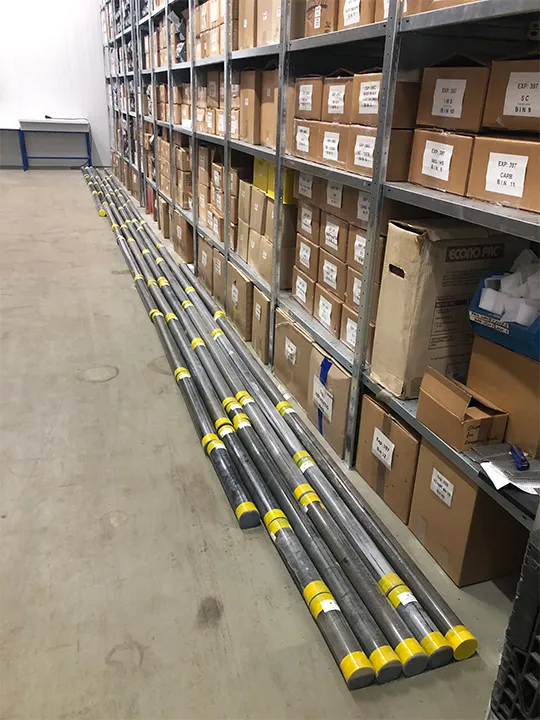
Some of the 718 drill cores are already ready and waiting in the Bremen Core Repository. Photo: MARUM – Center for Marine Environmental Sciences, University of Bremen; U. Röhl