
- Home
- Our Offers
- Media
- Archive News
- News 2025
- Women's Day 2025
International Women's Day at MARUM: Visibility, equality and progress

Women at MARUM: A look behind the scenes
Additionally, International Women’s Day is an opportunity to raise awareness for gender parity. As a research institute and workplace, we wanted take a look at the gender distribution of MARUM staff and how it has evolved over the last nine years (2015-2024).
The staff at MARUM can be divided into five groups:
- Scientific staff (doctoral students, temporary postdocs, permanent researchers)
- Technical staff
- Administrative staff
Professors are employed in the twelve faculties of the University of Bremen and are not included in this analysis.
More information:
- The team of women's representatives at MARUM
- Support for early career researchers.
- Support for families
- Support for equal opportunities and diversity
Contact:
The Women's Representative Collective at MARUM:
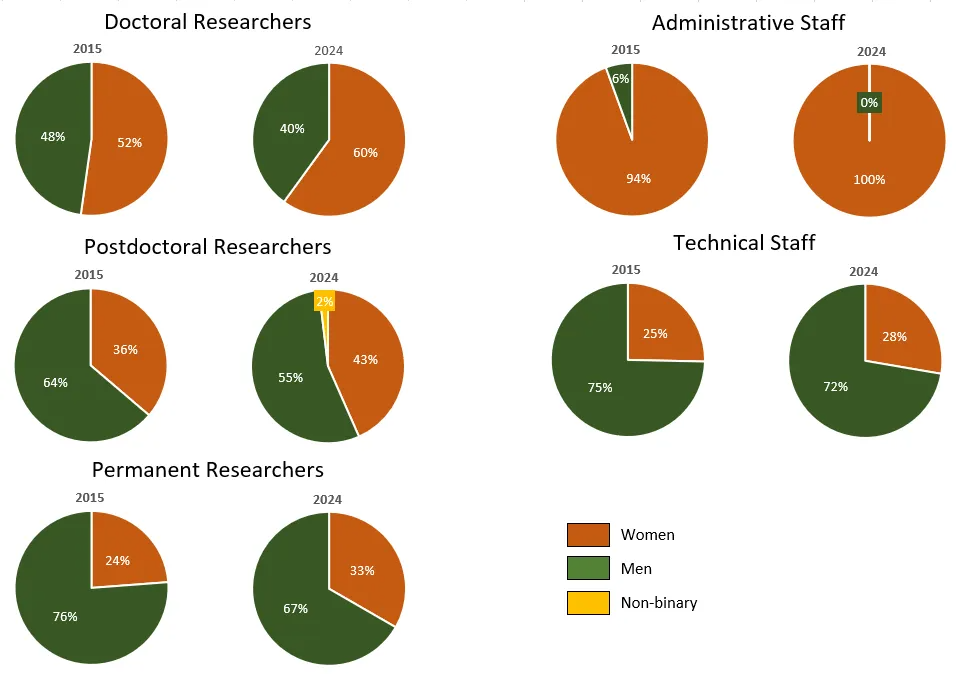
Insight into the gender distribution across all status groups at MARUM. Graphic: Alice Lefebvre
Gender distribution at MARUM: progress and challenges
There are currently only women working as administrative staff at MARUM (there was one man in 2015). For the technical staff, there are around three quarters men and only one quarter women, with a slight increase in the proportion of women over the last nine years.
As a research institute, scientific staff are the largest category of our employees (60 per cent). The percentage of women has increased in all scientific staff categories between 2015 and 2024. A majority of our doctoral researchers are women. Although increasing since 2015, the proportion of women (non-permanent) postdoctoral researchers in 2024 was still lower than the proportion of men (43 per cent vs. 55 per cent). And despite the proportion increasing over the last three years, women still only represent one third of all permanent scientific staff at MARUM. The so-called “leaky pipeline”, when a disproportionate number of women (compared to men) drop out when advancing to higher career levels in academia, is still evident.
Our commitment to greater gender equality
Although we’ve made progress over the last nine years, we at MARUM continue to address the loss of women and gender minorities along the pathway of academic careers, while also promoting gender balance in traditionally gendered roles, such as technical and administrative positions. A recent step toward greater parity and inclusion at the University of Bremen is allowing employees to self-identify their gender rather than taking the one listed on official documents, which may not reflect a non-binary identity or may still correspond to the gender assigned at birth.
Measures for more equality at MARUM
Thanks to the concerted action of gender equality actors at MARUM (women’s representatives and ECR support), a variety of actions are in place. For example:
- information and counselling on available assistance measures related to family support,
- organization of a "women@MARUM" network meeting to offer the opportunity for all MARUM female and non-binary employees to meet and exchange about specific gender-related topics, such as “Inappropriate behaviour and sexual aggressions at sea and during fieldwork”, “Gender is a spectrum” or “Everyday sexism”,
- involvement in hiring procedures to ensure a transparent and fair process, without gender discrimination,
- organization of gender-related events, such as a screening of the film “Picture a Scientist” or a lecture on “the Role of Gendered Wording in Job Advertisements”.
Our goal: an inclusive and fair working environment
International Women's Day reminds us that we have already made progress - but also that there is still a lot to do. At MARUM, we are committed to creating an environment in which all genders have equal opportunities. Because only with diversity and equal opportunities can science develop its full potential.
At MARUM, a collective takes care of gender equality. Even though the Bremen Higher Education Act calls them women's representatives, they are there to advise and address the equality concerns of all researchers and students.
The women's representative collective includes Rebecca Jackson, Maria Toyos Simón and Alice Lefebvre. They were elected for three years in January 2025 and provide advice and support with the aim of reducing existing gender-specific inequalities.
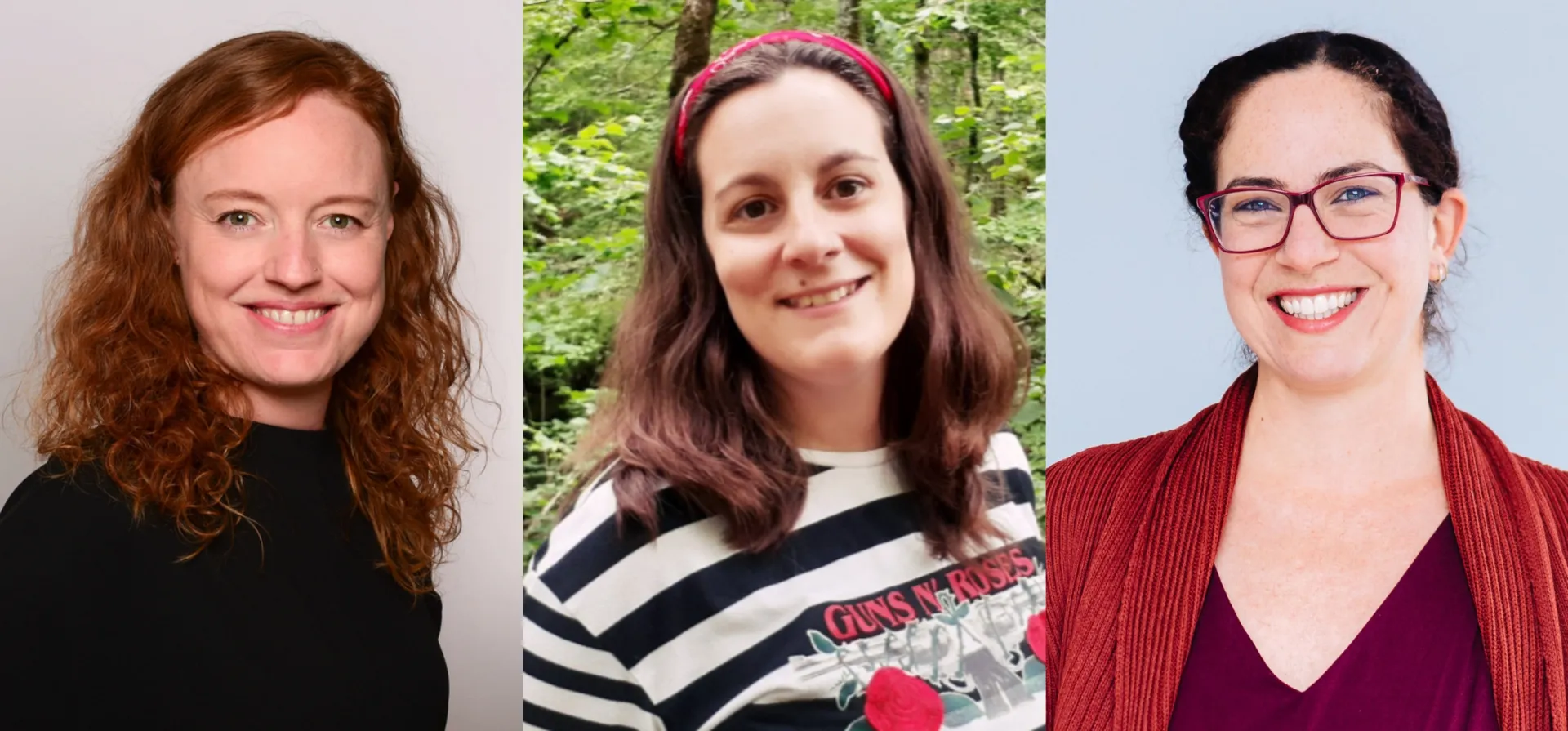
f.l.t.r. Rebecca Jackson, Maria Toyos Simón, Alice Lefebvre (Photo: Jonas Ginter, WFB Bremen)