
MARUM Research Academy
Report of Joely Maak
Organic Geochemistry Gordon Research Seminar (GRS) "Navigating the Modern Era of Organic Geochemistry" and Conference (GRC) "Contemporary Applications of Organic Geochemical Research" in Holderness, New Hampshire, USA from 27 July to 2 August 2024
I recently had the privilege of attending the Organic Geochemistry Gordon Research Seminar (GRS) and Conference (GRC) in Holderness, New Hampshire, from July 27 to August 2, 2024. These events are well-known for their intimate setting, which encourages deep discussions and offers fantastic networking opportunities. The GRS (held right before the GRC) provided a great platform for early-career researchers like myself to present our work and connect with peers in a more relaxed and supportive environment.
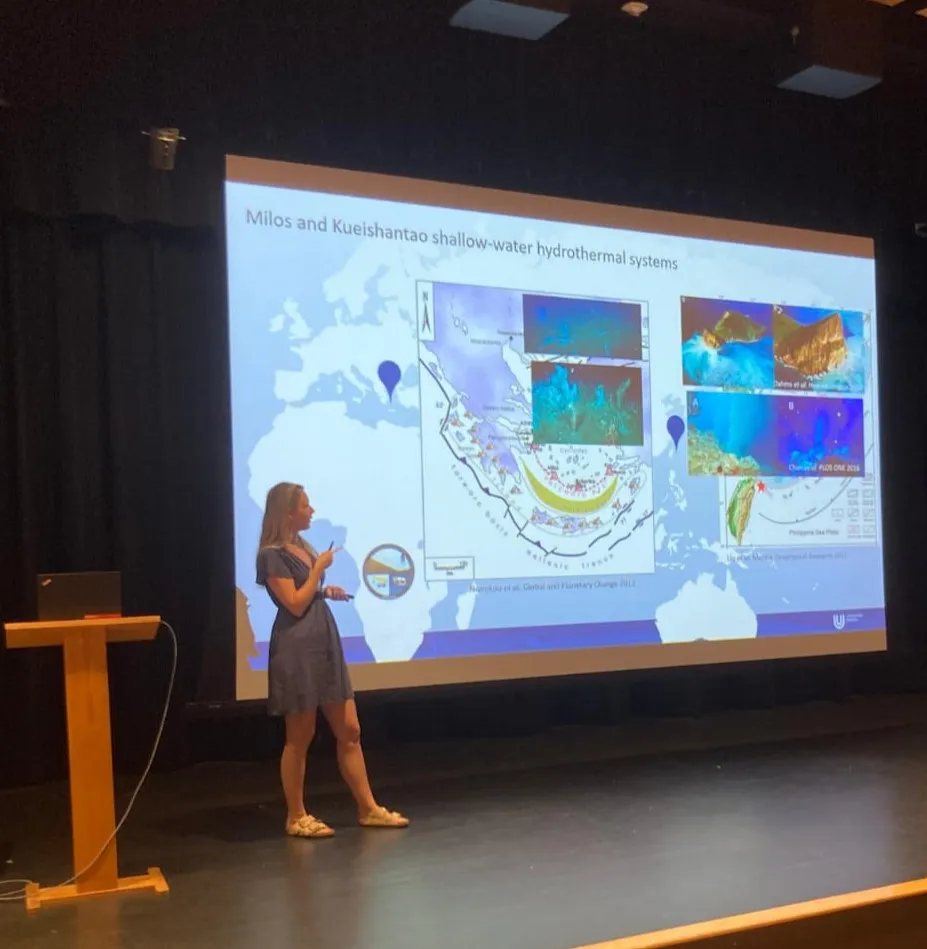
At the GRS, I presented an oral talk titled "Dynamics of Aged-Carbon Injections at Shallow-Water Hydrothermal Systems". This session focused on extreme environments and their astrobiological potential, which aligns closely with my research interests. Sharing my work here (compiled of results for three different manuscripts) allowed me to receive valuable feedback and engage in insightful discussions with other researchers exploring similar environments using different methods. The experience emphasized the importance of interdisciplinary approaches and gave me fresh perspectives on how to position my research within the broader field of geochemistry.
One session that stood out to me was the keynote by Magdalena Osburn, titled "Towards an Understanding of Subsurface Geomicrobiology Using Organic Geochemistry, -Omics, and Isotopes." Her talk was particularly relevant to my work, especially her focus on integrating various disciplines to better understand subsurface microbial ecosystems.
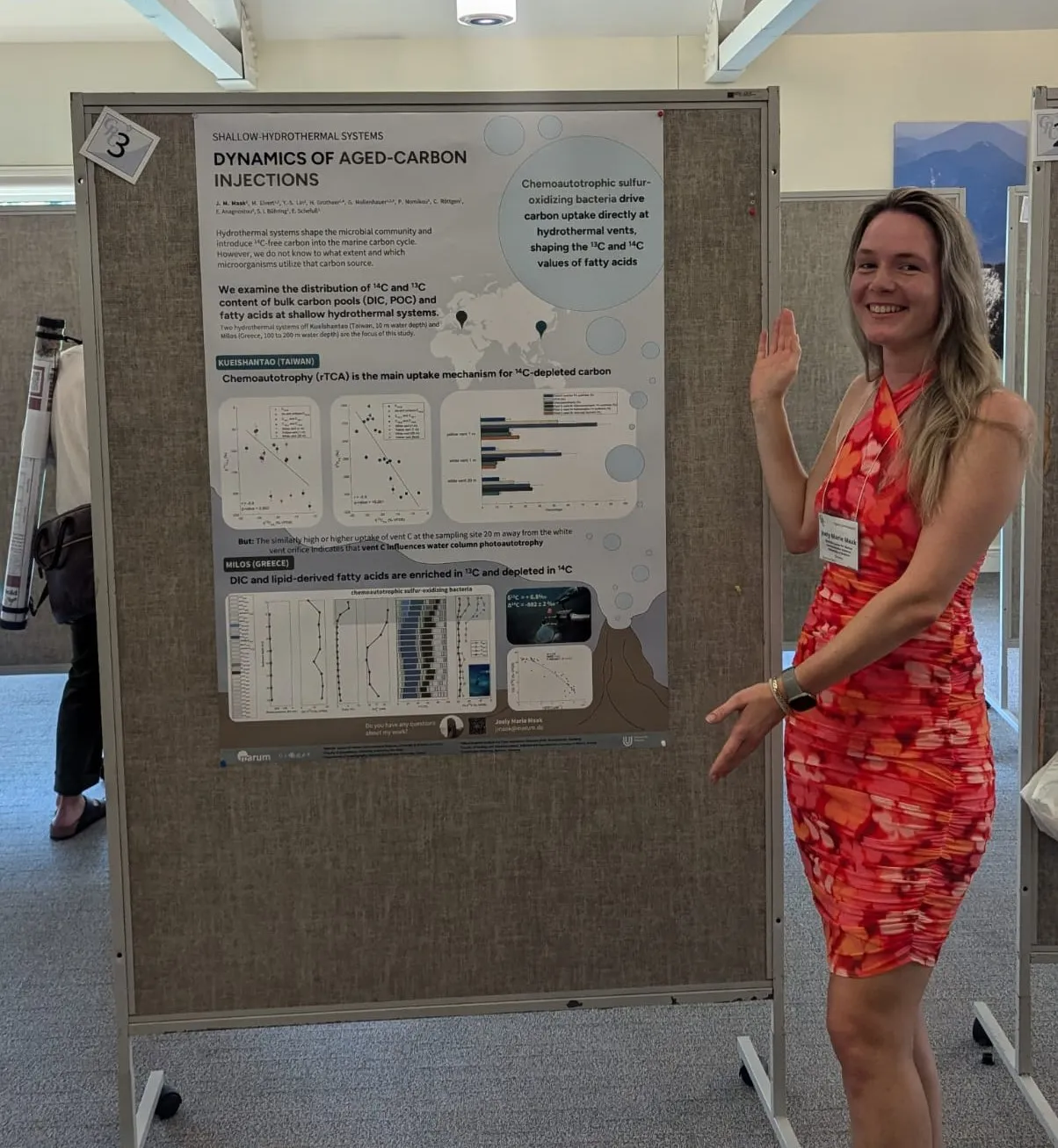
During the GRC, I presented a poster on the same topic as my GRS talk. Presenting in both formats was incredibly helpful—it allowed me to refine my ideas and get input from both early-career researchers and established scientists. This feedback will be crucial as I move forward with my research.
Among the many sessions at the GRC, I was especially drawn to those on carbon consumption and extremophilic microorganisms. The session on " Temporal and Spatial Dimensions of Organic Matter Cycling," led by Thomas Bianchi, was particularly inspiring. Talks by Shane Stoner on organic matter decomposition as a continuum and Brenna Boehman on the selective degradation of terrestrial carbon were directly relevant to my research on carbon dynamics.
Another highlight was the session on "Organic Matter in the Solar System," which provided a broader perspective on the role of organic geochemistry in planetary science. The discussions on biosignature detection and organic compound analysis on icy moons added an exciting new dimension to my understanding of the field and its far-reaching implications.
Overall, attending the GRS and GRC was a significant experience for me. Beyond the scientific knowledge I gained, the conference structure— with plenty of time for informal discussions and activities—allowed me to (re-)connect with other researchers, some of whom I had only known through their publications. These conversations have enriched my approach to research and sparked new ideas for future collaborations.
I am incredibly grateful to GLOMAR and the Deutsche Forschungsgemeinschaft (DFG) for their financial support, which made my participation in this conference possible. The insights and connections I gained during the GRS and GRC will be invaluable as I continue my PhD research and beyond.