


MARUM Research Academy
Report of Luis Greiffenhagen
The 2nd International Conference on Seafloor Landforms, Processes and Evolution (ICSLPE) in Lipari, Italy from 1 to 3 July 2024
In the heart of the Aeolian Archipelago (Mediterranean Sea) lies the island of Lipari, in an area of high volcanic activity. At the beginning of July, the International Conference on Seafloor Landforms, Processes and Evolution (ICSLPE) was held there, where I was lucky enough to give an oral presentation on my PhD research, the Carbon Budget of Cold-water Coral Mounds. Coral mounds are large seabed features that have been completely structured by corals and are rich in carbon.
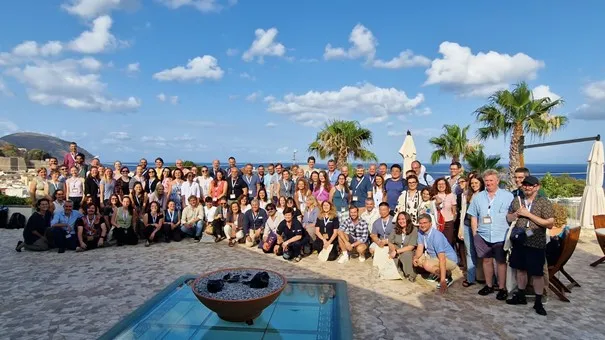
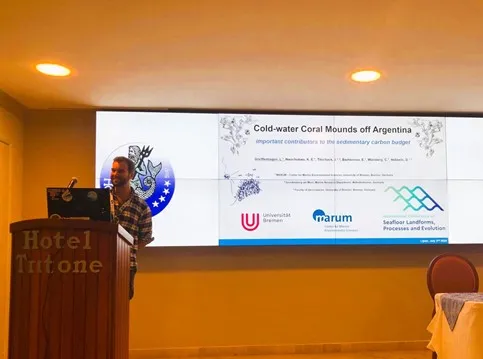
Organised by the Universities of Milano-Bicocca, Kiel, Malta, MBARI, and the Submarine Geomorphology Working Group of the International Association of Geomorphologists (IAG), the 2nd ICSLPE conference was the stage for 80 oral presentations and about 30 poster on a variety of interdisciplinary topics – all with the common aim of better understanding seafloor dynamics and morphologies across our oceans. The conference did not have any parallel sessions, which I found very convenient as it allowed me to attend every talk / session. These included a coast-to-shelf session, sessions on oceanography, slope failure, canyons and channels, fluids and tectonics, as well as a methods, biogenic, and volcanic session. Coming from a rather non-geological background, I learnt a lot as you can already imagine.
As part of the “biogenic” session, I presented some of my ongoing work on the carbon budget of Cold-water coral mounds in Argentina. Following a keynote on the seascapes of South America, I contributed to an underrepresented study area.
An important part of my work is the mapping of coral mounds as elevations on the seafloor. Together with my supervisor Prof. Dierk Hebbeln, I had fruitful discussions with other international scientists that specify on the mapping of elevated seabed features, such as coral mounds. It was very exciting to exchange ideas with the developers of a toolkit that allows the rapid detection of coral mounds from seabed data – based on these discussions I may be able to establish a future collaboration by integrating their tool with my data and analyses, and possibly even a do short research stay. It was such a cool feeling to finally come together with these researchers in person, whose names I have known and cited for years. Additionally, it was also interesting to hear where other marine scientists had recently found coral mounds or suspect their occurrences around the world.
Many talks from the methodology session were inspirational for my future work. Some of the most remarkable studies involved mysterious structures on the seabed of unknown origin, which reminded me that the seafloor is probably the place on Earth with the most features yet to be discovered and studied. Obviously, this was very motivating.
During coffee-breaks, a delicious Italian food-decorated ice breaker party, and poster sessions, I could also extend my network with other early-career scientists and share our experiences in the academic world, which is always helpful.
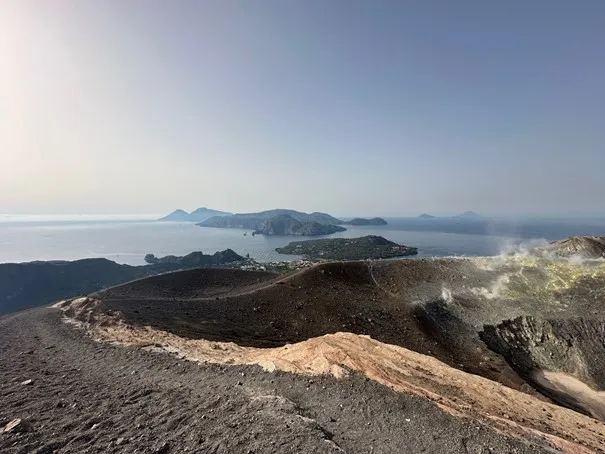
While the conference sessions themselves were amazing, my experience around the talks was also incredibly great, with nice social events in the evenings and a field trip to Vulcano: From a geological point of view, Lipari and the Aeolian Islands are already worth a visit – I got the chance to climb Vulcano’s Fossa Crater (see picture). This volcano, together with Stromboli (ca. 25 km to the north), plays a substantial role in Roman mythology and overall vulcanology - and can only be climbed during periods of low fumarole activity. Later during our visit, both Stromboli and Etna over in Sicily erupted, making the stay even more exciting.
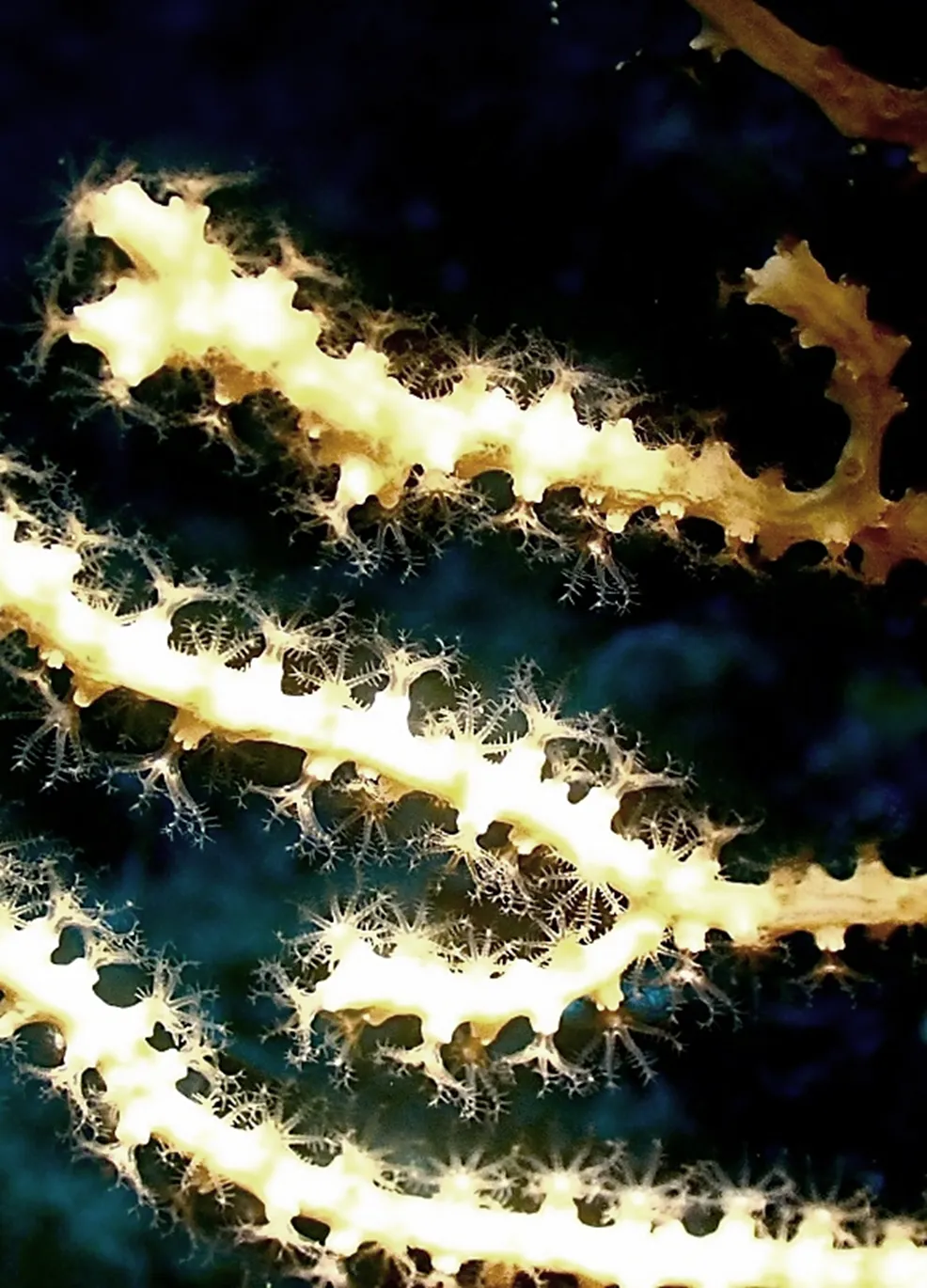
As a passionate coral scientist, having spoken about corals all week at the conference, I was grateful to be able to explore and document some corals off Lipari in “real-life” when scuba diving on the weekend after the conference (see picture).
Last but not least, I would like to thank GLOMAR and everyone involved for making this trip possible in the first place, which has certainly been an invaluable experience for me and vital to the progress of my PhD work.