

MARUM Research Academy
Joely Maak
Goldschmidt Conference in Prague, Czech Republic from 6 - 11 July 2025
From 6 to 11 July 2025, I had the opportunity to attend the Goldschmidt Conference in Prague—one of the most prominent international conferences in geochemistry. Ahead of the main conference, I participated in a workshop on July 5th titled "Microscale Transport Phenomena in the Origin of Life: From Hydrothermal Vents to Exobiology", which provided a fascinating introduction to current theories and experimental approaches linking geochemistry at hydrothermal systems to the origin of life.
During the conference, I presented an oral talk in the session 09j-O1 – From Geosphere to Biosphere: Hydrothermal Transitions and Energy Supplies for Chemoautotrophy from Shallow Shores to Dark Depths on Friday afternoon. My talk, "Sulfur as the link between geochemistry, mineralogy, and microbial life in submarine hydrothermal systems", showcased integrated results from mineralogical, isotopic, and lipid biomarker analyses. The audience included many researchers working on hydrothermal systems across different depth regimes, and the feedback I received was highly constructive for the final phase of my PhD.
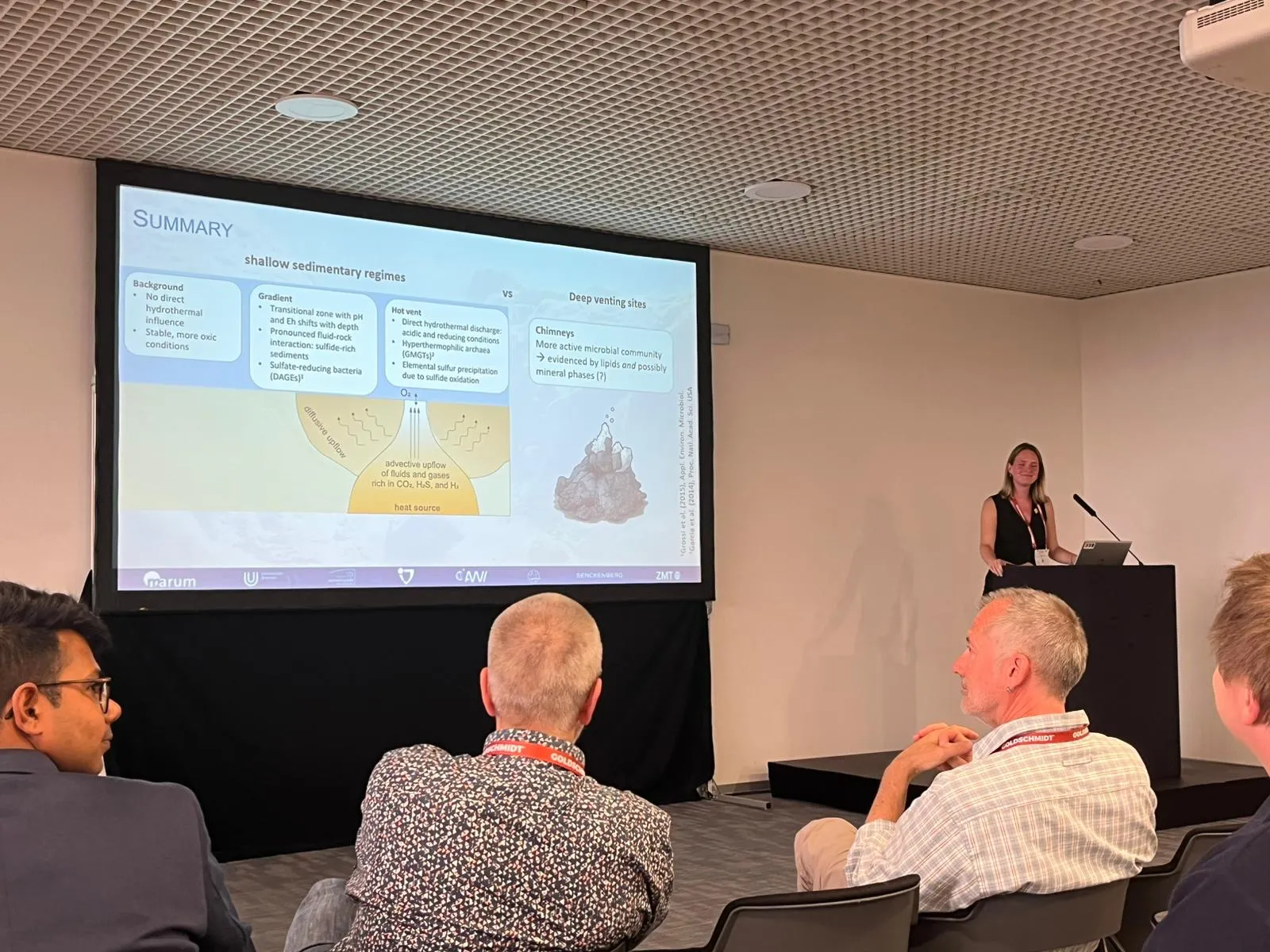
Presentation of results from a newly discovered vent field off Milos, Greece at Goldschmidt
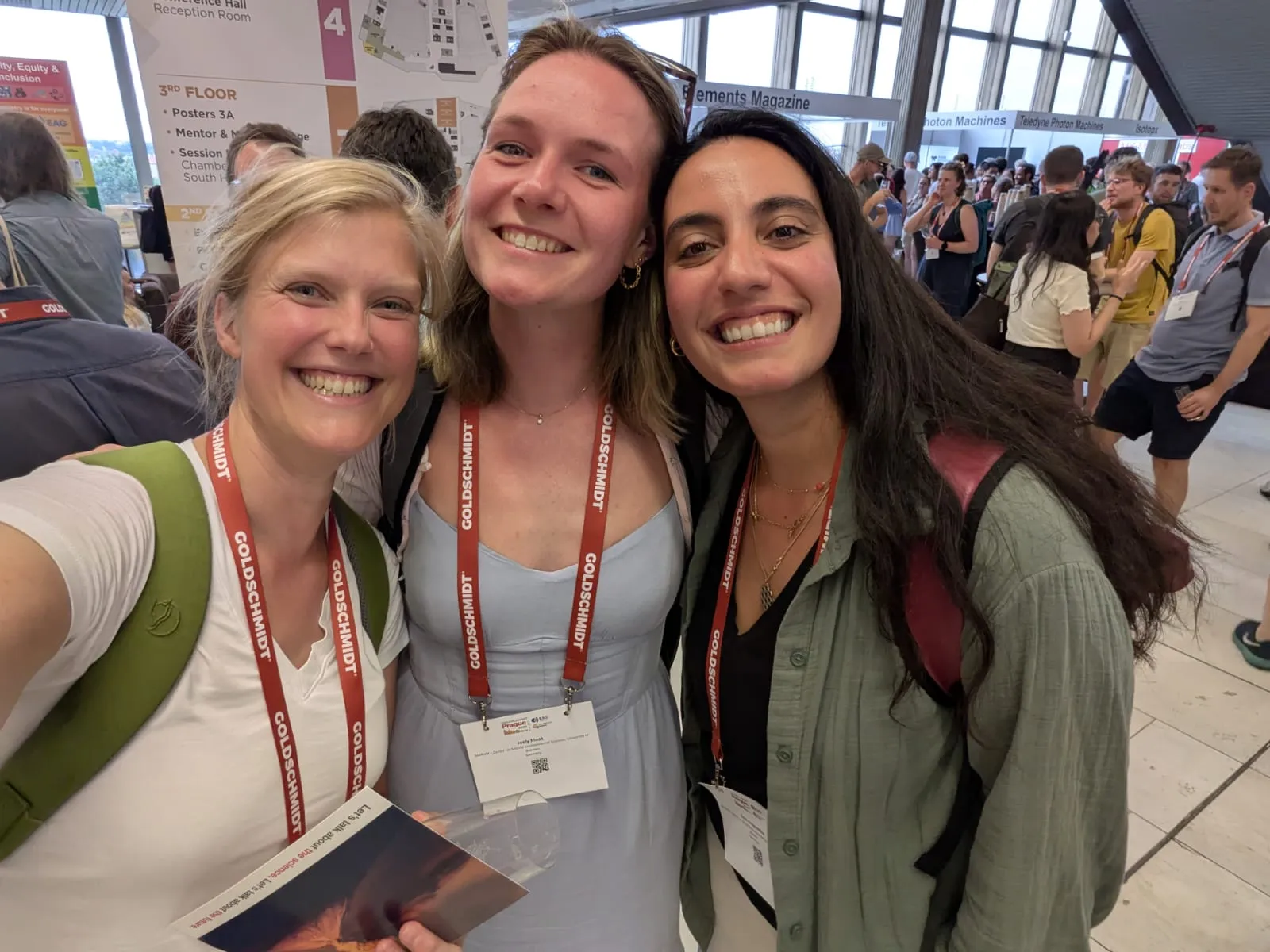
At the Goldschmidt conference with Prof. Desiree Roerding (left) and fellow PhD of MARUM Eirini Anagnostou (right)
In addition to my own presentation, I contributed to two other talks:
- "Lipid biomarkers and their stable carbon isotopes in hydrothermal sediments as life markers of chemoautotrophy under extreme conditions" (presented by one of my supervisors Dr. Marcus Elvert in the same session),
- and "Arsenic-sulfide mineralization as a key mechanism for biomass preservation in seafloor massive sulfide hydrothermal diffuser chimneys" (presented by Evangelia Dimou, a Greek collaborator, in the session 12g-O2 – Fluid–rock–life interactions in the oceanic lithosphere and their impacts on the modern and ancient Earth).
The conference was well-organized, with clearly structured poster sessions and a stimulating scientific program. One of the most engaging sessions for me was 06i-O3 – Technological innovations and methodological advances in isotope geochemistry and isotope ratio mass spectrometry, which highlighted exciting developments directly relevant to my work. A particular highlight was the keynote by Prof. Magdalena Osburn, "Living in the subsurface: local adaptations that define a global biome", which provided new insights into microbial life strategies beneath the Earth's surface.
Beyond the formal program, Goldschmidt offered a great setting to reconnect with colleagues I had met on previous field campaigns, such as Prof. Desiree Roerdink (University of Bergen) and Dr. Judith Klatt (Microcosm Earth Center, Marburg), and to meet new scientists in my field or in other fields. This conference, with roughly 4000 participants, is by far the biggest conference I have attended and holds a lot of potential to connect to researchers abroad many different fields.
I am sincerely grateful to the MARUM Research Academy and the Deutsche Forschungsgemeinschaft (DFG) for their financial support, which enabled me to attend this conference. The input I received, the new connections I made, and the overall experience have been incredibly valuable for the development of my PhD and future research directions.

Presentation of Evangelia Dimou, a Greek collaborator working with Prof. Stephanos Kilias at the National & Kapodistrian University of Athens