

- Startseite
- ...
- MARUM Research Academy
- Offers for Doctoral Researchers
- Graduate Programme
- Travel Reports
- Conference Reports 2025
- Jule Melina Sophie Krohn
MARUM Research Academy
Jule Melina Sophie Krohn
Goldschmidt Conference in Prague, Czech Republic from 6 - 11 July 2025
A total of 4.380 litres of coffee and 113 scientific session inspired geochemists from across the globe to make a pilgrimage to Prague, the historic capital of the Czech Republic. This mass movement was catalysed by this year’s Goldschmidt Conference, named after the founder of modern geochemistry, Victor Moritz Goldschmidt. Organized annually by the geochemical society and the European Association of Geochemistry, the conference provides a platform for international exchange and discussions about all geochemical topics, and acts as a reaction chamber for new ideas and future collaborations.
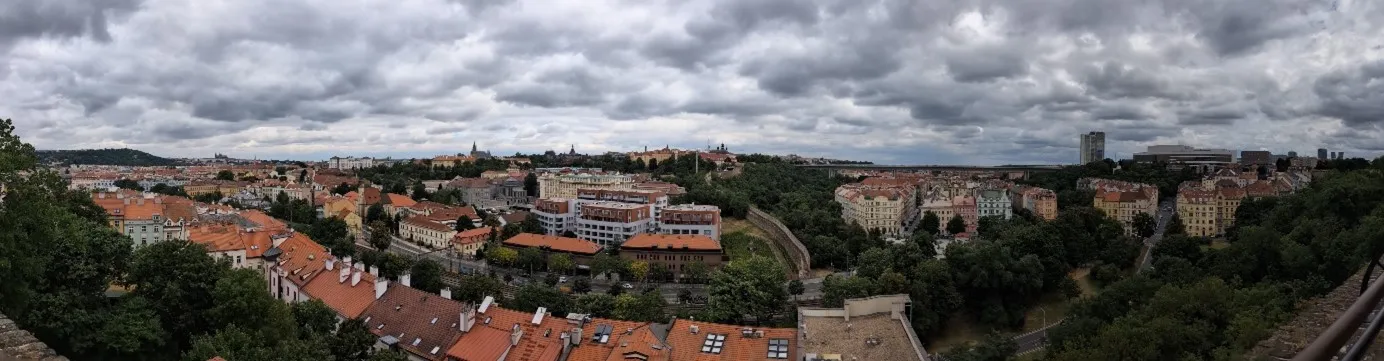
The view over Prague from the The view over Prague from the Vyšehrad fortress.
This year I had the great privilege of being one of the over 4.000 attendees who transformed the medieval streets into hotspots for debate about isotopes, elements and microbes. At first, it was overwhelming – just like in hydrothermal vents, so much was going on at the same time! This was my first experience of a large, international conference and I needed time to work out how to navigate it. But the (fortunately air-conditioned) conference centre is located close to the Vyšehrad fortress, that invites for a relaxing stroll with breathtaking views of Prague during the lunch breaks.
My contribution to the conference was a poster on the preliminary results of my doctoral project. The two hours of my poster session flew by faster than ions in a mass spectrometer. This led to inspiring discussions with other researchers, the development of new ideas and potential future collaborations. It also gave me the opportunity to connect with some of the shipboards scientist that were part of the expeditions during which the samples of my project were taken, opening up the possibility of valuable exchange. I also got the chance to meet a few people that I had only talked to in zoom meetings or that I only knew from their publications.
One thing that sets Goldschmidt apart from other conferences is the mentor program. Early career researchers like myself are paired with more experienced researchers who act as mentors, providing invaluable advice on research projects and career development. My mentor helped me reflect on how to structure my poster and manoeuvre the challenges of being a doctoral candidate. It was very helpful to get an outside perspective during a one-on-one conversation.
As this conference hosted a broad spectrum of research interest, it acted as a petri dish for interdisciplinary growth, giving me the opportunity to explore other areas of geochemistry. I was especially intrigued by sessions on microbially mediated biomineralization, and on the complex interactions between minerals and organics. The plethora of presentations about the chemical reactions going on above, within and underneath glacial ice opened my eyes to a research area I had previously only caught a glimpse of. Listening to talks that used methods I had not heard of before and combined different methods I did not realise were possible, really broadened my horizons.
Another highlight were the daily plenary talks, each showcasing cutting-edge topics from across the geochemical spectrum. Particularly the talk given by Tanja Bosak, titled 'Sampling Martian Carbonates by the Perseverance Rover', was interesting to me. It explored the challenges and prospects of investigating a planet from hundreds of millions of kilometres away. I also found the awards given to extraordinary scientists before the talks intriguing. Hearing the stories of these skilful scientist and learning about their accomplishments was both motivating and humbling.
Overall, the Goldschmidt conference was a great experience for me as a first-year doctoral candidate. I absorbed a wealth of new knowledge, developed a multitude of new ideas and met talented researchers from all over the world. Being among people who are excited by elemental pins and iron oxyhydroxides (i.e. rust) reminds you that you are among your people. The lively discussions and the passion with which the researchers talked about their projects renewed my sense of why I do what I do. I would like to take this opportunity to express my gratitude to the Deutsche Forschungsgemeinschaft (DFG) for funding my project and to the MARUM research academy (previously GLOMAR) for enabling me to participate in this conference.
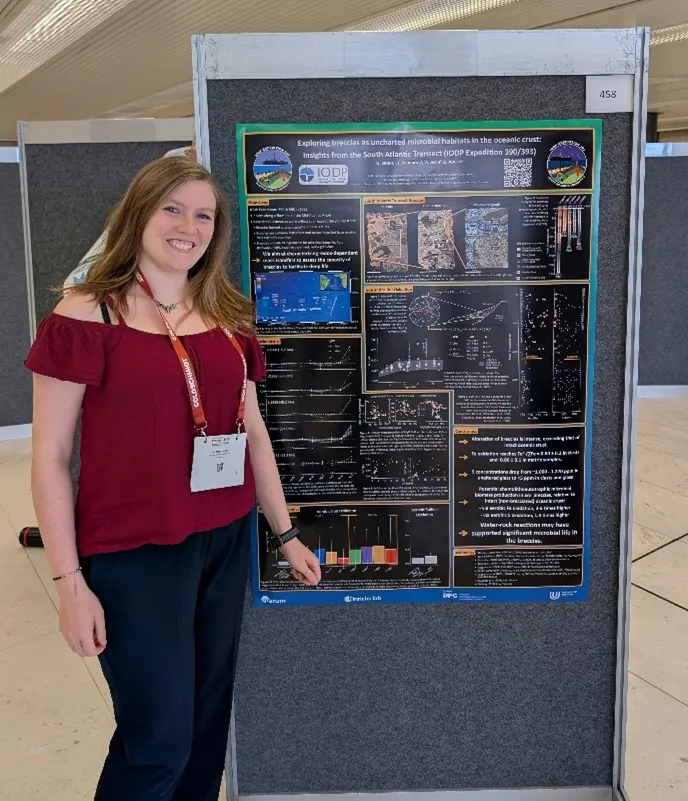
Me in front of my poster showing preliminary results of my project. I presented it in the session ‘Fluid–rock–life interactions in the oceanic lithosphere and their impacts on the modern and ancient Earth’.
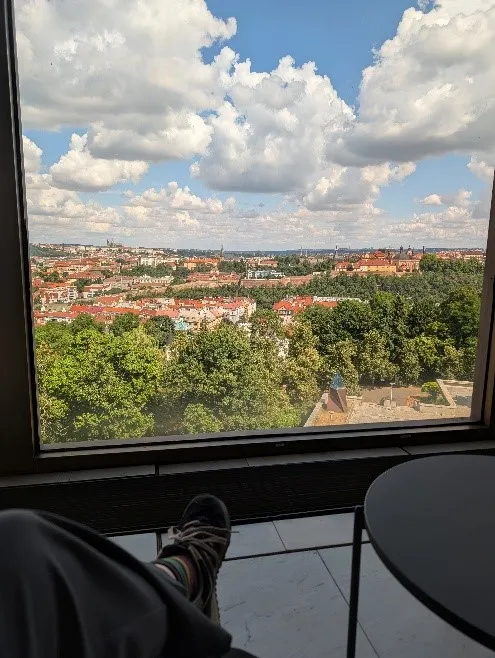
The view over Prague from the Prague congress centre, the venue of the conference.