


MARUM Research Academy
Runa Reuter
Report of GLOMAR member Runa Reuter about her research placement at NIOZ - Royal Netherlands Institute for Sea Research, Texel, Netherlands, in the Department of Ocean Systems from 1 November 2024 to 20 December 2024
Increasing dust deposition in the ocean due to desertification has been suggested as a mechanism that could counteract the negative effects of ocean warming on primary productivity and carbon export by stimulating and fertilizing primary productivity and increasing the sinking speed of particulate organic material, especially in lower latitudes. To better understand the relationship between dust deposition, phytoplankton response (e.g., changes in community composition) and particle/downward carbon export I conducted a research stay at the Royal Netherlands Institute for Sea Research, NIOZ, in the Department of Ocean Systems from 01 November to 20 December 2024
At NIOZ, I processed atmospheric dust samples collected by an Anderson high-volume dust collector as well as drifting trap samples from a depth of 100, 200 and 400 m in the water column. In the lab I learned how to extract the lithogenic fraction of these samples and determined their grainsize distribution as well as the total lithogenic mass flux at each sampling site. In total I worked on samples from four different research cruises, covering a transect from Africa to the Caribbean. These data will be compared to the type and number of exported (organic) particles, which were collected at each trap depth with a viscous gel, and in case of availability with biogeochemical measurements.
Beside extending my scientific method repertoire in the lab, I also had the chance to join a sedimentological excursion with students from the Vrije Universiteit Amsterdam, which allowed me a valuable insight into teaching activities.
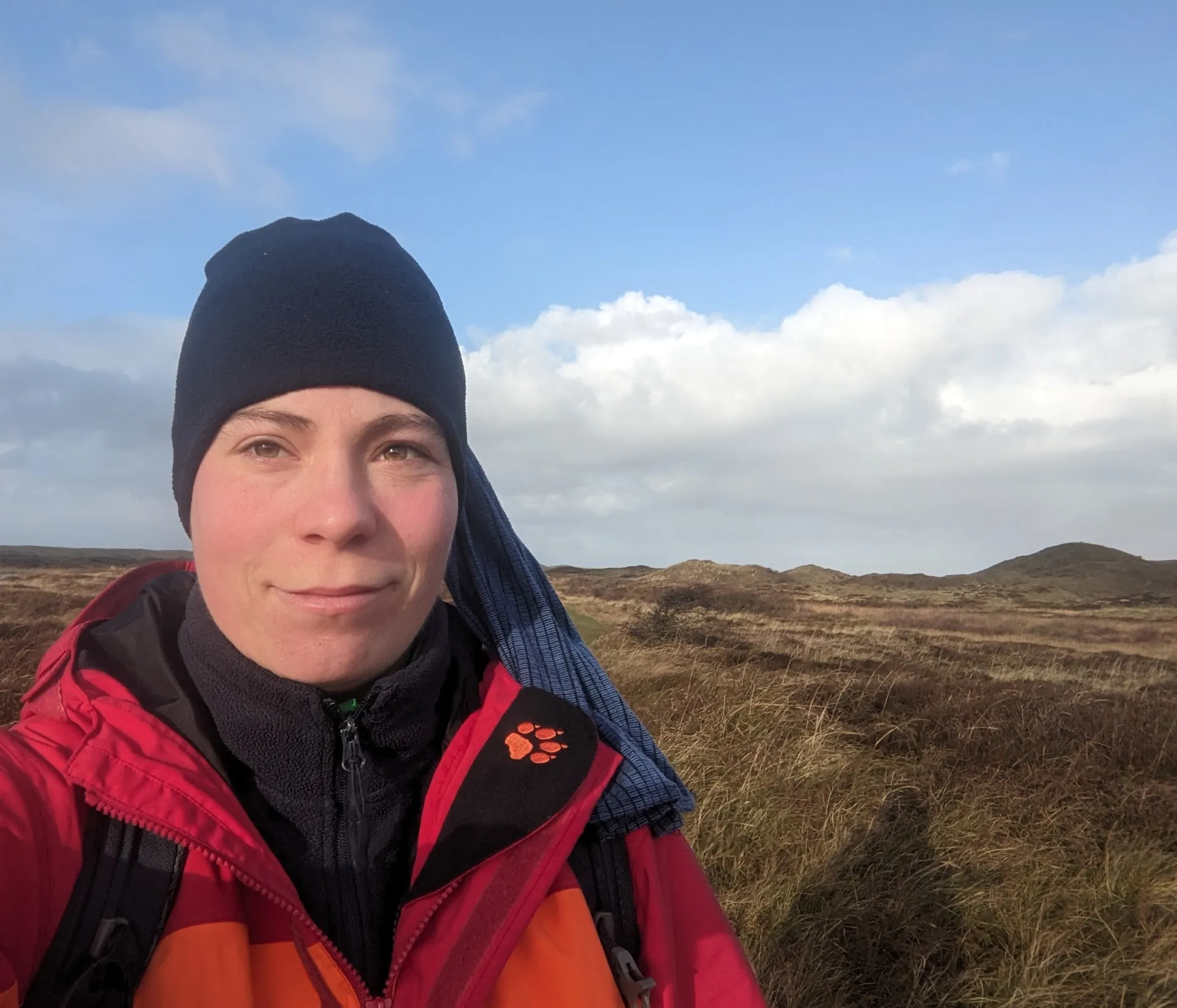
Runa on a sedimentological excursion
I am grateful for this international research experience during my PhD project. The research placement at NIOZ significantly enhanced my independence, flexibility and research network. I would like to thank Jan-Berend Stuut for welcoming me at NIOZ and sharing his passion about dust with me, the SeaPump Group at MARUM for their support before and during this adventure and GLOMAR for the financial contribution to my research stay.