

- Home
- Our Infrastructure
- Marine Robotics
- ROV MARUM-SQUID
- Operational requirements
Operational requirements
Logistics
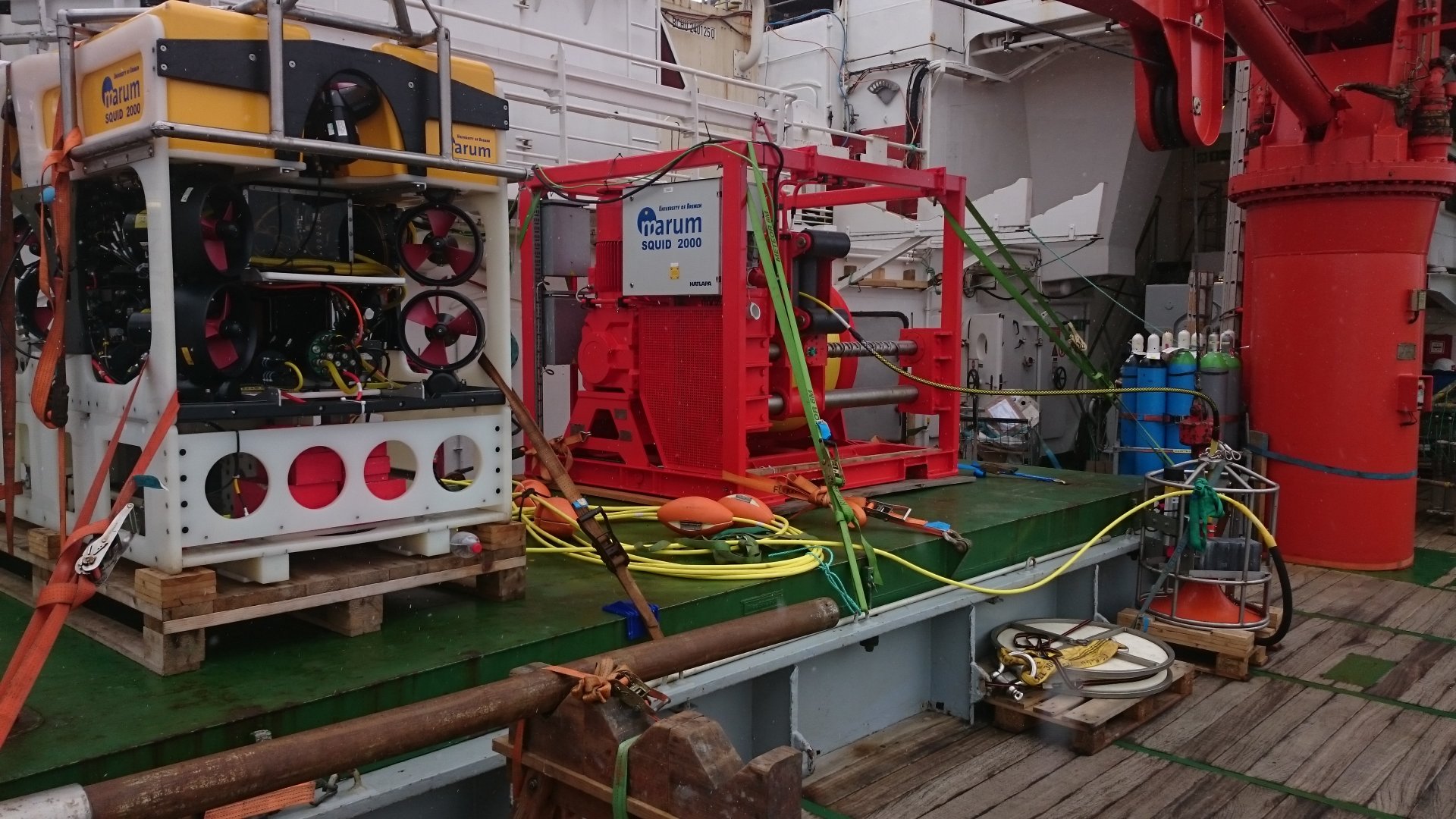
The entire system is shipped in a single 20" ISO open-top with hard-top container. To load and unload the container on the pier, a 5t forklift is required. If the ship has no crane to move the winch from the pier on deck, a suitable crane in the port needs to be organized.
Mobilisation
Mobilisation requires two to three days. On the first day, ROV and winch are placed and lashed on deck. Further, the control stands and the transformer are installed in the ship´s laboratory. On the second and third day, the remaining connections and installations are made. This can be done whilst sailing so only one day in port is necessary.
In case no USBL system is available onboard the vessel, the portable IXBLUE USBL System GAPS, that is part of the ROV system, can be installed. The USBL antenna can be either mounted inside the vessel´s moonpool or to a pole on the side of the ship.
Footprint
Once installed on the vessel, the winch remains at its position. The ROV can be moved from its deployment position on the working deck to its parking position using a hand-forklift or a ship crane to make space for other scientific gear that needs to be deployed.
For the installation of the control stands and the transformer, a laboratory large enough and with direct access to the working deck is necessary. The laboratory must have enough space for two pilots and two scientists.
| Device | Footprint (m) | Weight (kg) | Position |
| ROV | 2.1 x 1.2 | 1500 | Deck |
| Winde | 2.1 x 1.9 | 4700 | Deck |
| Depressor | 0.8 x 0.8 | 120 | Deck |
| Block | 1 x 1 | 100 | Deck |
| Videocase | 0.7 x 0.4 x 0,9 | 110 | Control Lab |
| SCU Flightcase | 1.2 x 0.8 x 0.8 | 345 | Control Lab |
| Transformer | 0.8 x 0.6 | 500 | Control Lab |
| Mittelkonsole | 1 x 0.4 x 0.4 | 45 | Control Lab |
| Filterbox | 0.4 x 0.6 | 200 | Control Lab |
Interfacing
To operate the system, the following interfaces and electrical connections are required:
| Unit | Specification | Connection | |
| Transformer | 380-480VAC/50Hz | 3 x 4² to M12 ring terminals | 120A fuse protection |
| Winch | 400VAC/50Hz | CEE 5pin (3P+N+PE) | 63A fuse protection |
| Control stand in the Lab | 4 x 220VAC/50Hz | CEE 7/4 (grounding receptable) | 16A fuse protection (stable grid) |
| Control stand in the Lab | 10-1000MBit Ethernet | CAT5 / RJ45 | Connection to ship network |
| USBL System (Posidonia) | +5V/0V TTL | BNC | Connection to Posidonia deck unit |
Crew / Personnel
ROV-Squid requires a crew of 4 pilots/technicians. In addition, 2 cable helpers from the scientific team are needed on deck during deployment and recovery of the system.
During dive operation the pilot is controlling the ROV while the co-pilot is in charge of the navigation and is taking the samples with the manipulator. The third crew member is operating the winch from outside the control lab. The fourth crew member will provide technical support during operation.
The control lab has place for two scientists, that are in charge of the dive. The remaining scientists can join the dive in a different lab on the ship via live videostream and VoIP connection to the control lab.
On the vessel, it has proven to start with the pre-dive check of the system at 6am so it is ready for deployment at 8am. Recovery is around 4pm. As soon as the vehicle is on deck, the samples can are recovered and the ROV is being prepared for the next dive by the crew. The presented schedule is not mandatory, but can be adjusted to the situation of the ship and expedition.
Deployment/Recovery |
|
| ROV Crew | Science team |
|
Spotter |
2 x Cable helper |
| Pilot | |
| Co-Pilot | |
| Winch operator | |
Dive operation |
|
| ROV Crew | Science team |
| Pilot | Scientist in charge |
| Co-Pilot | Transcript writer |
| Winch operator | |
| Support |
Operational mode
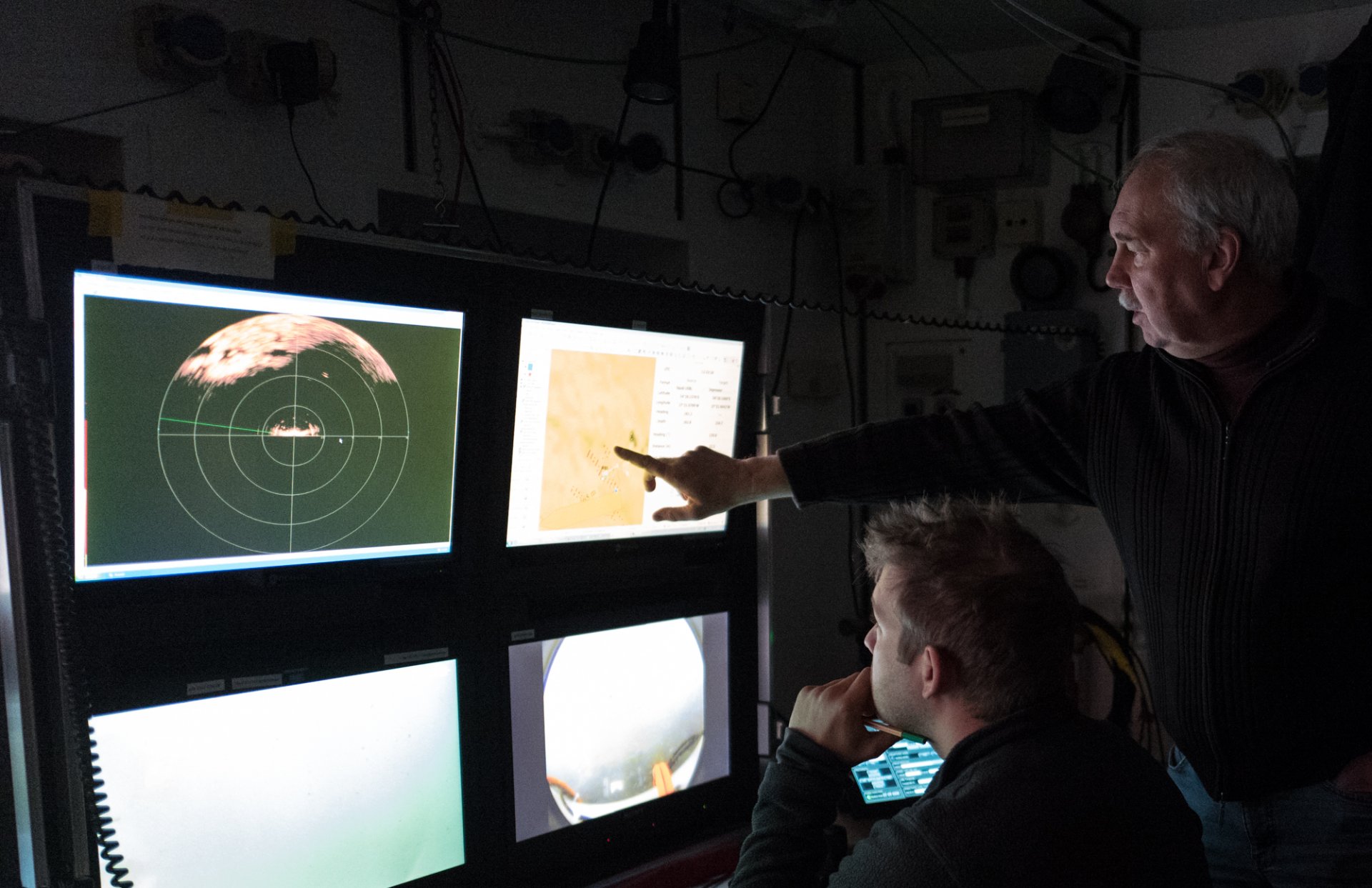
During dive Operation, the pilot is flying the ROV while the co-pilot is in charge of the navigation and is taking the samples with the manipulator. The third crew member is operating the winch from outside the control lab. The fourth crew member will provide technical support during operation.
The control lab has place for two scientists, that are in charge of the scientific program during the dive. The remaining scientists can join the dive in a different lab on the ship via live videostream and VoIP connection to the control lab.
On the vessel, it has proven to start with the pre-dive check of the system at 6am so it is ready for deployment at 8am. around 4pm. As soon as the vehicle is on deck, the samples can are recovered and the ROV is being prepared for the next dive by the crew. Depending on the water depth, this results in a bottom time between 5-7 hours. The presented schedule is not mandatory, but can be adjusted to the situation on the ship and expedition.
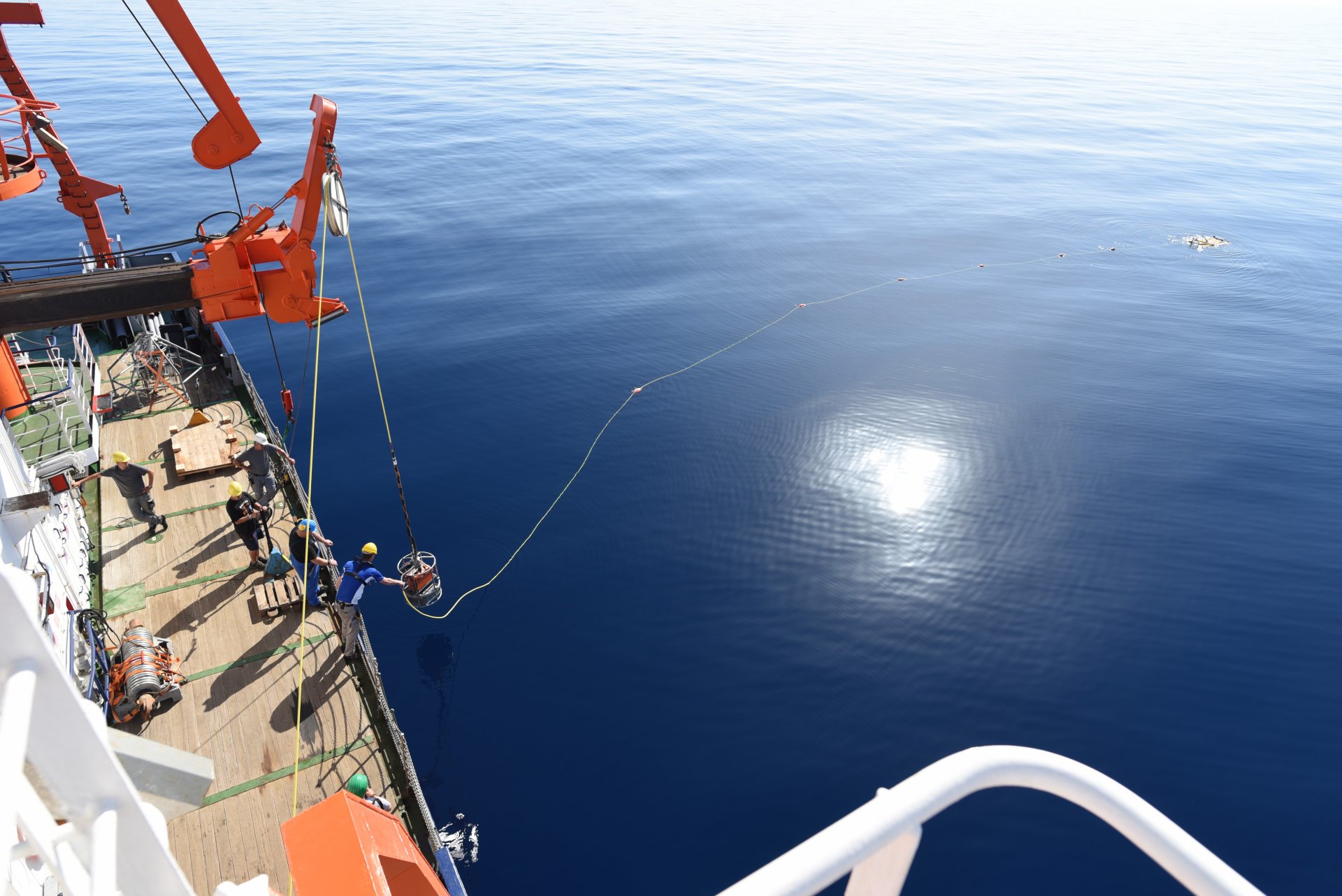
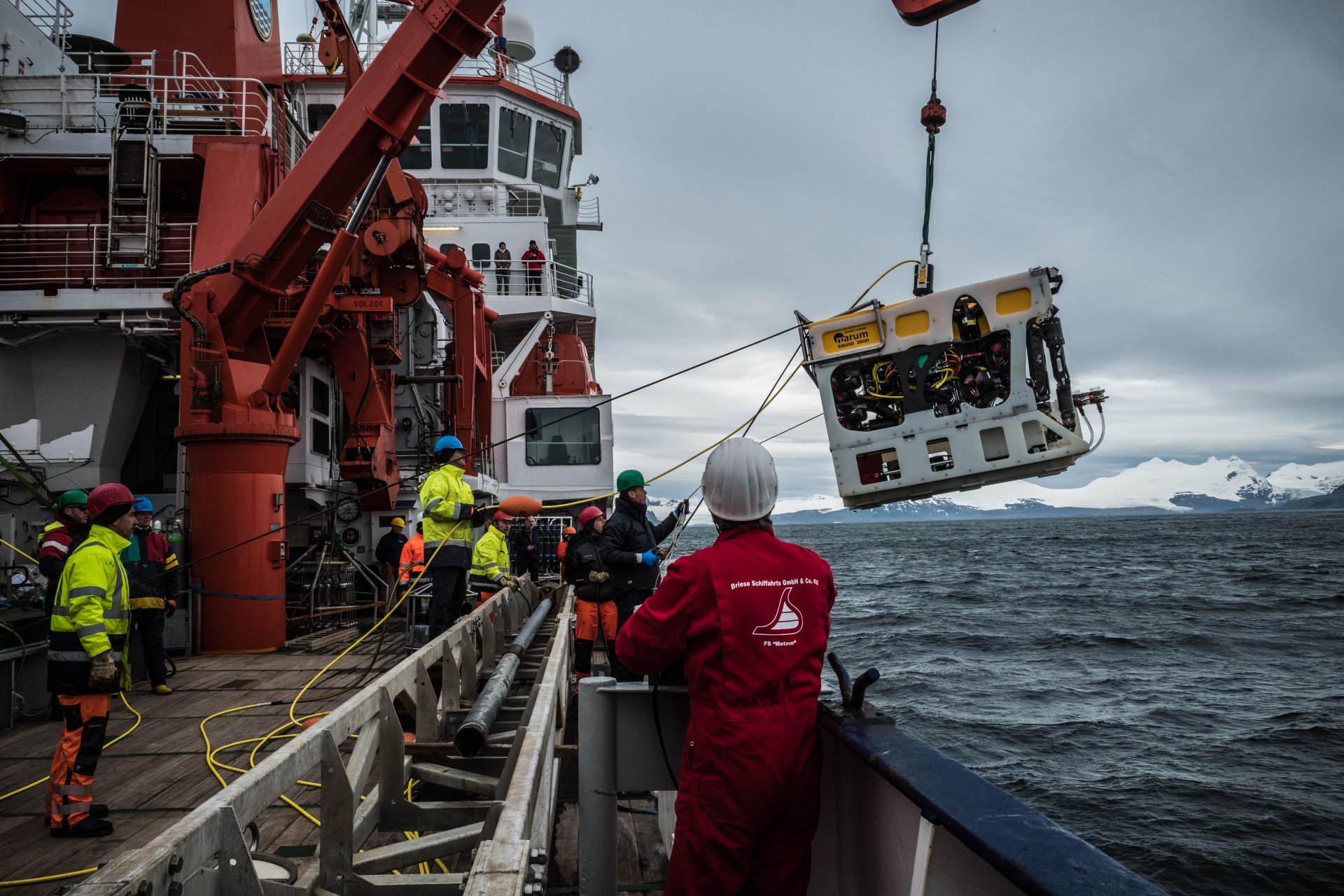
ROV-Squid is deployed over the side of the vessel. The system has no Tether Management System (TMS) and is deployed in the so called "free flying" or "live boating" mode. First, the ROV is deployed using a ship crane or winch. The pilot is standing on the working deck with the remote console and flies the ROV out on sight. While flying away perpedicular to the ship´s heading, 50m length of the supply cable with floats is payed out manually over the rail. Once this is done, the depressor weight is directly attached to the supply cable. The depressor limits drifting effects on the supply cable by the currents. As soon as the depressor is deployed, the pilot returns to the control lab and continues diving from there. While the ROV is diving to its operational depth, the depressor is lowered in parellel with the ROV winch.