

- Home
- ...
- The Ocean Floor
- Research Topics
- Objective 4
The Ocean Floor
Objective 4
Developing scenarios for a ›warmer-than-present world‹ from ocean-floor climate archives with the help of climate models
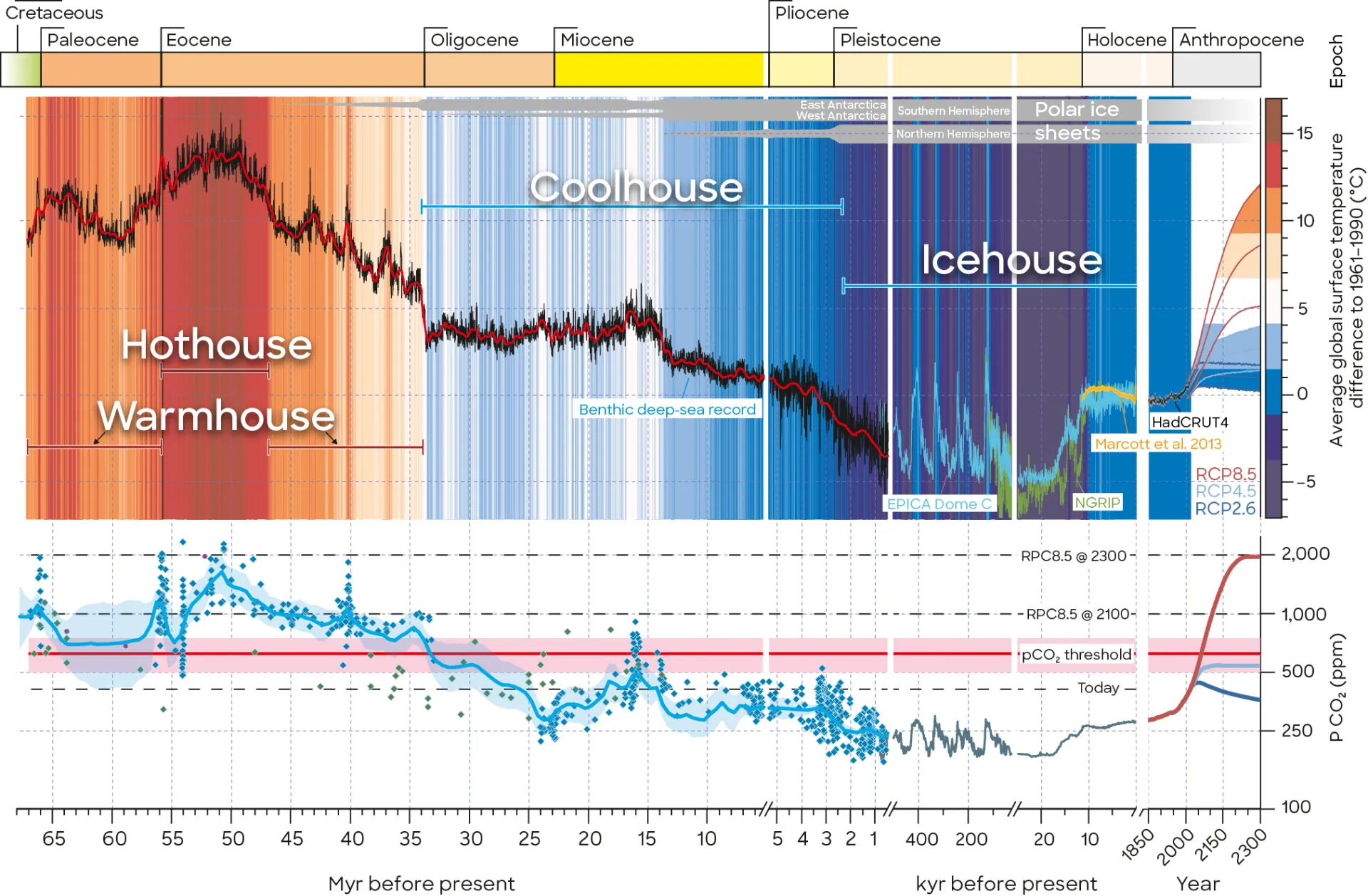
We have assembled a pivotal new climatic baseline of ocean temperatures throughout the past 66 million years. The resulting record of Earth’s climate allowed us to identify four fundamental climate states, i.e., Hothouse, Warmhouse, Coolhouse, Icehouse. We discovered that polar ice volume was the major factor defining these fundamental climate states and plays a crucial role in determining the predictability of the Earth’s climatological response to astronomical forcing.
Another focus is on the reconstruction of environmental changes on interannual to decadal timescales. A high-resolution reconstruction of sea-surface temperature in the tropical Atlantic during the most recent period of natural global warming (at the end of the last glacial period), revealed a pronounced increase in temperature seasonality, while annually averaged temperature remained essentially constant.
Prediction of future tipping behavior of marine communities from past threshold transgressions has been systematically prepared by a global meta-analysis on natural community experiments. Across more than 4500 experiments anticipating many future environmental conditions, signs for tipping behavior did not emerge from data. If such transitions cannot be predicted beforehand, the current focus on threshold-based management of ecosystems seems less well substantiated.