


- Home
- ...
- The Ocean Floor
- The Ocean Floor Phase II (2026-2032)
The Ocean Floor
The Ocean Floor Phase II (2026-2032)
Following its success in the Excellence Competition, the Excellence Cluster Ocean Floor – Earth's Uncharted Interface will enter its second funding period in January 2026.
As one of the world’s leading hubs for marine-based Earth-system research, the new cluster will systematically explore and understand the function of the ocean floor within the Earth system, its carbon cycle and biodiversity, and expand our expertise to understand biodiversity responses to changing climates by merging geological, paleobiological and ecological expertise, transferring modern molecular approaches to ocean-floor samples and combining recent advances in studying environmental variability and ecological stability.
The Cluster's integrating approach is organized along following overarching objectives:
- Biogenic Particles: To understand the processes that transform the properties and fluxes of biogenic particles on their transit to the ocean floor under changing climate conditions.
- Element Fluxes: To quantify fluxes of carbon and other elements to and across the ocean floor and estimate their budgets under current and past states of the Earth system.
- Ocean-floor ecosystems: To understand ocean-floor ecosystems under changing environmental conditions based on the interrelationship between biological communities and biogeochemistry at the ocean floor and above.
- Warmer Worlds: To derive scenarios for “warmer worlds” through comprehensive decoding of environmental signals from past warm climate conditions as recorded in ocean-floor archives.
Addressing these main scientific objectives, the Cluster is structured into four Research Areas:
- Receiver approaches the ocean floor with a downward view through the water column, investigating how matter is being partitioned between shelf and open ocean, transferred and transformed on its journey to the ocean floor, and how today’s oceanic system properties are embedded in the sedimentary record. Cluster Phase II will include a focus on carbon sequestration processes as well as elemental and energy fluxes.
- Reactor centers on geochemical and biogeochemical reactions at and within the ocean floor, their relationships to biological communities harnessing these reactions in a wide range of habitats, and fluxes of matter into and out of the overlying ocean. Cluster Phase II will focus on the dynamics of submarine hydrothermal systems, sedimentary basins, and their impacts on carbonation; fluxes and far-field effects of vents and seeps on the biological carbon pump; and the response of ocean-floor ecosystems to changing environmental conditions.
- Recorder will look into the past and decode proxy information stored in sedimentary records in order to elucidate the triangular relationships between physical climate processes, perturbations and marine ecosystems, so as to provide a better mechanistic understanding of the climate system. Cluster Phase II will include a focus on the biological carbon pump during warmer conditions; ocean biodiversity in a warmer world; forcings, feedbacks and threshold behavior; and the dependency of climate variability on the climate background state.
- For Cluster Phase II, a newly developed Synthesis Hub will provide Cluster-wide synthesis products and enhance knowledge-exchange with the wider international community.
More infos:
Interview with the Speaker Team (Up2Date)
Excellence-Podcast (Life in the Deep Biosphere)
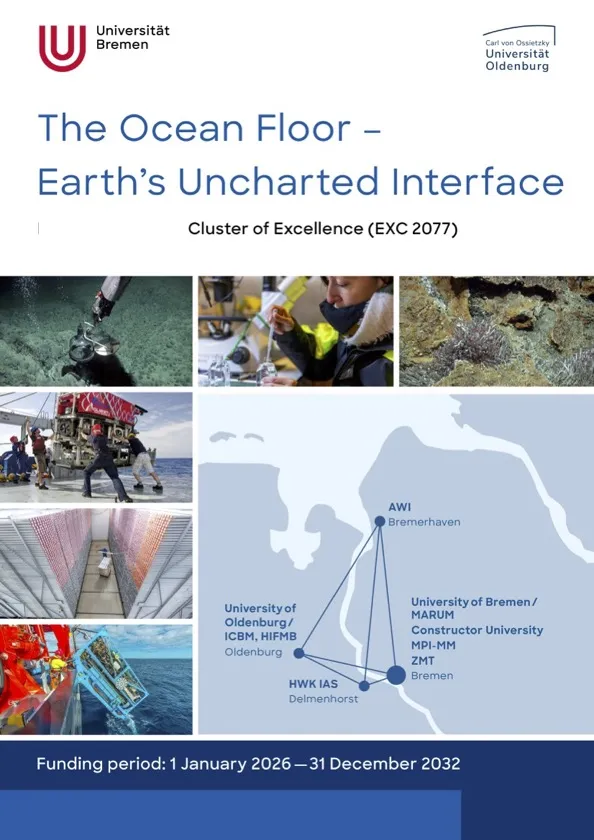
Participating Institutions for Cluster Phase II.
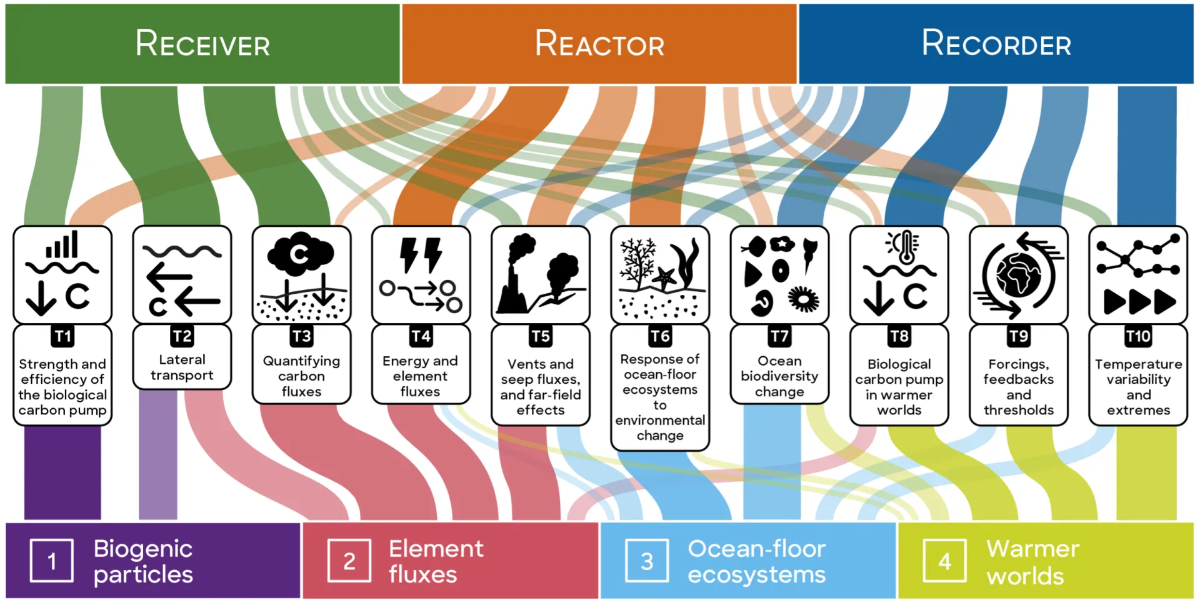
High-priority research topics identified for Cluster Phase II (center), and their main contributing Research Units (top) with mapping to most relevant Overarching Objectives (bottom).