
MARUM Research Academy
Report of Lennart Stock
Organic Geochemistry Gordon Research Seminar (GRS) "Navigating the Modern Era of Organic Geochemistry" and Conference (GRC) "Contemporary Applications of Organic Geochemical Research" in Holderness, New Hampshire, USA from 27 July to 2 August 2024
The Organic Geochemistry Gordon Research Conference (GRC) is a well-known international conference that brings together scientists from various institutions worldwide to discuss the latest developments in organic geochemistry. This conference is designed to encourage in-depth discussions and informal networking, creating an environment that fosters collaboration and scientific innovation. The associated Organic Geochemistry Gordon Research Seminar (GRS), held one day earlier, provides early-career researchers with an excellent platform to share emerging ideas and establish relationships with peers before the GRC begins.
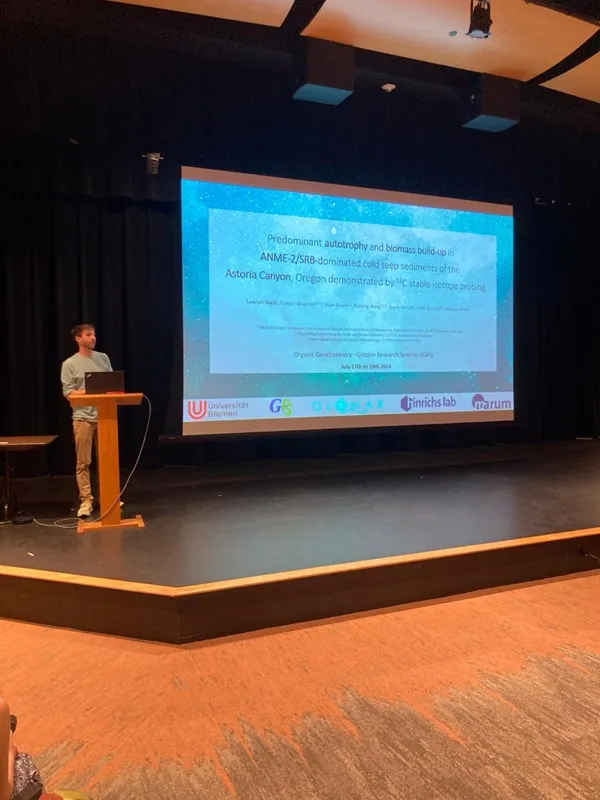
I was honored to be invited to present research from the first unpublished chapter of my doctoral thesis. My presentation focused on the predominant carbon assimilation mode of consortium-forming anaerobic methanotrophic archaea (ANME-2) and their sulfate-reducing partner bacteria (SRB) in cold seep systems, based on lipid stable isotope probing experiments. This was part of the session titled “Interrogating Extreme Environments for Their Astrobiological Potential”. Overall, I received only positive and encouraging feedback. Additionally, giving a presentation helped me engage in valuable discussions with other early-career scientists in my field who expressed interest in my research.
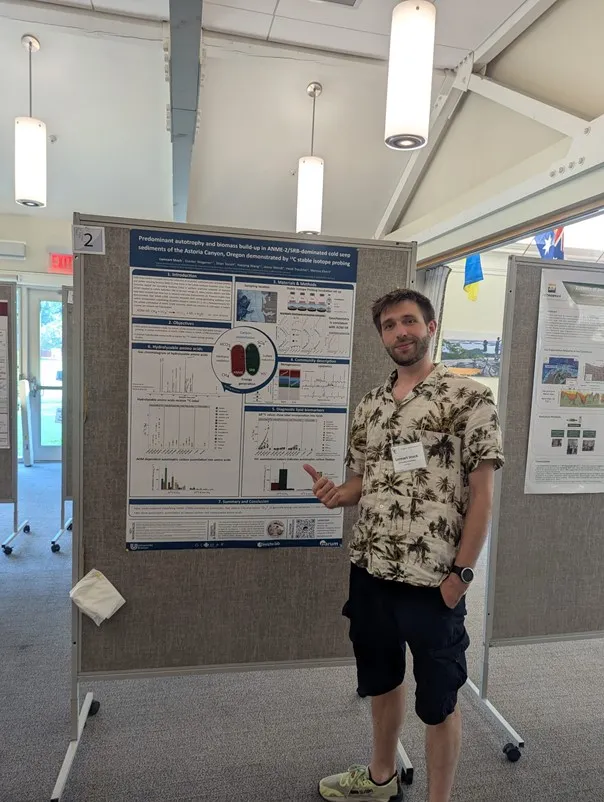
At the GRC, I presented the results of the same research in a poster format, but with additional preliminary findings on hydrolyzed amino acids from the same experiment. Here, I received valuable feedback from both early-career and established scientists, which helped enhance my interpretation of the experiment.
I found the experience of participating in the GRS before the GRC particularly beneficial. It provided an opportunity to engage with other early-career researchers, discuss my research, and build self-confidence for the subsequent GRC.
Two sessions of the GRC were of particular interest to me: “Methane Production, Consumption, and Fluxes,” led by Ellen Lark, a postdoc from the USGS with whom I had previously collaborated during a cruise to the Astoria Canyon in August 2023, and “Temporal and Spatial Dimensions of Organic Matter Cycling.” The talks from the first session by leading scientists in methane research, such as Tonya DelSontro, Jonathan Gropp, and Grayson Chadwick, were inspiring and significantly enhanced my understanding of my own research. The second session, “Temporal and Spatial Dimensions of Organic Matter Cycling,” was also relevant, as the last chapter of my thesis will focus on organic matter in cold seep sediments of the Astoria Canyon. The variety of high-resolution methods presented in this session provided valuable insights that will assist me in addressing my research questions more effectively.
Overall, attending the GRC and GRS—my first conference experience—was an ideal introduction to the world of scientific conferences. The small number of participants and their open-minded approach facilitated engaging discussions with leading scientists in my field, resulting in many fruitful conversations about both my research and the work of others. In addition to the scientific aspect of the conference, activities during free time were highly encouraged. For example, I participated in the traditional GRC soccer match and also took the opportunity to connect with other participants in the evening over a beer. I look forward to attending the GRC and GRS again in two years and highly recommend these conferences to anyone interested in organic geochemistry.
Last but not least, I want to thank my graduate school GLOMAR, and the MARUM for funding my participation in the GRS and GRC, which has been very valuable for my personal development during my PhD.