

MARUM Research Academy
Christin Wiggers
35th European Crystallographic Meeting in Poznań, Poland from 25 - 29 August 2025
The 35th European Crystallographic Meeting took place from 25 to 29 August 2025 in the vibrant Polish city of Poznań. As one of Poland’s oldest and largest cities, conveniently located between Berlin and Warsaw, Poznań provided an inspiring backdrop for this major crystallographic event. The Poznań Congress Center, situated close to the historic city center, welcomed more than a thousand participants for a week of scientific exchange, poster sessions, and social events.
The conference was jointly organized by the Ukrainian Crystallographic Committee, the Polish Crystallographic Association, the Ivan Franko National University of Lviv, and Adam Mickiewicz University. Several satellite workshops preceded the main program; I attended the one on diffuse scattering analysis and three-dimensional difference pair distribution function (3D-ΔPDF), where we explored data treatment and analysis using the programs yell and DISCUS. This proved to be a fitting introduction to many of the themes that resurfaced throughout the week.
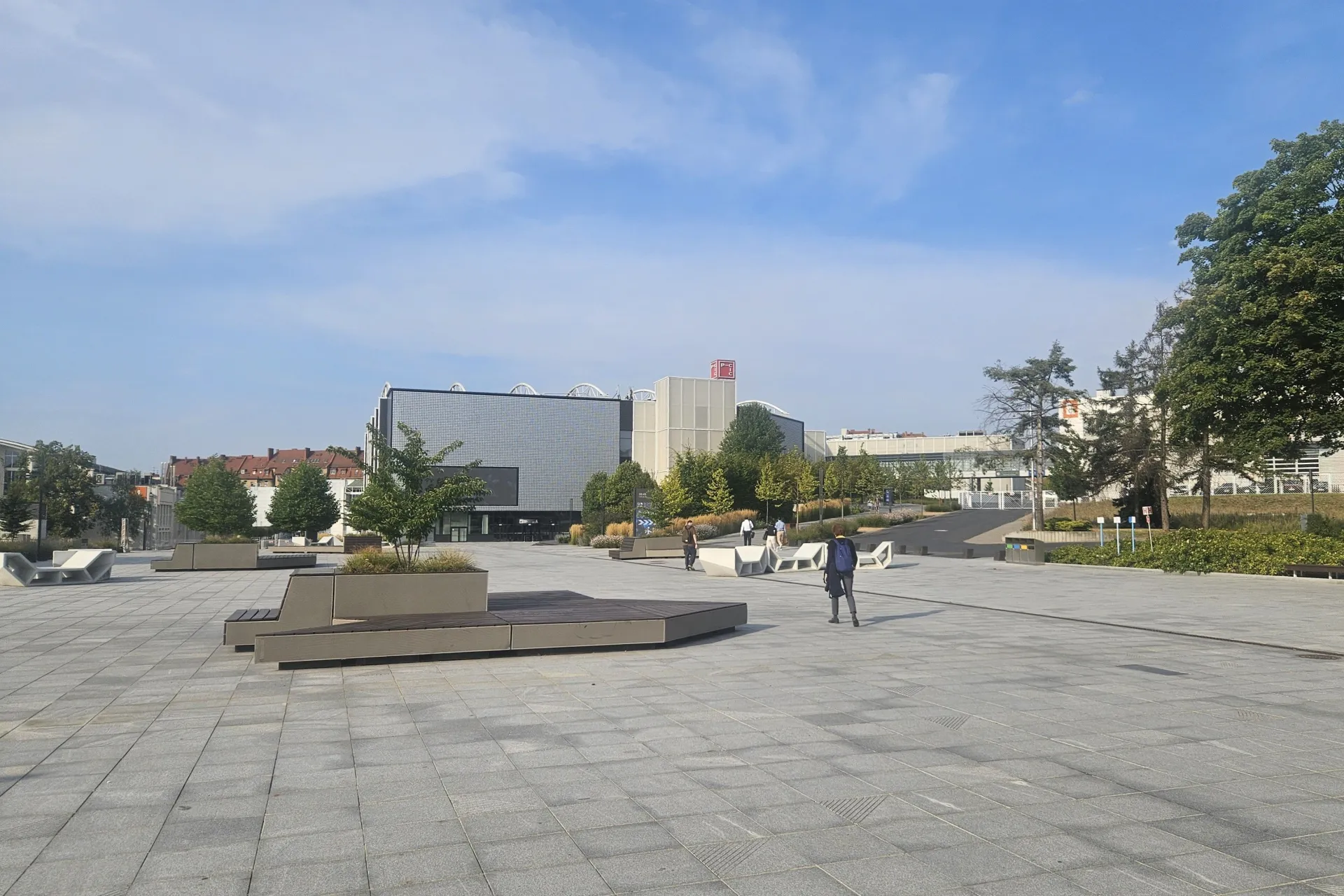
Poznań Congress Center
After registration and collecting our conference materials, participants gathered for the official opening. Sven Lidin delivered the first plenary lecture, titled “Crystallography – a subject that constantly reinvents itself”, which set the tone for the days ahead. Part of the ceremony was the awarding of the Perutz Prize to Professor Gilberto Artioli (University of Padova) for his contributions across materials science, cultural heritage, and public engagement in crystallography. The formalities were followed by a moving performance from the women’s choir of the University of Lviv, performing classical works as well as Ukrainian folk songs. The evening concluded with a lively welcome reception, where new connections were made, and old ones rekindled.
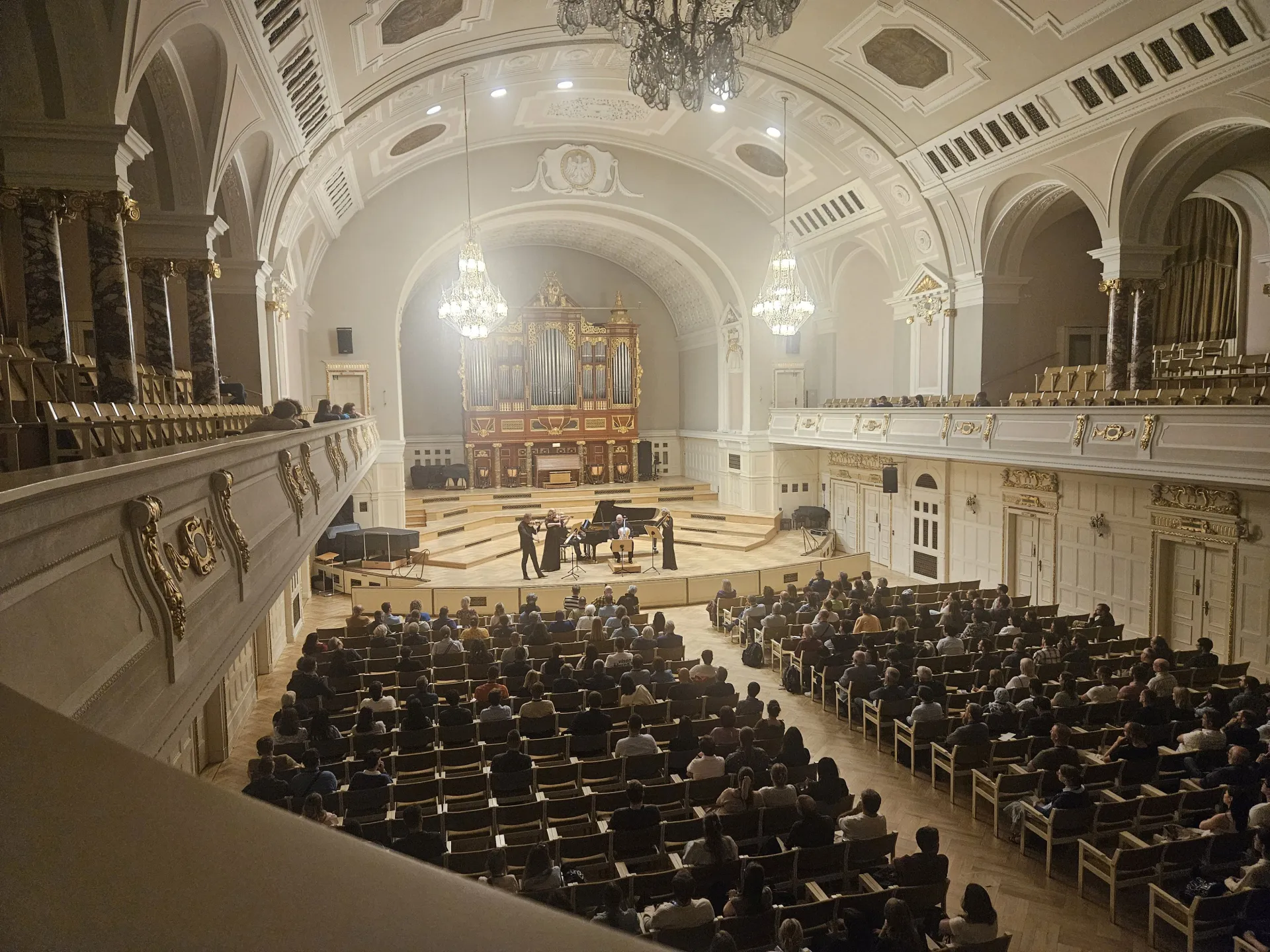
Concert in the AMU Hall
The scientific program began with keynote lectures from Berthold Stöger on modulation and modularity in sulfosalts, Simona Galli on in situ powder diffraction in functional materials, and Isabel Uson on the impact of George Sheldrick’s SHELX programs. Before and after lunch we could choose from six parallel microsymposia offering a wide range of topics—from enzymology to teaching crystallography. I personally attended the microsymposia on Short-range order as seen by different techniques, showcasing advances in diffuse scattering, PDF methods, and modelling. In the late afternoon there were again three keynote lectures on structural insights into the regulation of the Calvin-Benson cycle by Simona Fermani, electron density and chemical bonding in intermetallic compounds by Juri Grin and on the application of crystal engineering tools in the food and pharmaceutical industry. In between the keynotes, microsymposia and lunch, the poster session created a buzzing atmosphere. The first full day at the conference center ended with a remembering of George Sheldrick and awarding the Sheldrick Prize to Lauren E. Hatcher for her pioneering contributions to time-resolved crystallography and the structural study of photoactive materials. In the evening, we enjoyed a classical concert in the beautiful AMU Hall. The day closed with the Young Crystallographers’ mixer at the Blue Note Jazz Club—an enjoyable evening that encouraged informal exchanges, particularly among early-career scientists.
Wednesday opened with keynotes on electron diffraction at nanoscale, self-learning in integrative structural biology, and new approaches to discover the details of protein structures. Among the microsymposia, I was especially drawn to Aperiodic order and complex superstructures, which explored quasicrystals, modulated structures, and complex unit cells. In parallel, other sessions addressed functional molecular structures and biomolecular interactions. After a full day of engaging keynotes and microsymposia, the Kalman Prize was presented to Felipe Gándara Barragán in recognition of his pioneering crystallographic work, which combines experimental and computational approaches in the field of reticular chemistry and the study of MOFs and COFs. The day closed with the conference dinner at the Conference Center, where everyone enjoyed delicious food and the jazz band playing after dinner.
Thursday’s program started with Keynotes on data and model quality of experimental charge density and a session celebrating the 60th anniversary of the Cambridge Structural Database (CSD), with Suzanna Ward reflecting on its enduring impact. During the day there were a number of compelling microsymposia on software developments, surfaces, interfaces and thinfilms, advances and new techniques to study inorganic materials, Quantum mechanical models for disorder, dynamics and diffuse scattering, as well as how to (successfully) apply for funding, just to name a few. Some Talks emphasized how databases now underpin structure solving, refinement, and validation in both academia and industry, while others showcased how experimental innovation and theoretical modeling jointly advance our understanding of complex systems. On this forth day off the ECM the second group got to put up their posters (including myself) and a lot of lively discussions were had over the lunch and coffee breaks. In the evening a fun science slam was followed by an open lecture “The Nobel Prize winner Max von Laue was a schoolboy in Poznań”.
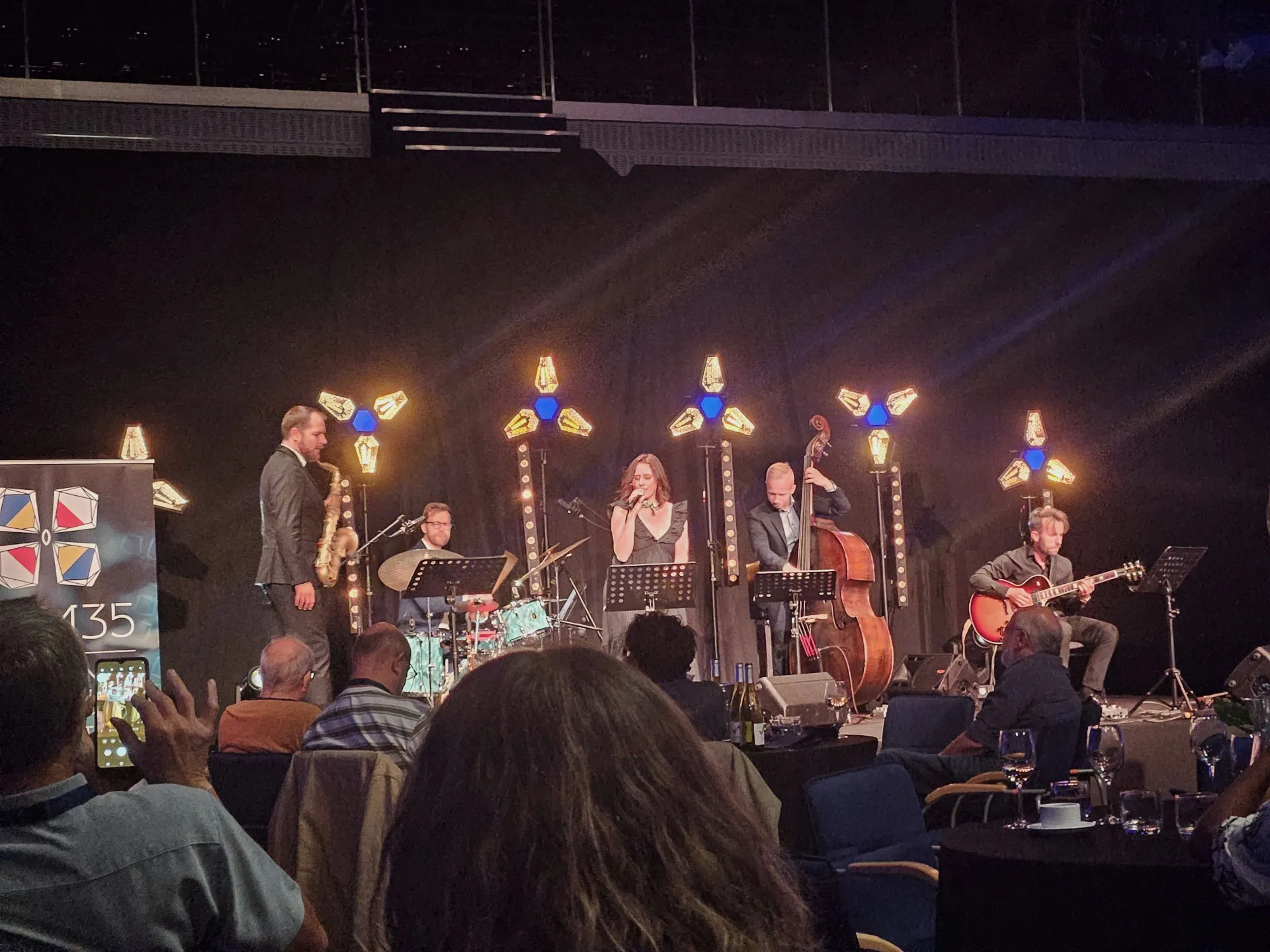
The Jazzband playing at the Conference dinner
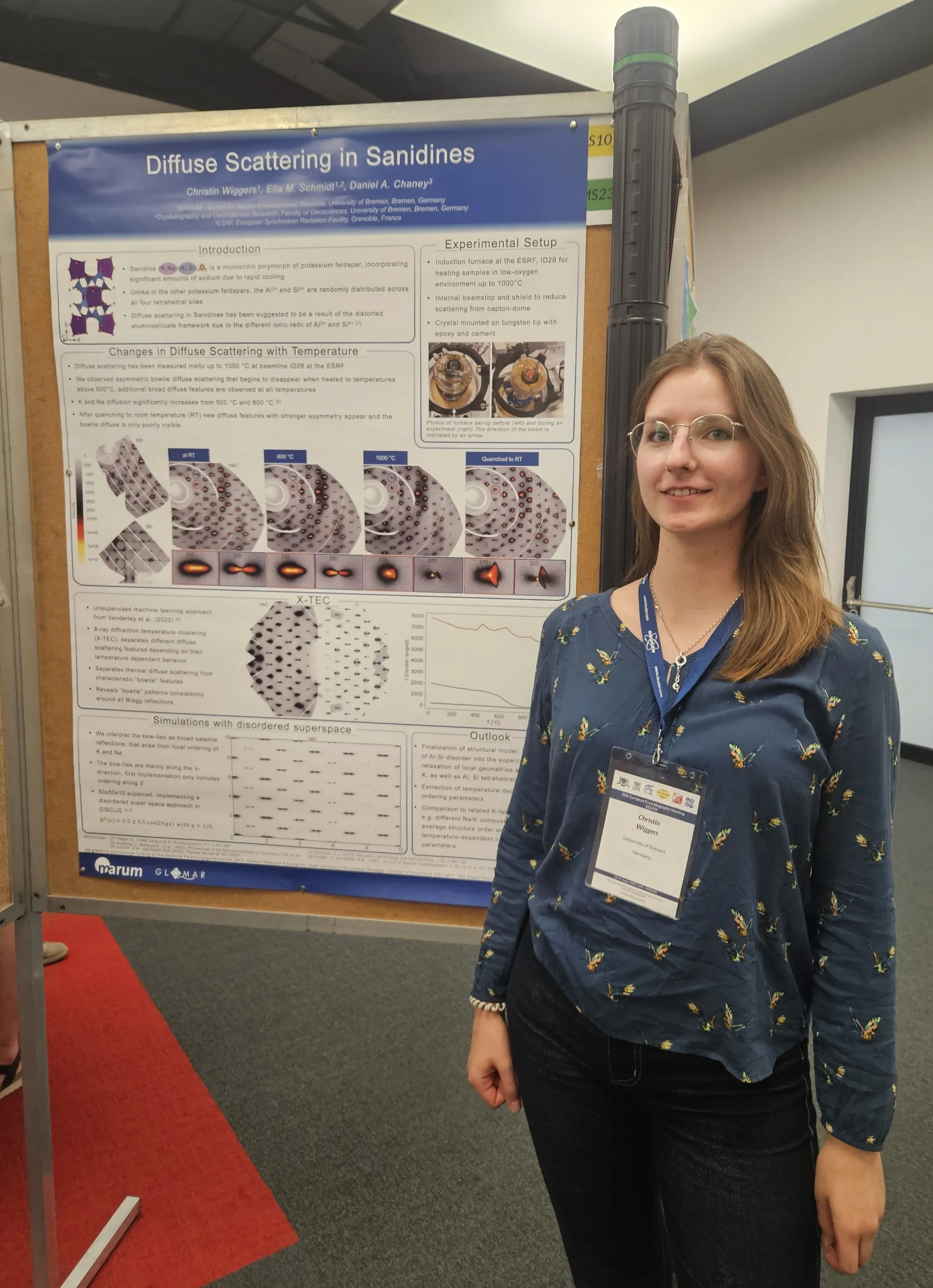
Me at the Poster section
Despite an intense week, the final day was well attended. Keynotes and microsymposia sessions tackled topics ranging from serial crystallography at 4th generation synchrotrons to cross-method structural studies. Two microsymposia on disordered systems on complex inorganic and molecular systems highlighted how structural imperfections can drive material functionality. The meeting closed with reflections from the organizing committee marking the end of an inspiring week.
The 35th ECM in Poznań was a comprehensive and vibrant meeting that showcased the full breadth of crystallography. Across plenary lectures, keynotes, microsymposia, and poster sessions, the program highlighted advances in theory, methodology, and applications ranging from materials science to biology and cultural heritage. Sessions devoted to short-range order, aperiodic and complex structures, and disordered systems underlined the continuing importance of combining experimental and computational approaches to address structural complexity.
Beyond the scientific content, the meeting was enriched by cultural and social events, including the opening choir performance, the classical concert in the AMU Hall, and the Young Crystallographers’ activities, which together fostered exchange and strengthened community ties. I am sincerely grateful to the MARUM Research Academy and the Deutsche Gesellschaft für Kristallographie (DGK) for their financial support, which enabled me to attend this conference.