


MARUM Research Academy
Lennart Stock
European Geosciences Union (EGU) General Assembly 2025 in Vienna, Austria from 27 April to 2 May 2025
The EGU (European Geosciences Union) General Assembly 2025 is one important conference in geosciences, welcoming over 20,000 attendees from around the globe participating in more than 1,000 diverse sessions. The conference aims to connect geoscientists internationally, providing a platform for sharing knowledge across various disciplines of Earth, planetary, and space sciences. EGU particularly encourages early-career scientists by creating opportunities to present and discuss their work directly with experts in their respective fields. Since 2005, the conference has taken place in Vienna, with the venue directly beside the Danube River, creating a special atmosphere.
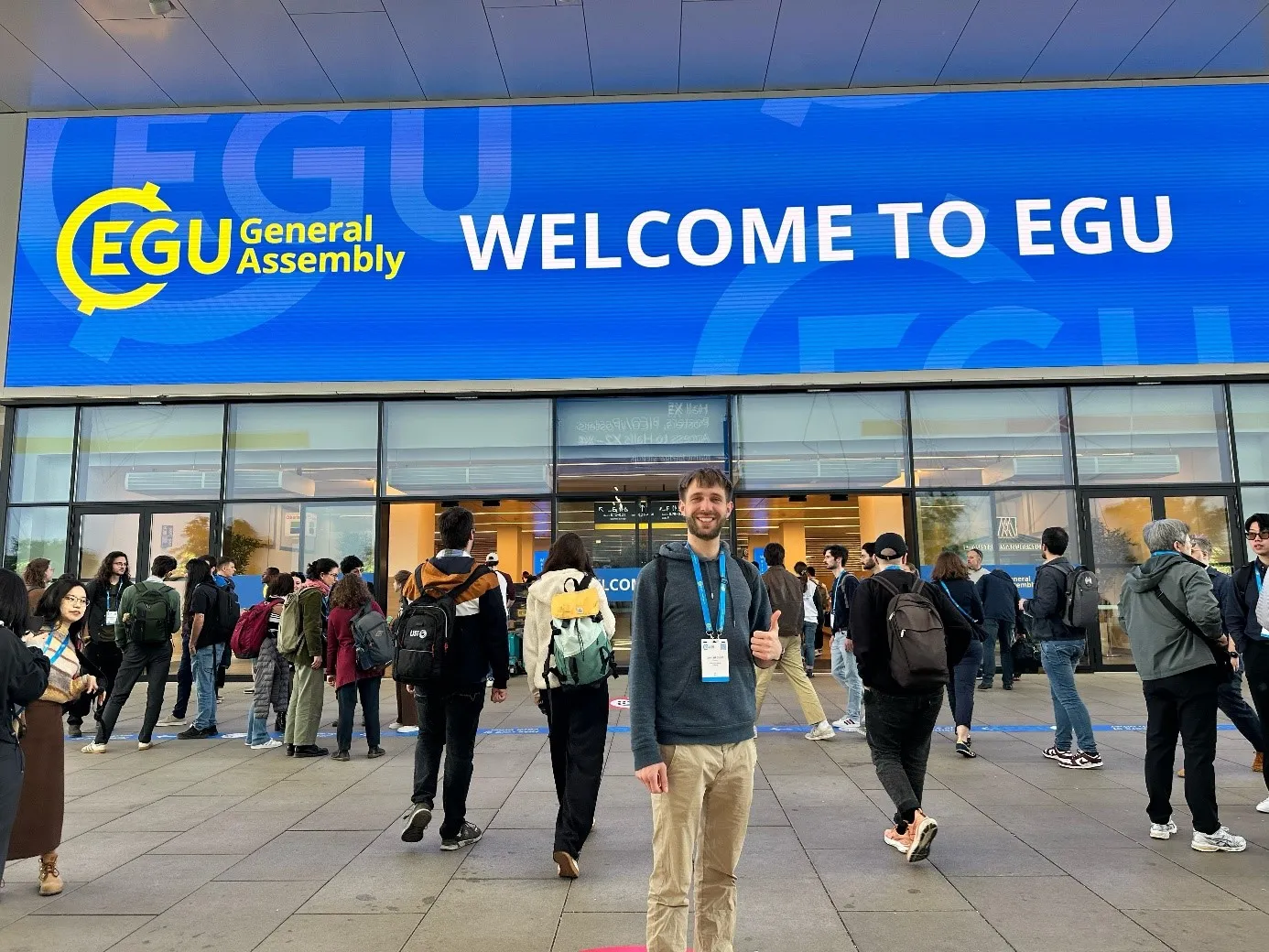
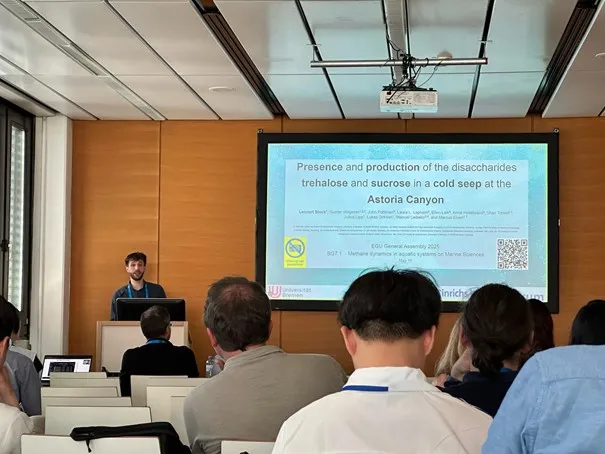
Lennart Stock during his presentation at the EGU about the presence and production of the disaccharides trehalose and sucrose within cold seeps
I was pleased to be accepted as a speaker to present findings from my second doctoral thesis chapter. My talk focused on the occurrence and production of two disaccharides, trehalose and sucrose, within a cold seep system at Astoria Canyon off the Oregon coast, USA. My presentation was part of the session titled "Methane dynamics in aquatic systems," convened by Helge Niemann alongside co-conveners Alina Stadnitskaia, Tina Treude, and Claudio Argentino. Although limited to 8 minutes of speaking time and 2 minutes for discussion, I successfully communicated my research clearly and received positive and supportive feedback. Presenting also led to helpful discussions afterward, allowing me to interact with both established and early-career scientists within the methane community.
Given the large number and diversity of sessions at EGU, selecting sessions to attend was challenging. Nevertheless, I managed to choose several closely related to my research interests, particularly sessions on carbon cycling and organic matter. Among others, I attended two interesting oral sessions about blue carbon dynamics and the second half of the oral and poster session "Opening the black box of organic matter." Unfortunately, the first half of the oral session coincided with my own presentation slot. Especially relevant for me was the poster portion of the "Methane dynamics in aquatic systems" session. Here, I engaged with numerous scientists, from experienced researchers to early-career peers, which improved my understanding of current methane-related research and provided valuable perspectives for my own project.
Overall, participating in EGU 2025—my first major conference—was very rewarding. It provided a good opportunity to learn and exchange ideas about my research and that of others. In addition, I met many scientists that I usually only know from publications. While the large scale and number of simultaneous sessions made it impossible to attend everything interesting, I feel I made effective use of my time during the week. I am grateful to GLOMAR for their financial support, which enabled my attendance and participation at the EGU.